Sleep Medicine Centre 'Kempenhaeghe', Heeze, The Netherlands.
J Neurol. 2012 Oct;259(10):2031-40. doi: 10.1007/s00415-012-6505-7. Epub 2012 Apr 26.
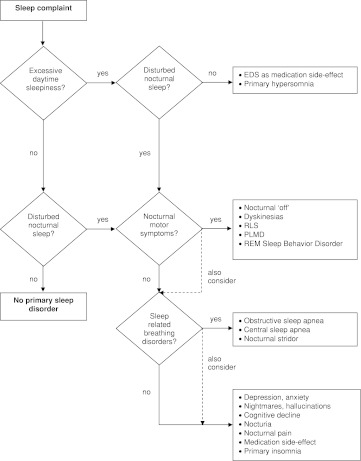
Sleep disturbances are among the most frequent and incapacitating non-motor symptoms of Parkinson's disease (PD), and are increasingly recognized as an important determinant of impaired quality of life. Here we review several recent developments regarding the recognition and diagnosis of sleep disorders in PD. In addition, we provide a practical and easily applicable approach to the diagnostic process as a basis for tailored therapeutic interventions. This includes a stepwise scheme that guides the clinical interview and subsequent ancillary investigations. In this scheme, the various possible sleep disorders are arranged not in order of prevalence, but in a 'differential diagnostic' order. We also provide recommendations for the use of sleep registrations such as polysomnography. Furthermore, we point out when a sleep specialist could be consulted to provide additional diagnostic and therapeutic input. This structured approach facilitates early detection of sleep disturbances in PD, so treatment can be initiated promptly.
睡眠障碍是帕金森病(PD)最常见和最使人丧失能力的非运动症状之一,并且越来越被认为是生活质量受损的一个重要决定因素。在这里,我们回顾了一些关于 PD 中睡眠障碍的识别和诊断的最新进展。此外,我们提供了一种实用且易于应用的诊断方法作为制定针对性治疗干预措施的基础。这包括一个逐步方案,指导临床访谈和随后的辅助调查。在这个方案中,各种可能的睡眠障碍不是按照流行程度排列,而是按照“鉴别诊断”的顺序排列。我们还为睡眠记录(如多导睡眠图)的使用提供了建议。此外,我们指出何时可以咨询睡眠专家以提供额外的诊断和治疗意见。这种结构化的方法有助于在 PD 中及早发现睡眠障碍,以便及时开始治疗。