Duke Cardiovascular Research Center, Duke University Medical Center, Durham, NC 27710, USA.
Circ Res. 2012 May 25;110(11):1465-73. doi: 10.1161/CIRCRESAHA.112.269035. Epub 2012 Apr 26.
Repopulation of the injured heart with new, functional cardiomyocytes remains a daunting challenge for cardiac regenerative medicine. An ideal therapeutic approach would involve an effective method at achieving direct conversion of injured areas to functional tissue in situ.
The aim of this study was to develop a strategy that identified and evaluated the potential of specific micro (mi)RNAs capable of inducing reprogramming of cardiac fibroblasts directly to cardiomyocytes in vitro and in vivo.
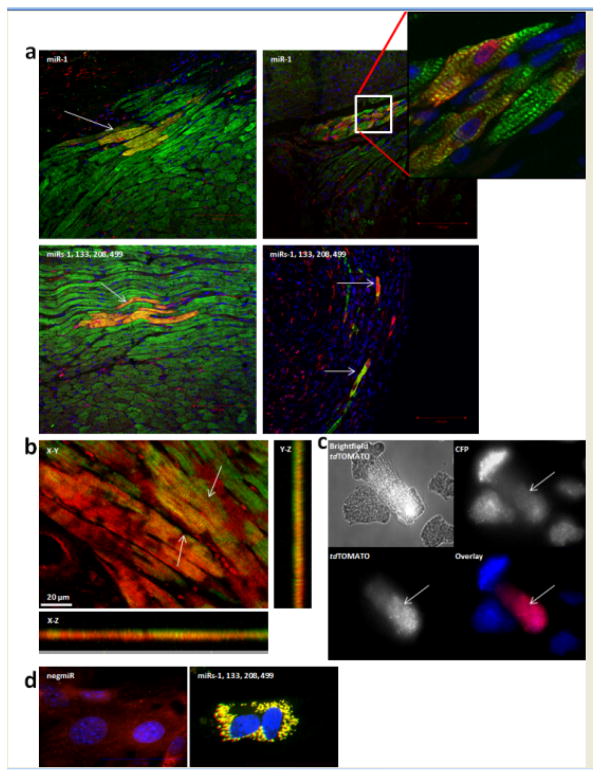
Using a combinatorial strategy, we identified a combination of miRNAs 1, 133, 208, and 499 capable of inducing direct cellular reprogramming of fibroblasts to cardiomyocyte-like cells in vitro. Detailed studies of the reprogrammed cells demonstrated that a single transient transfection of the miRNAs can direct a switch in cell fate as documented by expression of mature cardiomyocyte markers, sarcomeric organization, and exhibition of spontaneous calcium flux characteristic of a cardiomyocyte-like phenotype. Interestingly, we also found that miRNA-mediated reprogramming was enhanced 10-fold on JAK inhibitor I treatment. Importantly, administration of miRNAs into ischemic mouse myocardium resulted in evidence of direct conversion of cardiac fibroblasts to cardiomyocytes in situ. Genetic tracing analysis using Fsp1Cre-traced fibroblasts from both cardiac and noncardiac cell sources strongly suggests that induced cells are most likely of fibroblastic origin.
The findings from this study provide proof-of-concept that miRNAs have the capability of directly converting fibroblasts to a cardiomyocyte-like phenotype in vitro. Also of significance is that this is the first report of direct cardiac reprogramming in vivo. Our approach may have broad and important implications for therapeutic tissue regeneration in general.
用新的、功能正常的心肌细胞来再生受损的心脏仍然是心脏再生医学面临的一个艰巨挑战。一种理想的治疗方法是采用一种有效的方法,实现在损伤部位原位直接转化为功能性组织。
本研究旨在开发一种策略,该策略旨在鉴定和评估特定 microRNA(miRNA)的潜力,这些 miRNA 能够在体外和体内将受损区域直接诱导转化为功能性组织。
我们使用组合策略,鉴定出了一组 miRNA(miRNA-1、miRNA-133、miRNA-208 和 miRNA-499),它们能够在体外将成纤维细胞直接诱导为心肌细胞样细胞。对重编程细胞的详细研究表明,单个瞬时转染这些 miRNA 可以诱导细胞命运的转变,这一点可以通过成熟心肌细胞标志物的表达、肌节组织和表现出的自发钙流来证明,这些特征都具有心肌细胞样表型。有趣的是,我们还发现,在 JAK 抑制剂 I 处理后,miRNA 介导的重编程增强了 10 倍。重要的是,将 miRNA 给药到缺血性小鼠心肌中,导致了在原位直接将成纤维细胞转化为心肌细胞的证据。使用来自心脏和非心脏细胞来源的 Fsp1Cre 追踪成纤维细胞的遗传追踪分析强烈表明,诱导的细胞很可能来自成纤维细胞。
这项研究的结果提供了概念验证,表明 miRNA 具有在体外将成纤维细胞直接转化为心肌细胞样表型的能力。同样重要的是,这是体内直接心脏重编程的首次报道。我们的方法可能对一般的治疗性组织再生具有广泛而重要的意义。