Nancy-Université, UMR 1137 Ecologie et Ecophysiologie Forestières, Boulevard des Aiguillettes, BP 70239, F-54506 Vandœuvre lès Nancy, France; INRA, UMR 1137 Ecologie et Ecophysiologie Forestières, F-54280 Champenoux, France.
J Exp Bot. 2012 Jun;63(11):4291-301. doi: 10.1093/jxb/ers118. Epub 2012 May 2.
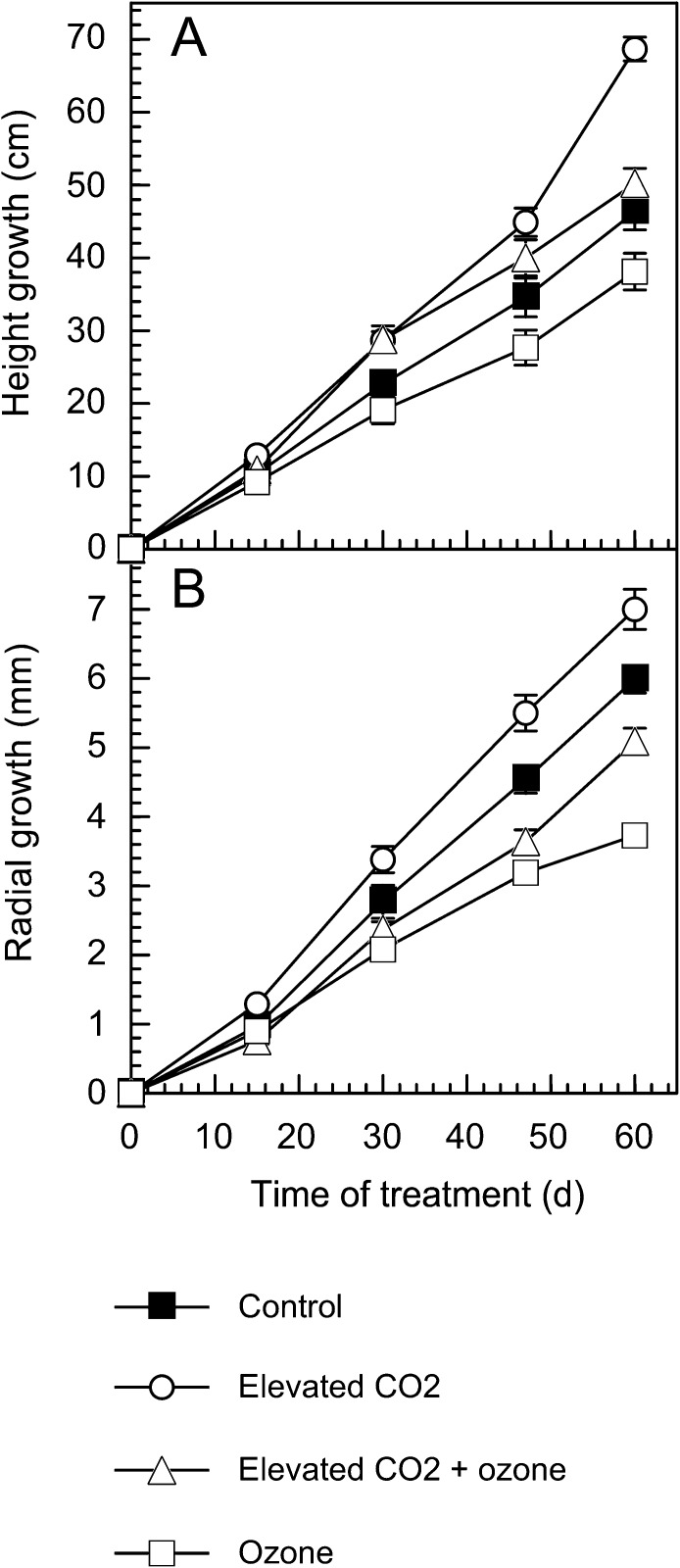
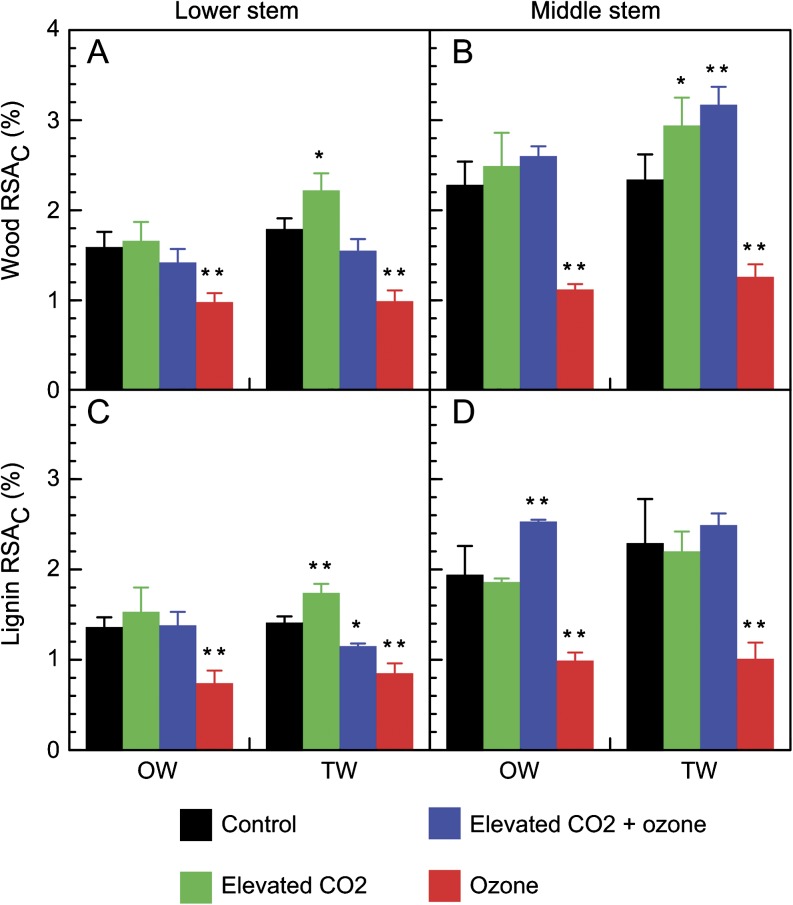
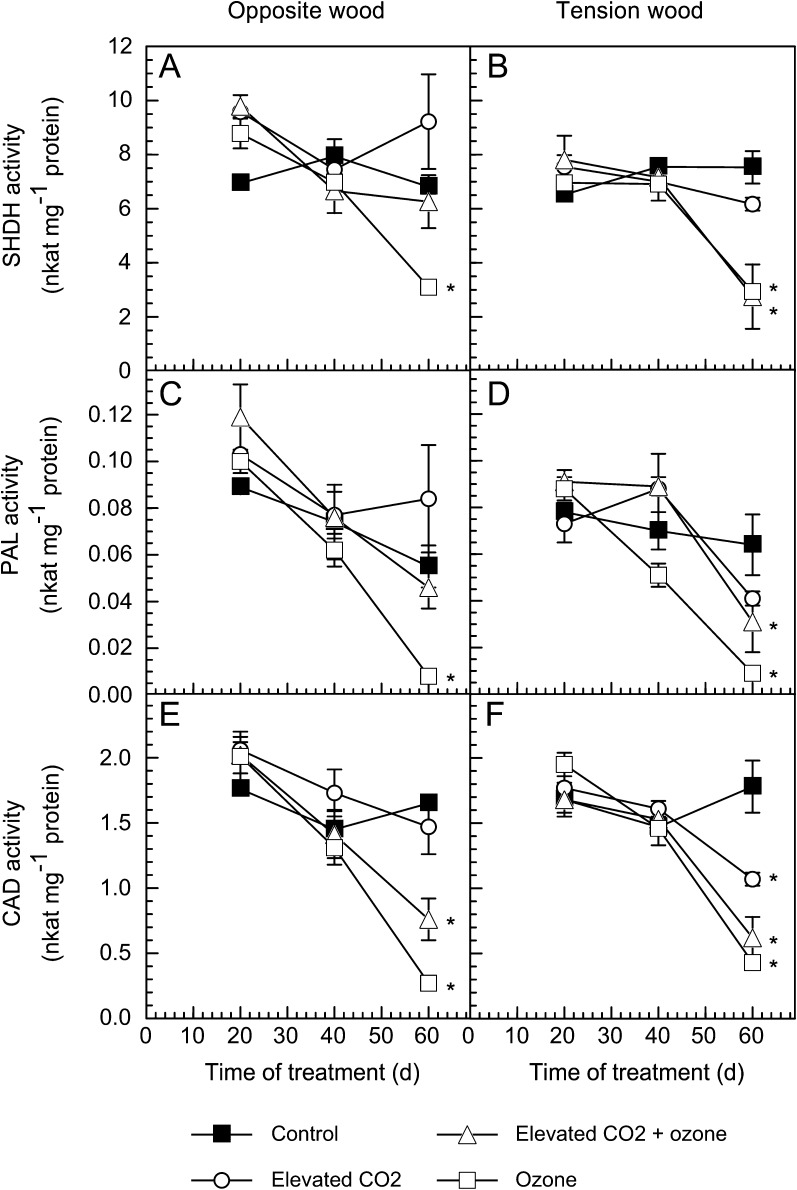
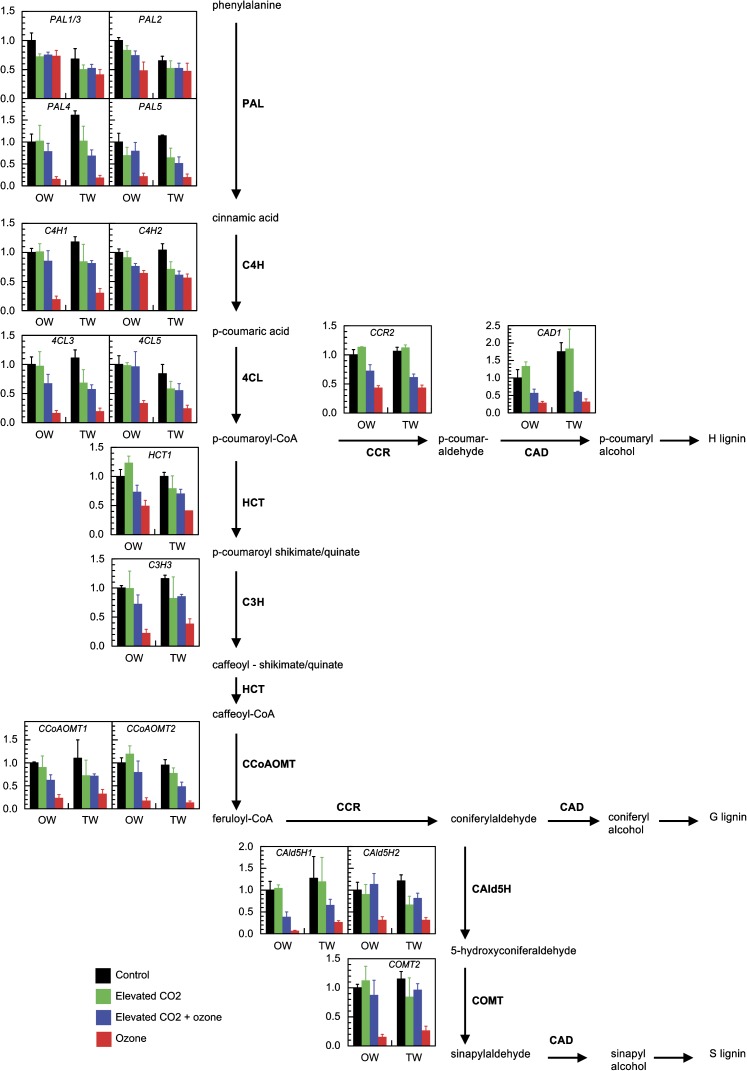
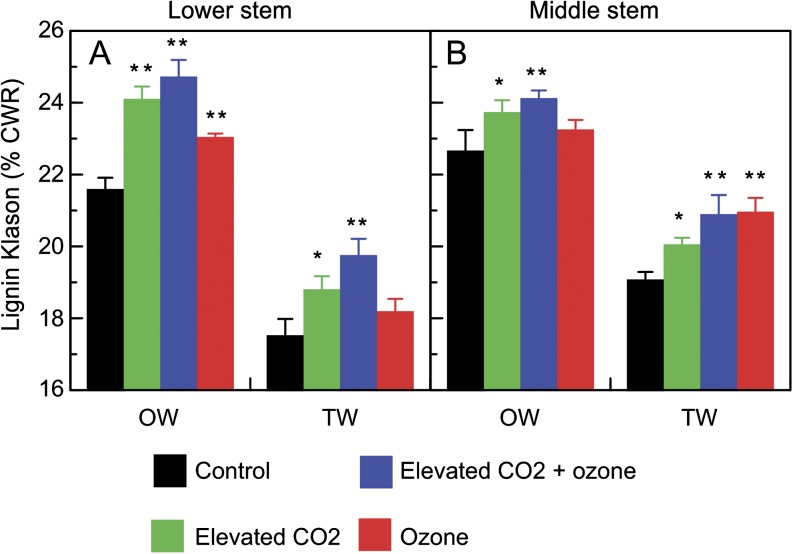
Trees will have to cope with increasing levels of CO(2) and ozone in the atmosphere. The purpose of this work was to assess whether the lignification process could be altered in the wood of poplars under elevated CO(2) and/or ozone. Young poplars were exposed either to charcoal-filtered air (control), to elevated CO(2) (800 μl l(-1)), to ozone (200 nl l(-1)) or to a combination of elevated CO(2) and ozone in controlled chambers. Lignification was analysed at different levels: biosynthesis pathway activities (enzyme and transcript), lignin content, and capacity to incorporate new assimilates by using (13)C labelling. Elevated CO(2) and ozone had opposite effects on many parameters (growth, biomass, cambial activity, wood cell wall thickness) except on lignin content which was increased by elevated CO(2) and/or ozone. However, this increased lignification was due to different response mechanisms. Under elevated CO(2), carbon supply to the stem and effective lignin synthesis were enhanced, leading to increased lignin content, although there was a reduction in the level of some enzyme and transcript involved in the lignin pathway. Ozone treatment induced a reduction in carbon supply and effective lignin synthesis as well as transcripts from all steps of the lignin pathway and some corresponding enzyme activities. However, lignin content was increased under ozone probably due to variations in other major components of the cell wall. Both mechanisms seemed to coexist under combined treatment and resulted in a high increase in lignin content.
树木将不得不应对大气中不断增加的二氧化碳和臭氧水平。这项工作的目的是评估在升高的二氧化碳和/或臭氧条件下,杨树木材的木质化过程是否会发生改变。年轻的杨树被暴露在以下环境中:经过木炭过滤的空气(对照)、升高的二氧化碳(800μl l(-1))、臭氧(200 nl l(-1)) 或在受控室中同时暴露在升高的二氧化碳和臭氧下。木质化在不同水平上进行分析:生物合成途径活性(酶和转录本)、木质素含量,以及利用(13)C 标记物掺入新同化产物的能力。升高的二氧化碳和臭氧对许多参数(生长、生物量、形成层活动、木材细胞壁厚度)产生了相反的影响,除了木质素含量外,它因升高的二氧化碳和/或臭氧而增加。然而,这种木质素的增加是由于不同的反应机制所致。在升高的二氧化碳下,碳供应到茎部和有效木质素合成增强,导致木质素含量增加,尽管参与木质素途径的一些酶和转录本水平降低。臭氧处理会导致碳供应和有效木质素合成减少,以及木质素途径的所有步骤的转录本和一些相应的酶活性减少。然而,木质素含量在臭氧下增加,可能是由于细胞壁的其他主要成分发生了变化。这两种机制似乎在联合处理下同时存在,导致木质素含量的大幅增加。