Institute for Health Services Research in Dermatology and Nursing, University Medical Centre Hamburg-Eppendorf, Martinistraße 52, 20246, Hamburg, Germany.
J Occup Med Toxicol. 2012 Jul 13;7(1):8. doi: 10.1186/1745-6673-7-8.
Healthcare workers (HCW) are exposed to infectious agents. Disease surveillance is therefore needed in order to foster prevention.
The data of the compensation board that covers HCWs of non-governmental healthcare providers in Germany was analysed for a five-year period. For hepatitis B virus (HBV) and hepatitis C virus (HCV) infections, the period analysed was extended to the last 15 years. The annual rate of occupational infectious diseases (OIDs) per 100,000 employees was calculated. For needlestick injuries (NSI) a rate per 1,000 employees was calculated.
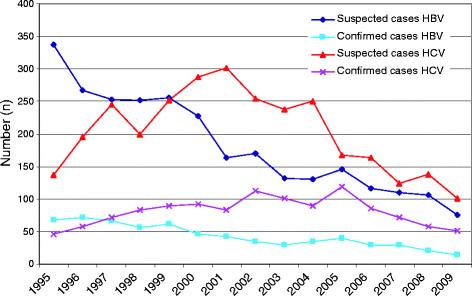
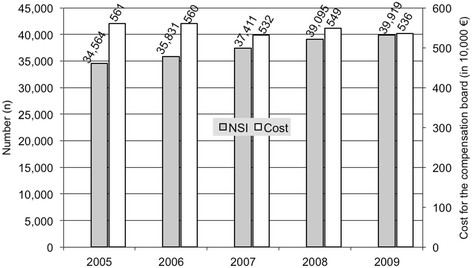
Within the five years from 2005 to 2009 a total of 384 HCV infections were recognised as OIDs (1.5/100,000 employees). Active TB was the second most frequent cause of an OID. While the numbers of HBV and HCV infections decreased, the numbers for active TB did not follow a clear pattern. Needlestick injuries (NSIs) were reported especially often at hospitals (29.9/1,000 versus 7.4/1,000 employees for all other HCWs).
Although they are declining, HCV infections remain frequent in HCWs, as do NSIs. Whether the reinforcement of the recommendations for the use of safety devices in Germany will prevent NSIs and therefore HCV infections should be closely observed.
医护人员(HCW)接触传染性病原体。因此,需要进行疾病监测以促进预防。
对德国非政府医疗机构 HCW 赔偿委员会的数据进行了五年的分析。对于乙型肝炎病毒(HBV)和丙型肝炎病毒(HCV)感染,分析的时间延长到过去 15 年。每 10 万名员工的职业传染病(OID)的年发病率。对于针刺伤(NSI),按每 1000 名员工计算发病率。
在 2005 年至 2009 年的五年中,共有 384 例 HCV 感染被确认为 OID(1.5/100,000 名员工)。活动性结核病是 OID 的第二大常见原因。虽然 HBV 和 HCV 感染的数量有所下降,但活动性结核病的数量并没有呈现出明显的模式。针刺伤(NSI)在医院尤为常见(29.9/1,000 与所有其他 HCW 的 7.4/1,000 员工相比)。
尽管有所下降,但 HCV 感染在 HCW 中仍然很常见,NSI 也是如此。德国加强安全设备使用建议是否会预防 NSI 从而预防 HCV 感染,应密切观察。