Given D, Kieff E
J Virol. 1979 Aug;31(2):315-24. doi: 10.1128/JVI.31.2.315-324.1979.
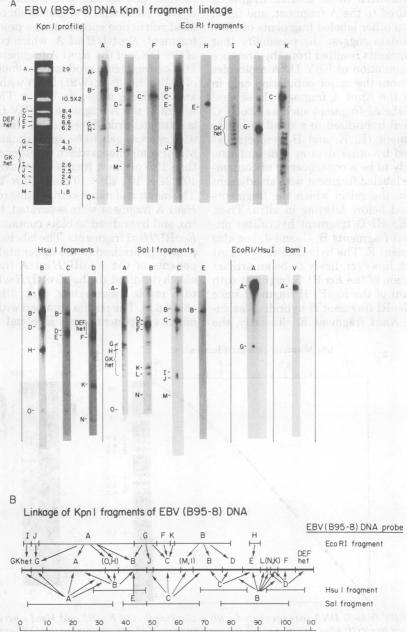
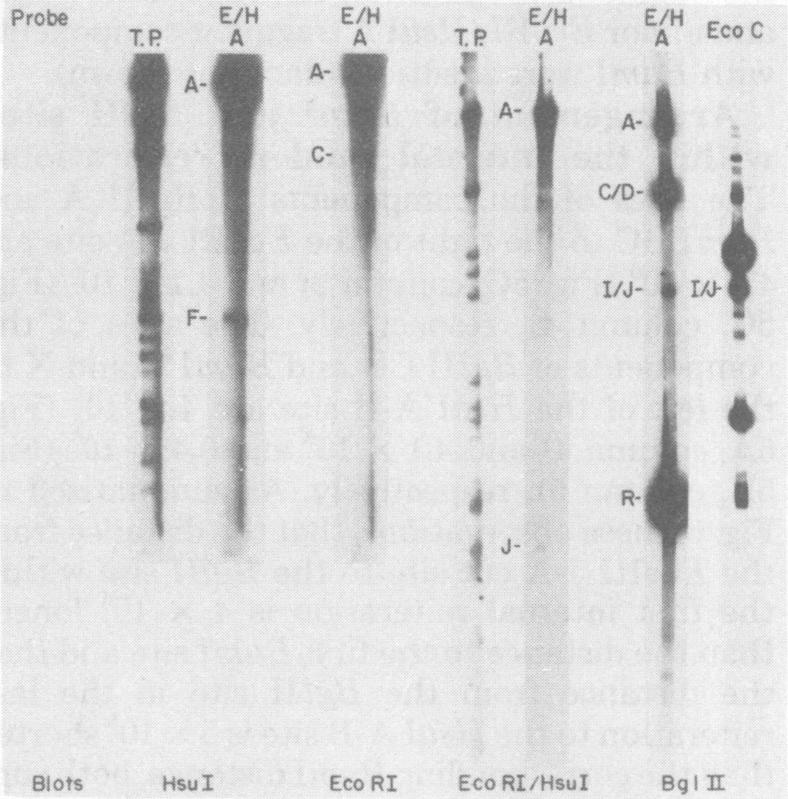
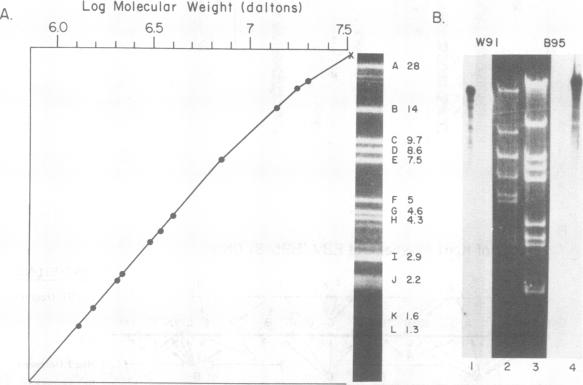
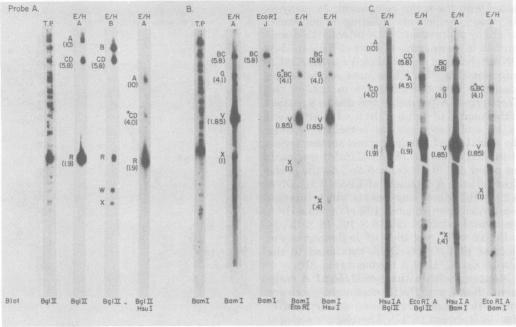
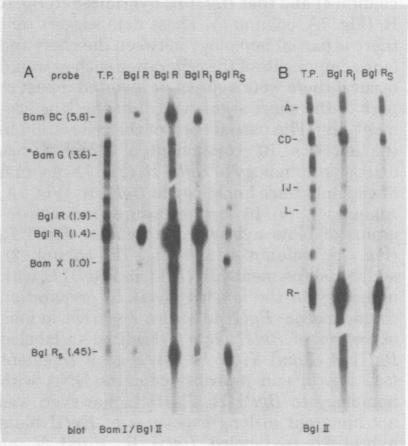
Epstein-Barr virus (B95-8) DNA consists of short (10 X 10(6)) and long (87 X 10(6)) unique DNA sequences joined by 10 tandem reiterations of a 1.85 X 10(6) DNA segment. The reiterated sequence contains BamI and BglII sites separated by 4 X 10(5). The 4.5 X 10(5) and 14.0 X 10(5) segments generated by cleavage of the reiterated DNA with BamI and BglII contain sequences which hybridize to each other, suggesting that the internal tandemly reiterated sequence has a direct or inverted repeat within it. The opposite ends of the linear, nicked, double-stranded DNA molecule (R. F. Pritchett, S. D. Hayward, and E. D. Kieff, J. Virol. 15:556--569, 1975) consist of from 1 to 12 direct repeats of another 3 X 10(5) sequence (D. Given and E. Kieff, J. Virol. 28:524--542, 1978; D. Given, D. Yee, K. Griem, and E. Kieff, J. Virol. 30:852--862, 1979). There is no homology between the internal reiterated sequence and either terminus. However, part of the internal reiteration (less than 5 X 10(5) is reiterated at two separate locations in the long unique region. The internal reiterations are a source of variation within EBV (B95-8) DNA preparations. Thus, although the majority of molecules contain 10 tandem reiterations, some molecules have 9, 8, 7, 6, 5, 4, or fewer tandem reiterations. A consequence of this variability is that the KpnI A fragment and the EcoRI/Hsul A fragment consist of a family of seven or more fragments differing in the number of tandem internal reiterations. The EcoRI/HsuI A fragment of EBV (W91) DNA is approximately 6 X 10(6) smaller than the largest and dominant EcoRI/HsuI A fragment of EBV (B95-8) DNA. EBV (W91 DNA also differs from EBV (B95-8) DNA by an additional 7 X 10(6) to 8 X 10(6) of DNA in the long unique DNA region (D. Given and E. Kieff, J. Virol. 28:524--542, 1978; N. Raab-Traub, R. Pritchett, and E. Kieff, J. Virol. 27:388--398, 1978). These data suggest the possibility that the smaller number of internal reiterations in EBV (W91) DNA may be a consequence of the additional unique DNA and a restriction in the overall size of EBV DNA.
爱泼斯坦-巴尔病毒(B95 - 8)的DNA由短(10×10⁶)和长(87×10⁶)的独特DNA序列组成,这些序列由一个1.85×10⁶DNA片段的10个串联重复序列连接。重复序列包含被4×10⁵隔开的BamI和BglII位点。用BamI和BglII切割重复DNA产生的4.5×10⁵和14.0×10⁵片段包含相互杂交的序列,这表明内部串联重复序列内部有正向或反向重复。线性、带切口的双链DNA分子(R.F.普里切特、S.D.海沃德和E.D.基夫,《病毒学杂志》15:556 - 569,1975)的相对末端由另一个3×10⁵序列的1至12个正向重复组成(D.吉文和E.基夫,《病毒学杂志》28:524 - 542,1978;D.吉文、D.叶、K.格里姆和E.基夫,《病毒学杂志》30:852 - 862,1979)。内部重复序列与任何一个末端之间都没有同源性。然而,内部重复序列的一部分(小于5×10⁵)在长独特区域的两个不同位置重复。内部重复序列是EBV(B95 - 8)DNA制剂中变异的一个来源。因此,尽管大多数分子含有10个串联重复序列,但一些分子有9、8、7、6、5、4个或更少串联重复序列。这种变异性的一个结果是,KpnI A片段和EcoRI/HsuI A片段由七个或更多片段组成的家族,这些片段在串联内部重复序列的数量上有所不同。EBV(W91)DNA的EcoRI/HsuI A片段比EBV(B95 - 8)DNA最大且占主导地位的EcoRI/HsuI A片段小约6×10⁶。EBV(W91)DNA在长独特DNA区域还与EBV(B95 - 8)DNA相差另外7×10⁶至8×10⁶的DNA(D.吉文和E.基夫,《病毒学杂志》28:524 - 542,1978;N.拉布 - 特劳布、R.普里切特和E.基夫,《病毒学杂志》27:388 - 398,1978)。这些数据表明,EBV(W91)DNA中内部重复序列数量较少可能是额外独特DNA以及EBV DNA总体大小受限的结果。