School of Agriculture and Food Science, University of Queensland, Gatton, Queensland, Australia.
PLoS One. 2012;7(4):e36396. doi: 10.1371/journal.pone.0036396. Epub 2012 Apr 27.
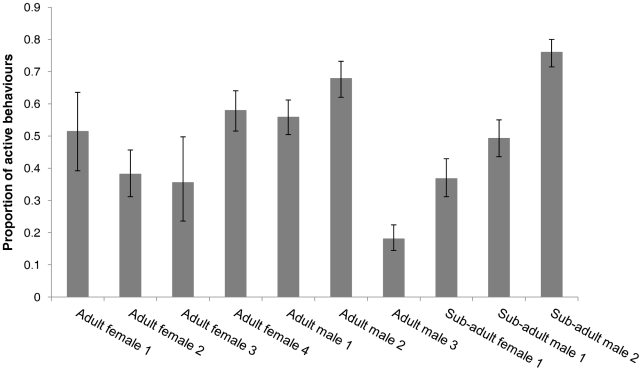
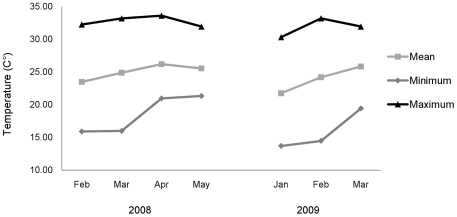
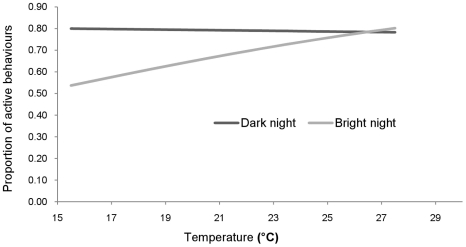
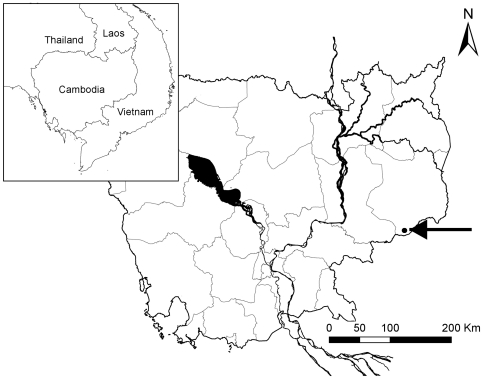
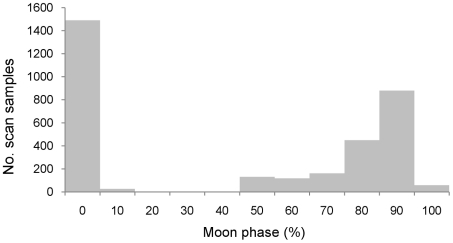
The effect of moonlight and temperature on activity of slow lorises was previously little known and this knowledge might be useful for understanding many aspects of their behavioural ecology, and developing strategies to monitor and protect populations. In this study we aimed to determine if the activity of the pygmy loris (Nycticebus pygmaeus) is affected by ambient temperature and/or moonlight in a mixed deciduous forest. We radio-collared five females and five males in the Seima Protection Forest, Cambodia, in February to May, 2008 and January to March, 2009 and recorded their behaviour at 5 minutes intervals, totalling 2736 observations. We classified each observation as either inactive (sleeping or alert) or active behaviour (travel, feeding, grooming, or others). Moon luminosity (bright/dark) and ambient temperature were recorded for each observation. The response variable, activity, was binary (active or inactive), and a logit link function was used. Ambient temperature alone did not significantly affect mean activity. Although mean activity was significantly affected by moonlight, the interaction between moonlight and temperature was also significant: on bright nights, studied animals were increasingly more active with higher temperature; and on dark nights they were consistently active regardless of temperature. The most plausible explanation is that on bright cold nights the combined risk of being seen and attacked by predators and heat loss outweigh the benefit of active behaviours.
月光和温度对懒猴活动的影响此前知之甚少,而这些知识可能有助于了解其行为生态学的许多方面,并制定监测和保护种群的策略。本研究旨在确定在混合落叶林中,环境温度和/或月光是否会影响侏长尾猴(Nycticebus pygmaeus)的活动。我们于 2008 年 2 月至 5 月和 2009 年 1 月至 3 月在柬埔寨赛美保护森林为 5 只雌性和 5 只雄性佩戴无线电项圈,并以 5 分钟的间隔记录它们的行为,共记录了 2736 次观察。我们将每次观察分为不活动(睡眠或警觉)或活动行为(旅行、进食、梳理或其他)。每次观察都记录了月光亮度(明亮/黑暗)和环境温度。因变量为活动,是二元的(活跃或不活跃),并使用对数链接函数。环境温度单独对平均活动没有显著影响。尽管月光显著影响了平均活动,但月光和温度之间的相互作用也很显著:在明亮的夜晚,研究动物在温度较高时活动增加;而在黑暗的夜晚,无论温度如何,它们都保持活跃。最合理的解释是,在寒冷的明亮夜晚,被捕食者看到和攻击以及热量损失的综合风险超过了积极行为的好处。