Lemaire Jane B, Wallace Jean E, Lewin Adriane M, de Grood Jill, Schaefer Jeffrey P
Department of Medicine, University of Calgary, Health Sciences Center, 3330 University Drive NW, Calgary AB T2N 4N1; 403 220-4506, Canada.
Open Med. 2011;5(4):e154-63. Epub 2011 Oct 4.
Physicians often experience work-related stress that may lead to personal harm and impaired professional performance. Biofeedback has been used to manage stress in various populations.
To determine whether a biofeedback-based stress management tool, consisting of rhythmic breathing, actively self-generated positive emotions and a portable biofeedback device, reduces physician stress.
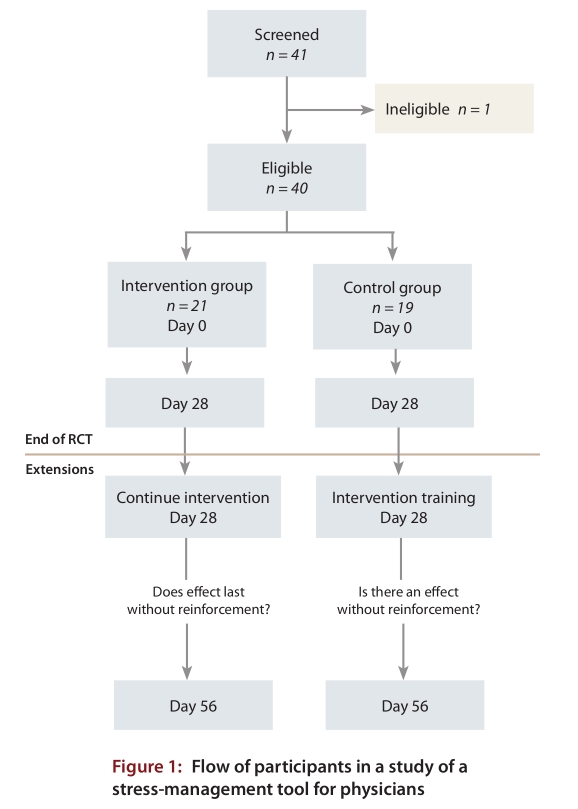
Randomized controlled trial measuring efficacy of a stress-reduction intervention over 28 days, with a 28-day open-label trial extension to assess effectiveness.
Urban tertiary care hospital.
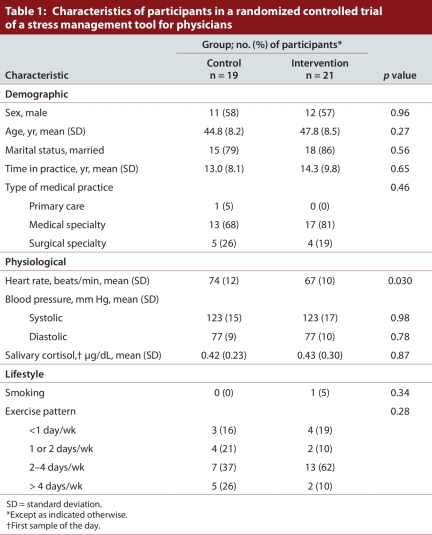
Forty staff physicians (23 men and 17 women) from various medical practices (1 from primary care, 30 from a medical specialty and 9 from a surgical specialty) were recruited by means of electronic mail, regular mail and posters placed in the physicians' lounge and throughout the hospital.
Physicians in the intervention group were instructed to use a biofeedback-based stress management tool three times daily. Participants in both the control and intervention groups received twice-weekly support visits from the research team over 28 days, with the intervention group also receiving re-inforcement in the use of the stress management tool during these support visits. During the 28-day extension period, both the control and the intervention groups received the intervention, but without intensive support from the research team.
Stress was measured with a scale developed to capture short-term changes in global perceptions of stress for physicians (maximum score 200).
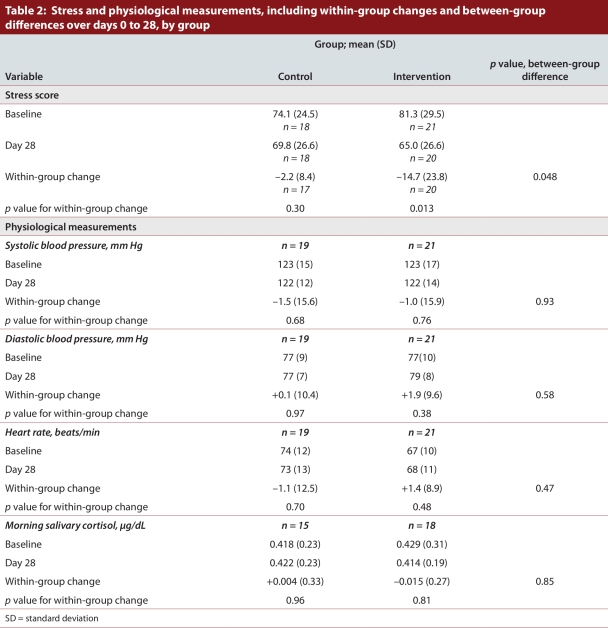
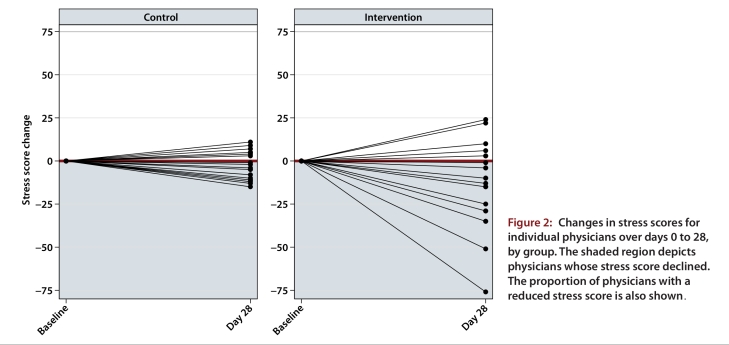
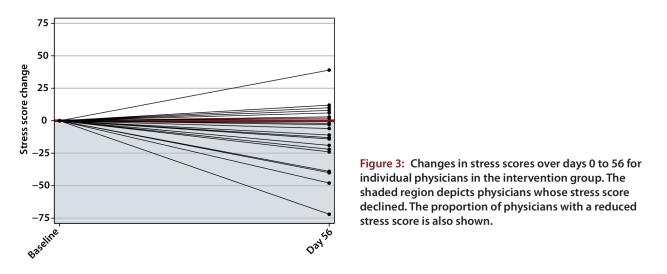
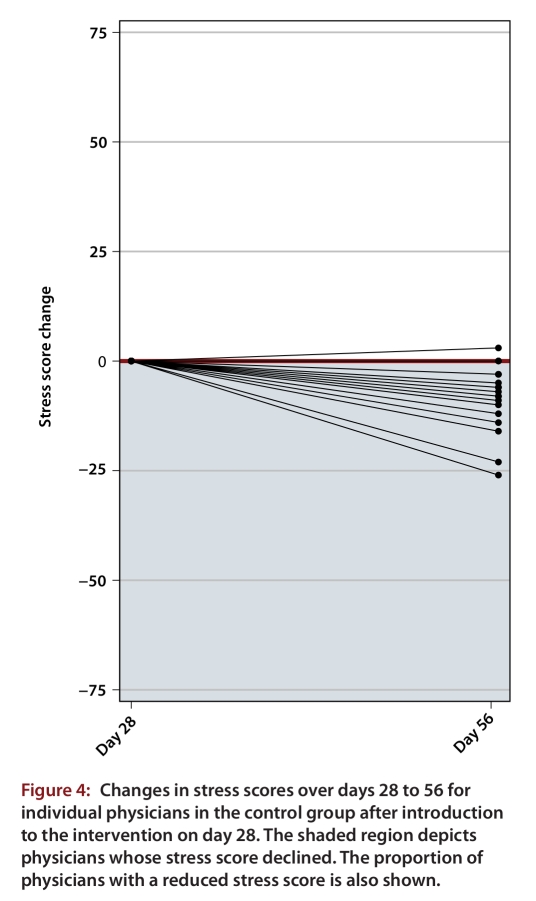
During the randomized controlled trial (days 0 to 28), the mean stress score declined significantly for the intervention group (change -14.7, standard deviation [SD] 23.8; p = 0.013) but not for the control group (change -2.2, SD 8.4; p = 0.30). The difference in mean score change between the groups was 12.5 (p = 0.048). The lower mean stress scores in the intervention group were maintained during the trial extension to day 56. The mean stress score for the control group changed significantly during the 28-day extension period (change -8.5, SD 7.6; p < 0.001).
A biofeedback-based stress management tool may be a simple and effective stress-reduction strategy for physicians.
医生经常经历与工作相关的压力,这可能会导致个人伤害和职业表现受损。生物反馈已被用于管理不同人群的压力。
确定一种基于生物反馈的压力管理工具,包括有节奏的呼吸、主动自我产生的积极情绪和一个便携式生物反馈设备,是否能减轻医生的压力。
一项随机对照试验,测量为期28天的减压干预措施的疗效,并进行为期28天的开放标签试验扩展以评估效果。
城市三级护理医院。
通过电子邮件、平信以及张贴在医生休息室和医院各处的海报,招募了40名来自不同医疗科室的在职医生(23名男性和17名女性)(1名来自初级保健科室,30名来自医学专科,9名来自外科专科)。
干预组的医生被指示每天使用三次基于生物反馈的压力管理工具。对照组和干预组的参与者在28天内每周接受两次研究团队的支持访问,干预组在这些支持访问期间还接受了压力管理工具使用方面的强化指导。在为期28天的延长期内,对照组和干预组都接受了干预,但没有研究团队的密集支持。
使用一个专门为捕捉医生对压力的整体认知的短期变化而开发的量表来测量压力(最高分200分)。
在随机对照试验期间(第0天至第28天),干预组的平均压力得分显著下降(变化-14.7,标准差[SD]23.8;p=0.013),而对照组没有下降(变化-2.2,SD 8.4;p=0.30)。两组之间平均得分变化的差异为12.5(p=0.048)。在试验扩展至第56天期间,干预组较低的平均压力得分得以维持。对照组的平均压力得分在28天的延长期内有显著变化(变化-8.5,SD 7.6;p<0.001)。
一种基于生物反馈的压力管理工具可能是一种简单有效的医生减压策略。