Department of Microelectronics, Faculty of Electrical Engineering and Communication, Brno University of Technology, Údolní 53, 602 00 Brno, Czech Republic; E-Mails:
Sensors (Basel). 2009;9(4):2352-62. doi: 10.3390/s90402352. Epub 2009 Mar 30.
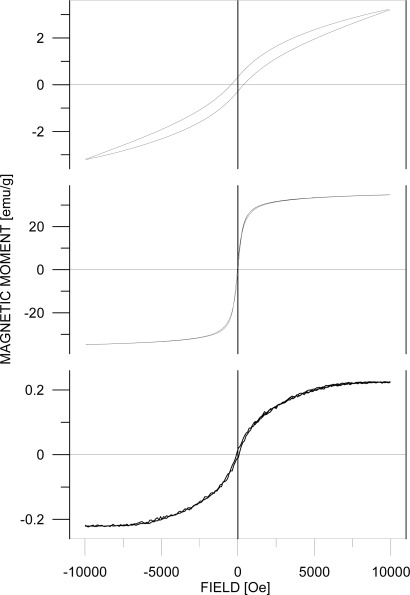
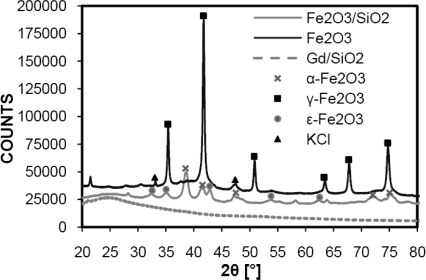
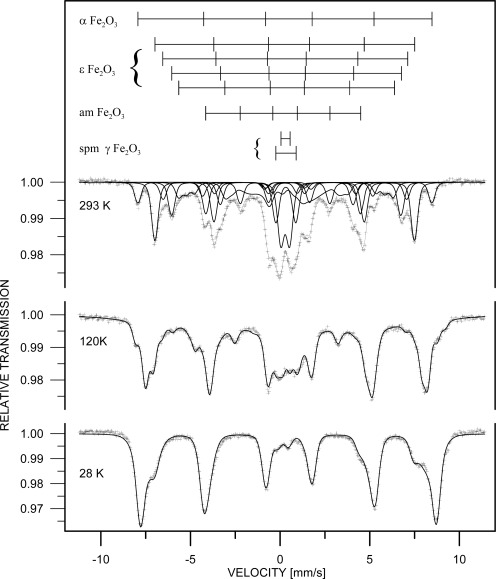
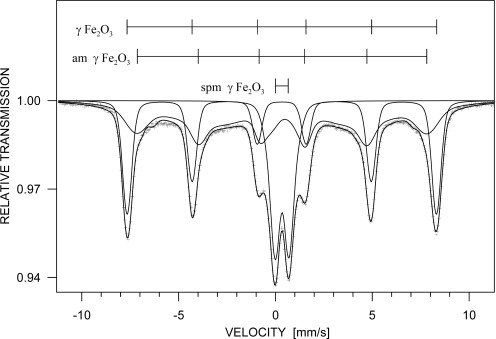
The fabrications of iron oxides nanoparticles using co-precipitation and gadolinium nanoparticles using water in oil microemulsion method are reported in this paper. Results of detailed phase analysis by XRD and Mössbauer spectroscopy are discussed. XRD analysis revealed that the crystallite size (mean coherence length) of iron oxides (mainly γ-Fe(2)O(3)) in the Fe(2)O(3) sample was 30 nm, while in Fe(2)O(3)/SiO(2) where the ε-Fe(2)O(3) phase dominated it was only 14 nm. Gd/SiO(2) nanoparticles were found to be completely amorphous, according to XRD. The samples showed various shapes of hysteresis loops and different coercivities. Differences in the saturation magnetization (MS) correspond to the chemical and phase composition of the sample materials. However, we observed that MS was not reached in the case of Fe(2)O(3)/SiO(2), while for Gd/SiO(2) sample the MS value was extremely low. Therefore we conclude that only unmodified Fe(2)O(3) nanoparticles are suitable for intended biosensing application in vitro (e.g. detection of viral nucleic acids) and the phase purification of this sample for this purpose is not necessary.
本文报道了使用共沉淀法制备氧化铁纳米粒子和使用水包油微乳液法制备钆纳米粒子的方法。讨论了详细的 X 射线衍射(XRD)和穆斯堡尔谱分析结果。XRD 分析表明,Fe2O3 样品中氧化铁(主要为γ-Fe2O3)的晶粒度(平均相干长度)为 30nm,而以ε-Fe2O3 相为主的 Fe2O3/SiO2 中仅为 14nm。根据 XRD 分析,Gd/SiO2 纳米粒子完全是非晶态的。这些样品表现出不同形状的磁滞回线和不同的矫顽力。饱和磁化强度(MS)的差异与样品材料的化学和相组成相对应。然而,我们观察到在 Fe2O3/SiO2 情况下未达到 MS,而对于 Gd/SiO2 样品,MS 值极低。因此,我们得出结论,只有未经修饰的 Fe2O3 纳米粒子适用于体外(例如检测病毒核酸)的预期生物传感应用,并且不需要对该样品进行相纯化以达到此目的。