Quantitative Veterinary Epidemiology Group, Wageningen Institute of Animal Sciences, Wageningen University, P,O, Box 338, Wageningen, 6700 AH, The Netherlands.
BMC Vet Res. 2012 May 18;8:58. doi: 10.1186/1746-6148-8-58.
ABSBACKGROUND: Since the detection of MRSA CC398 in pigs in 2004, it has emerged in livestock worldwide. MRSA CC398 has been found in people in contact with livestock and thus has become a public health issue. Data from a large-scale longitudinal study in two Danish and four Dutch pig herds were used to quantify MRSA CC398 transmission rates within pig herds and to identify factors affecting transmission between pigs.
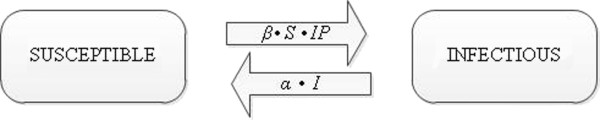
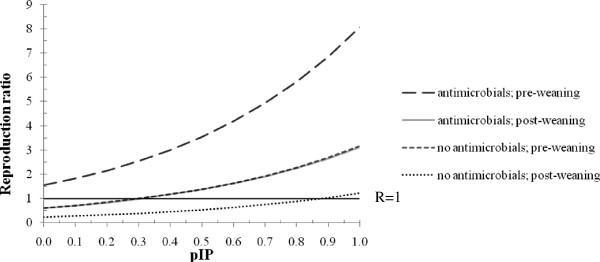
Sows and their offspring were sampled at varying intervals during a production cycle. Overall MRSA prevalence of sows increased from 33% before farrowing to 77% before weaning. Overall MRSA prevalence of piglets was>60% during the entire study period. The recurrent finding of MRSA in the majority of individuals indicates true colonization or might be the result of contamination. Transmission rates were estimated using a Susceptible-Infectious-Susceptible (SIS-)model, which resulted in values of the reproduction ratio (R0) varying from 0.24 to 8.08. Transmission rates were higher in pigs treated with tetracyclins and β-lactams compared to untreated pigs implying a selective advantage of MRSA CC398 when these antimicrobials are used. Furthermore, transmission rates were higher in pre-weaning pigs compared to post-weaning pigs which might be explained by an age-related susceptibility or the presence of the sow as a primary source of MRSA CC398. Finally, transmission rates increased with the relative increase of the infection pressure within the pen compared to the total infection pressure, implying that within-pen transmission is a more important route compared to between-pen transmission and transmission through environmental exposure.
Our results indicate that MRSA CC398 is able to spread and persist in pig herds, resulting in an endemic situation. Transmission rates are affected by the use of selective antimicrobials and by the age of pigs.
自 2004 年在猪中发现耐甲氧西林金黄色葡萄球菌(MRSA)CC398 以来,它已在世界范围内的牲畜中出现。MRSA CC398 已在与牲畜接触的人群中发现,因此已成为一个公共卫生问题。利用丹麦两个和荷兰四个猪群的大规模纵向研究的数据,定量评估了猪群内 MRSA CC398 的传播率,并确定了影响猪之间传播的因素。
在一个生产周期中,母猪及其后代会在不同时间进行采样。分娩前母猪的总体 MRSA 患病率从 33%增加到断奶前的 77%。整个研究期间,仔猪的总体 MRSA 患病率超过 60%。大多数个体中 MRSA 的反复出现表明这是真正的定植,或者可能是污染的结果。使用易感性-感染-易感性(SIS)模型估计了传播率,结果表明繁殖率(R0)值从 0.24 到 8.08 不等。与未治疗的猪相比,用四环素和β-内酰胺类药物治疗的猪的传播率更高,这表明当使用这些抗生素时,MRSA CC398 具有选择性优势。此外,与断奶后猪相比,断奶前猪的传播率更高,这可能是由于年龄相关的易感性或母猪作为 MRSA CC398 的主要来源。最后,与总感染压力相比,随着猪舍内感染压力的相对增加,传播率也会增加,这表明与环境暴露相比,猪舍内传播是一种更重要的途径。
我们的结果表明,MRSA CC398 能够在猪群中传播和持续存在,导致地方性流行。传播率受选择性抗生素的使用和猪的年龄的影响。