Bastard Jonathan, Haenni Marisa, Gay Emilie, Glaser Philippe, Madec Jean-Yves, Temime Laura, Opatowski Lulla
Université Paris-Saclay, UVSQ, Univ. Paris-Sud, Inserm, CESP, Anti-infective evasion and pharmacoepidemiology team, F-78180 Montigny-le-Bretonneux, France.
Institut Pasteur, Epidemiology and Modelling of Antibiotic Evasion unit, F-75015 Paris, France.
One Health. 2021 Mar 18;12:100238. doi: 10.1016/j.onehlt.2021.100238. eCollection 2021 Jun.
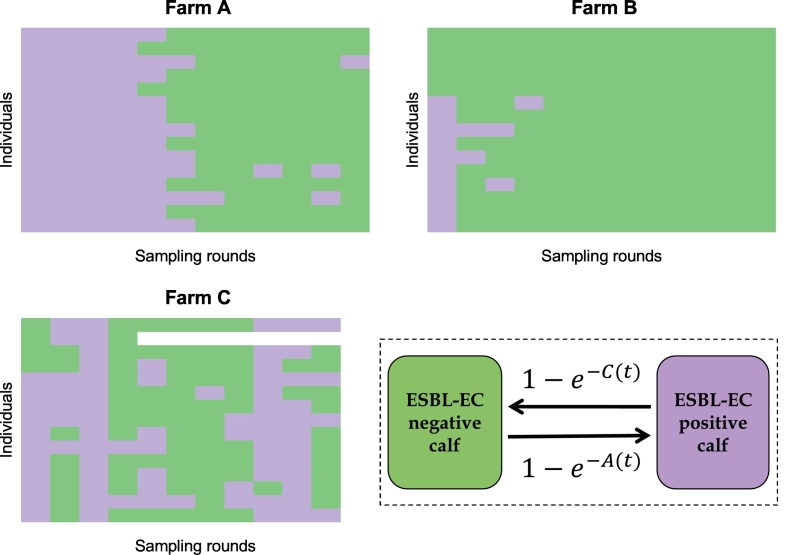
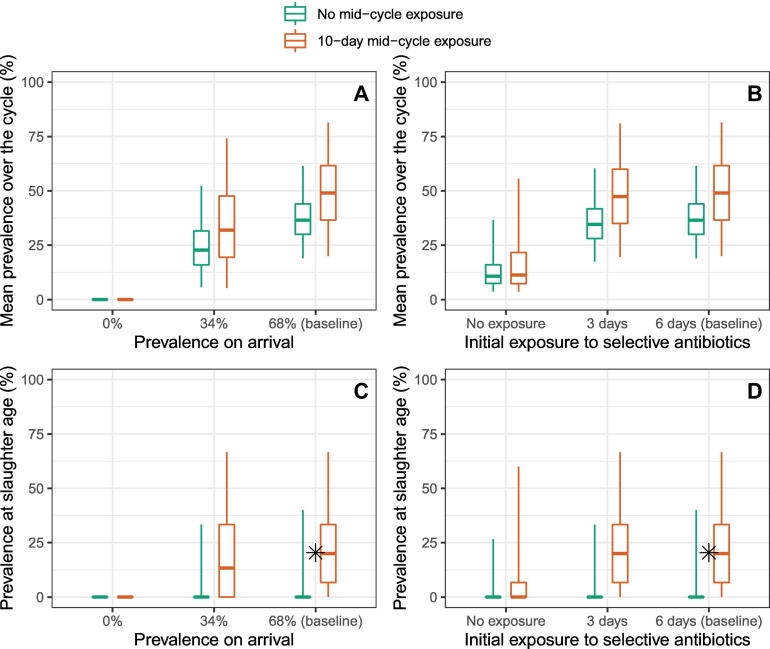
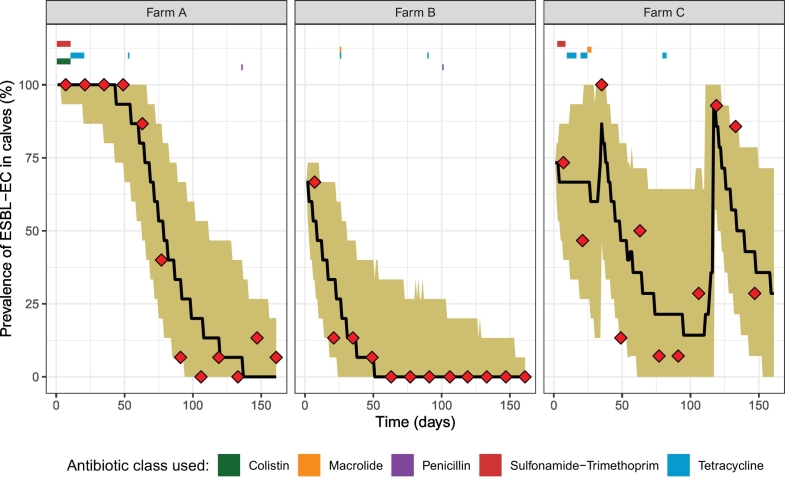
The contribution of bacteria in livestock to the global burden of antimicrobial resistance raises concerns worldwide. However, the dynamics of selection and diffusion of antimicrobial resistance in farm animals are not fully understood. Here, we used veal calf fattening farms as a model system, as they are a known reservoir of Extended Spectrum β-Lactamase-producing (ESBL-EC). Longitudinal data of ESBL-EC carriage and antimicrobial use (AMU) were collected from three veal calf farms during the entire fattening process. We developed 18 agent-based mechanistic models to assess different hypotheses regarding the main drivers of ESBL-EC dynamics in calves. The models were independently fitted to the longitudinal data using Markov Chain Monte Carlo and the best model was selected. Within-farm transmission between individuals and sporadic events of contamination were found to drive ESBL-EC dynamics on farms. In the absence of AMU, the median carriage duration of ESBL-EC was estimated to be 19.6 days (95% credible interval: [12.7; 33.3]). In the best model, AMU was found to influence ESBL-EC dynamics, by affecting ESBL-EC clearance rather than acquisition. This effect of AMU was estimated to decrease gradually after the end of exposure and to disappear after 62.5 days [50.0; 76.9]. Moreover, using a simulation study, we quantified the efficacy of ESBL-EC mitigation strategies. Decreasing ESBL-EC prevalence by 50% on arrival at the fattening farm reduced prevalence at slaughter age by 33.3%. Completely eliminating the use of selective antibiotics on arrival had a strong effect on average ESBL-EC prevalence (relative reduction of 77.0%), but the effect was mild if this use was only decreased by 50% compared to baseline (relative reduction of 3.3%).
家畜体内的细菌对全球抗菌药物耐药性负担的影响引发了全球关注。然而,农场动物中抗菌药物耐药性的选择和传播动态尚未完全明确。在此,我们以小牛肉犊育肥场作为模型系统,因为它们是产超广谱β-内酰胺酶大肠杆菌(ESBL-EC)的已知宿主。在整个育肥过程中,收集了来自三个小牛肉犊场的ESBL-EC携带情况和抗菌药物使用(AMU)的纵向数据。我们开发了18个基于主体的机制模型,以评估关于犊牛中ESBL-EC动态主要驱动因素的不同假设。使用马尔可夫链蒙特卡罗方法将这些模型独立拟合到纵向数据,并选出最佳模型。发现个体间的场内传播和偶发的污染事件推动了农场中ESBL-EC的动态变化。在不使用抗菌药物的情况下,ESBL-EC的中位携带持续时间估计为19.6天(95%可信区间:[12.7;33.3])。在最佳模型中,发现抗菌药物使用通过影响ESBL-EC的清除而非获得来影响其动态变化。抗菌药物使用的这种影响在暴露结束后估计会逐渐降低,并在62.5天[50.0;76.9]后消失。此外,通过模拟研究,我们量化了ESBL-EC缓解策略的效果。育肥场入场时将ESBL-EC流行率降低50%,可使屠宰年龄时的流行率降低33.3%。入场时完全停止使用选择性抗生素对平均ESBL-EC流行率有显著影响(相对降低77.0%),但与基线相比仅减少50%时,效果则较弱(相对降低3.3%)。