Orci L, Ravazzola M, Baetens D, Inman L, Amherdt M, Peterson R G, Newgard C B, Johnson J H, Unger R H
Department of Morphology, University of Geneva Medical School, Switzerland.
Proc Natl Acad Sci U S A. 1990 Dec;87(24):9953-7. doi: 10.1073/pnas.87.24.9953.
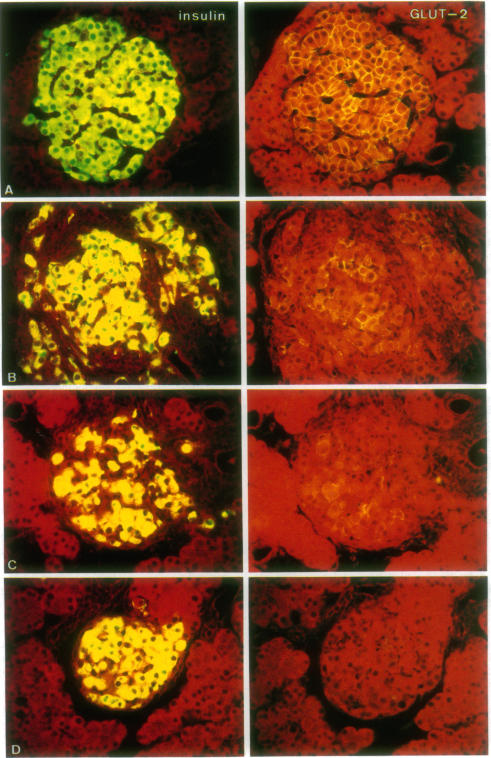
Non-insulin-dependent diabetes mellitus (NIDDM) is attributed to a failure of pancreatic beta cells to maintain insulin secretion at a level sufficient to compensate for underlying insulin resistance. In the ZDF rat, a model of NIDDM that closely resembles the human syndrome, we have previously reported profound underexpression of GLUT-2, the high-Km facilitative glucose transporter expressed by beta cells of normal animals. Here we report that islets of diabetic rats exhibit a marked decrease in the volume of GLUT-2-positive beta cells and a reduction at the electron-microscopic level in the number of GLUT-2-immunoreactive sites per unit of beta-cell plasma membrane. The deficiency of GLUT-2 cannot be induced in normal beta cells by in vivo or in vitro exposure to high levels of glucose nor can it be prevented in beta cells of prediabetic ZDF rats by elimination of hyperglycemia. We conclude that this dearth of immunodetectable GLUT-2 in NIDDM is not secondary to hyperglycemia and therefore that it may well play a causal role in the development of hyperglycemia.
非胰岛素依赖型糖尿病(NIDDM)归因于胰腺β细胞无法将胰岛素分泌维持在足以补偿潜在胰岛素抵抗的水平。在ZDF大鼠(一种与人类综合征极为相似的NIDDM模型)中,我们之前曾报道过GLUT-2(正常动物β细胞所表达的高Km易化型葡萄糖转运体)存在严重的低表达。在此我们报告,糖尿病大鼠的胰岛中GLUT-2阳性β细胞的体积显著减小,并且在电子显微镜水平上,每单位β细胞质膜上GLUT-2免疫反应位点的数量减少。正常β细胞在体内或体外暴露于高水平葡萄糖时不会诱导出GLUT-2缺乏,并且通过消除高血糖也无法在糖尿病前期ZDF大鼠的β细胞中预防这种缺乏。我们得出结论,NIDDM中这种免疫可检测的GLUT-2缺乏并非继发于高血糖,因此它很可能在高血糖的发生中起因果作用。