Yang Soon Bum, Cho Wonik, Chang Ung-Kyu
Department of Neurosurgery, Korea Cancer Center Hospital, Korea Institute of Radiological and Medical Science, Seoul, Korea.
J Korean Neurosurg Soc. 2012 Mar;51(3):127-34. doi: 10.3340/jkns.2012.51.3.127. Epub 2012 Mar 31.
To analyze the prognostic factors thought to be related with survival time after a spinal metastasis operation.
We retrospectively analyzed 217 patients who underwent spinal metastasis operations in our hospital from 2001 to 2009. Hematological malignancies, such as multiple myeloma and lymphoma, were excluded. The factors thought to be related with postoperative survival time were gender, age (below 55, above 56), primary tumor growth rate (slow, moderate, rapid group), spinal location (cervical, thoracic, and lumbo-sacral spine), the timing of radiation therapy (preoperative, postoperative, no radiation), operation type (decompressive laminectomy with or without posterior fixation, corpectomy with anterior fusion, corpectomy with posterior fixation), preoperative systemic condition (below 5 points, above 6 points classified by Tomita scoring), pre- and postoperative ambulatory function (ambulatory, non-ambulatory), number of spinal metastases (single, multiple), time to spinal metastasis from the primary cancer diagnosis (below 21 months, above 22 months), and postoperative complication.
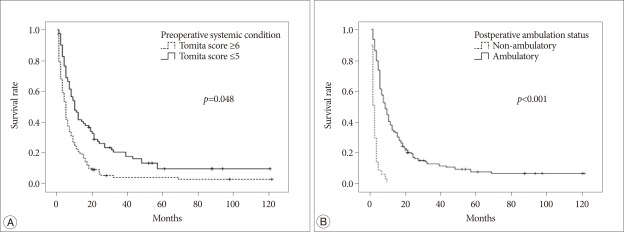
The study cohort mean age at the time of surgery was 55.5 years. The median survival time after spinal operation and spinal metastasis diagnosis were 6.0 and 9.0 months. In univariate analysis, factors such as gender, primary tumor growth rate, preoperative systemic condition, and preoperative and postoperative ambulatory status were shown to be related to postoperative survival. In multivariate analysis, statistically significant factors were preoperative systemic condition (p=0.048) and postoperative ambulatory status (p<0.001). The other factors had no statistical significance.
The factors predictive for postoperative survival time should be considered in the surgery of spinal metastasis patients.
分析被认为与脊柱转移瘤手术后生存时间相关的预后因素。
我们回顾性分析了2001年至2009年在我院接受脊柱转移瘤手术的217例患者。排除血液系统恶性肿瘤,如多发性骨髓瘤和淋巴瘤。被认为与术后生存时间相关的因素包括性别、年龄(55岁以下、56岁以上)、原发肿瘤生长速度(缓慢、中等、快速组)、脊柱位置(颈椎、胸椎和腰骶椎)、放疗时机(术前、术后、未放疗)、手术类型(减压性椎板切除术伴或不伴后路固定、椎体次全切除术伴前路融合、椎体次全切除术伴后路固定)、术前全身状况(根据Tomita评分低于5分、高于6分)、术前和术后行走功能(可行走、不能行走)、脊柱转移瘤数量(单发、多发)、从原发癌诊断到脊柱转移的时间(21个月以下、22个月以上)以及术后并发症。
研究队列手术时的平均年龄为55.5岁。脊柱手术和脊柱转移瘤诊断后的中位生存时间分别为6.0个月和9.0个月。单因素分析显示,性别、原发肿瘤生长速度、术前全身状况以及术前和术后行走状态等因素与术后生存相关。多因素分析显示,具有统计学意义的因素是术前全身状况(p = 0.048)和术后行走状态(p < 0.001)。其他因素无统计学意义。
在脊柱转移瘤患者的手术中应考虑预测术后生存时间的因素。