Department of Virology, Institute of Medical Microbiology and Hygiene, University Medical Center Freiburg, Hermann-Herder Str. 11, 79104 Freiburg, Germany.
Eur J Clin Microbiol Infect Dis. 2012 Oct;31(10):2851-61. doi: 10.1007/s10096-012-1639-1. Epub 2012 May 30.
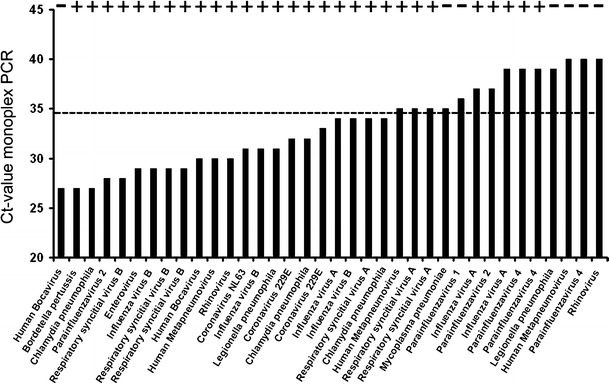
Symptoms of acute febrile respiratory tract infection are often unspecific, but the rapid identification of pathogens allows optimised patient management. The objective of this study was to evaluate a novel multiplex polymerase chain reaction (PCR) suspension microarray which detects 19 viral and four atypical bacterial targets. A comprehensive set of sensitive monoplex real-time PCR assays was used for each pathogen as the gold standard. A panel of archived as well as 300 prospectively collected clinical samples was analysed by both methods. At least one target was detected in 165/300 (55 %) samples by monoplex PCR and in 140/300 (46 %) samples by multiplex PCR, respectively. The positivity rate was significantly higher in paediatric patients compared to adults [126/154 (82 %) vs. 39/146 (27 %) by monoplex and 114/154 (74 %) vs. 26/146 (18 %) by multiplex PCR, respectively]. Among all samples, 17/300 (5.6 %) were positive for atypical bacteria by monoplex and 8/300 (2.6 %) by multiplex PCR, respectively. Multiple detections were recorded in 35/300 (11.6 %) samples by monoplex and 26/300 (8.7 %) by multiplex PCR. For the most common pathogens, the sensitivity ranged from 57 to 93 % and the specificity ranged from 95 to 100 %. The overall concordance between both methods was 77 % [95 % confidence interval (CI) 72-81 %]. False-negative results by multiplex PCR were mainly due to the low target concentration. Compared to monoplex PCR, the novel microarray assay proved its principle but displayed overall lower sensitivities, potentially restricting its use to paediatric patients. For some targets, only small numbers of positive samples were available, requiring larger studies to firmly assess the sensitivity and specificity.
急性发热性呼吸道感染的症状通常不具有特异性,但快速识别病原体可实现患者管理的最优化。本研究的目的是评估一种新型的多重聚合酶链反应(PCR)悬浮微阵列,该微阵列可检测 19 种病毒和 4 种非典型细菌靶标。针对每种病原体,我们使用了一整套敏感的单重实时 PCR 检测作为金标准。使用这两种方法对一组存档样本和 300 份前瞻性采集的临床样本进行了分析。通过单重 PCR 检测到至少一个靶标,在 300 个样本中占 165 个(55%),通过多重 PCR 检测到 140 个(46%)。儿科患者的阳性率明显高于成人[单重 126/154(82%)比 146/146(27%);多重 114/154(74%)比 146/146(18%)]。在所有样本中,通过单重 PCR 检测到 17 个(5.6%)非典型细菌阳性,通过多重 PCR 检测到 8 个(2.6%)阳性。单重 PCR 检测到 35 个(11.6%)样本存在多重检测,多重 PCR 检测到 26 个(8.7%)样本存在多重检测。对于最常见的病原体,敏感性范围为 57%至 93%,特异性范围为 95%至 100%。两种方法之间的总体一致性为 77%(95%置信区间[CI]72-81%)。多重 PCR 的假阴性结果主要归因于靶标浓度低。与单重 PCR 相比,新型微阵列检测法证实了其原理,但总体敏感性较低,可能限制了其在儿科患者中的应用。对于一些靶标,阳性样本数量较少,需要更大规模的研究来确定其敏感性和特异性。