Instituto de Medicina Integral Professor Fernando Figueira (IMIP), Recife, Brazil.
PLoS One. 2011 Apr 18;6(4):e18928. doi: 10.1371/journal.pone.0018928.
Acute respiratory infection (ARI) is a leading cause of morbidity and mortality in children worldwide. This study aimed to determine the viral and atypical bacterial causes of different severities and clinical manifestations of ARI in preschool children from low-income families in North-East Brazil.
Clinical/demographic data and nasopharyngeal aspirates (NPA) were prospectively collected from children <5 years presenting with ARI over one year to a paediatric A&E department. Disease severity was grouped according to presence of lower respiratory tract signs, need for hospital admission and need for oxygen. Clinical manifestation of ARI was based on discharge diagnosis from hospital with four conditions predominating: bronchiolitis, pneumonia, episodic viral wheeze/asthma and upper respiratory tract infection. Multiplex PCR was used to detect 17 common respiratory viral and atypical bacterial pathogens in NPA.
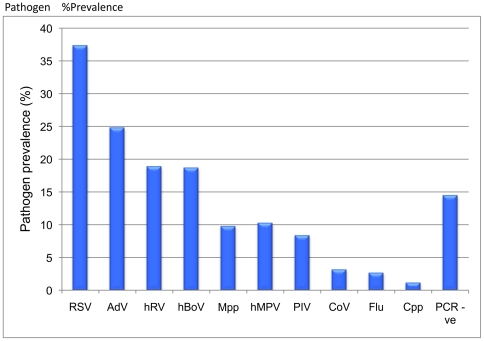
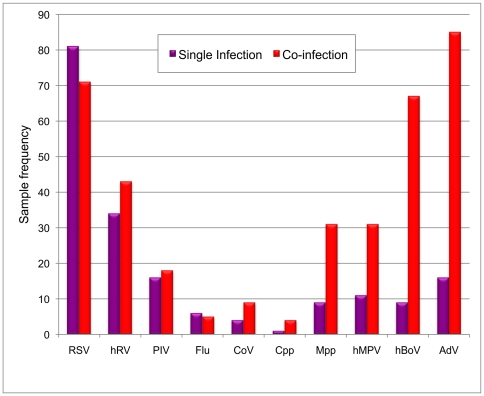
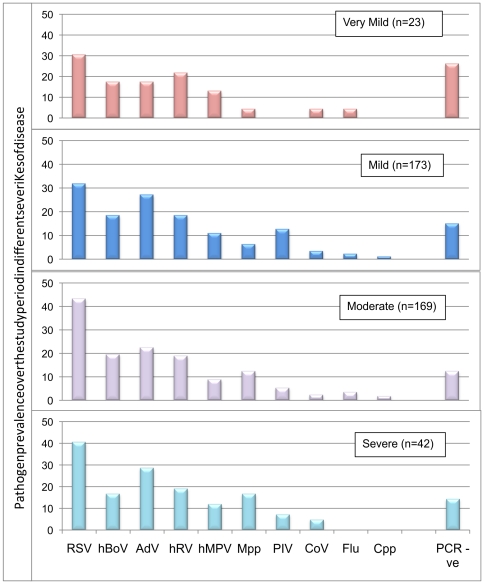
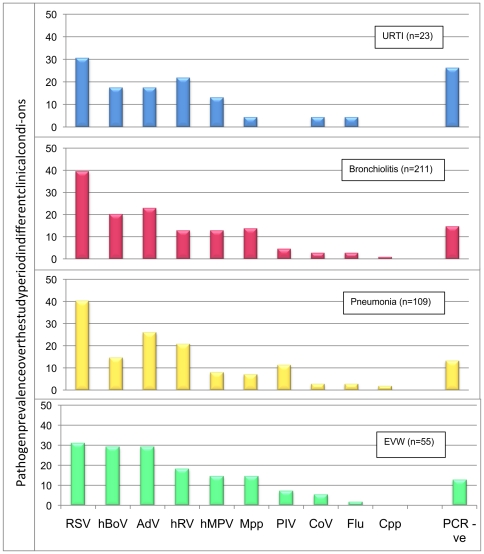
407 children with a median age of eight months were recruited. Pathogens were detected in 85·5% samples with co-infection being particularly common (39·5%). Respiratory Syncytial Virus (RSV; 37%), Adenoviruses (AdV; 25%), Rhinoviruses (hRV; 19%), Bocavirus (hBoV; 19%), human Meta-pneumovirus (hMPV; 10%) and Mycoplasma pneumoniae (Mpp; 10%) were most prevalent. Detection and co-infection rates were similar in all severities and clinical manifestations of ARI apart from RSV, which was associated with more severe disease and specifically more severe cases of bronchiolitis, and Mpp, which was associated with more severe cases of pneumonia. Mpp was detected in 17% of children admitted to hospital with pneumonia.
This study underlines the importance of viral and atypical bacterial pathogens in ARI in pre-school children and highlights the complex epidemiology of these pathogens in this age group. Generally, viruses and atypical bacteria were detected in all severities and clinical manifestations of ARI but RSV and Mpp were associated with more severe cases of bronchiolitis and pneumonia respectively.
急性呼吸道感染(ARI)是全球儿童发病率和死亡率的主要原因。本研究旨在确定巴西东北部低收入家庭学龄前儿童不同严重程度和临床表现的ARI 的病毒和非典型细菌病因。
在一年时间内,前瞻性地从儿科急症科就诊的患有ARI 的<5 岁儿童中收集临床/人口统计学数据和鼻咽抽吸物(NPA)。根据是否存在下呼吸道体征、是否需要住院以及是否需要吸氧,将疾病严重程度分为组。ARI 的临床表现基于医院出院诊断,其中四种情况占主导地位:细支气管炎、肺炎、间歇性病毒性喘息/哮喘和上呼吸道感染。使用多重 PCR 检测 NPA 中 17 种常见呼吸道病毒和非典型细菌病原体。
共招募了 407 名中位年龄为 8 个月的儿童。85.5%的样本中检测到病原体,合并感染特别常见(39.5%)。呼吸道合胞病毒(RSV;37%)、腺病毒(AdV;25%)、鼻病毒(hRV;19%)、博卡病毒(hBoV;19%)、人偏肺病毒(hMPV;10%)和肺炎支原体(Mpp;10%)最为常见。除 RSV 外,所有 ARI 严重程度和临床表现中检测和合并感染率相似,RSV 与更严重的疾病相关,特别是与更严重的细支气管炎相关,Mpp 与更严重的肺炎相关。肺炎支原体在因肺炎住院的儿童中占 17%。
本研究强调了病毒和非典型细菌病原体在学龄前儿童 ARI 中的重要性,并突出了这些病原体在该年龄组中的复杂流行病学。通常,病毒和非典型细菌在所有 ARI 严重程度和临床表现中均可检测到,但 RSV 和 Mpp 分别与更严重的细支气管炎和肺炎病例相关。