Litzelman Kristin, Barker Emily, Catrine Kristine, Puccetti Diane, Possin Peggy, Witt Whitney P
Department of Population Health Sciences, School of Medicine and Public Health, University of Wisconsin, Madison, WI 53726, USA.
Psychooncology. 2013 May;22(5):1081-8. doi: 10.1002/pon.3113. Epub 2012 May 30.
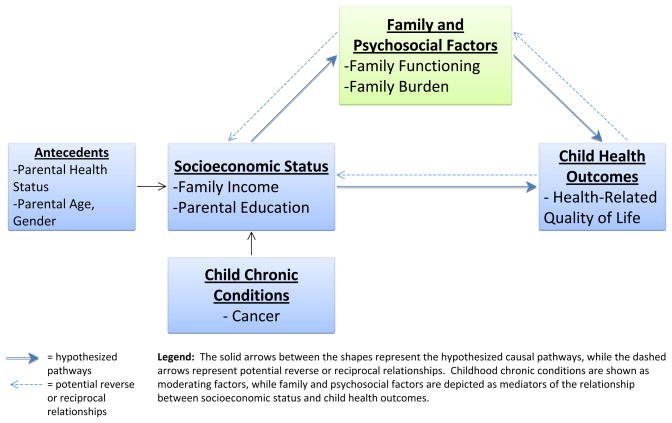
This study aimed to determine if and to what extent (i) socioeconomic disparities exist in the health-related quality of life (QOL) of children with cancer or brain tumors and healthy children; and (ii) family functioning and burden mediate the relationship between socioeconomic status and children's QOL.
In this cross-sectional study, parents of children ages 2-18 with (n = 71) and without (n = 135) cancer or brain tumors completed in-person interviewer-assisted surveys assessing sociodemographics (including income and parental education), child QOL (measure: PedsQL), family functioning (measure: Family Adaptability and Cohesion Evaluation Scale IV) and burden (measure: Impact on the Family Scale). For children with cancer, clinical characteristics were captured through medical record abstraction. Multiple linear regression was used to determine the relationship between income and child QOL; the interaction between group status and income was assessed. Staged multivariate regression models were used to assess the role of family factors in this relationship among children with cancer.
In multivariate analyses, the effect of income differed by cancer status; lower income was associated with worse QOL in children with cancer but not among healthy children. Among children with cancer, this relationship was significantly attenuated by family burden.
Significant socioeconomic disparities exist in the QOL of children with cancer. Family factors partially explain the relationship between low income and poor QOL outcomes among these children. Lower-income families may have fewer resources to cope with their child's cancer. Increased support, monitoring, and referrals to reduce burden for these families may lead to improved QOL in children with cancer.
本研究旨在确定(i)癌症或脑肿瘤患儿与健康儿童在健康相关生活质量(QOL)方面是否存在社会经济差异以及差异程度如何;(ii)家庭功能和负担是否介导社会经济地位与儿童生活质量之间的关系。
在这项横断面研究中,2至18岁患(n = 71)癌或脑肿瘤及未患(n = 135)癌或脑肿瘤儿童的父母完成了由访员协助的面对面调查,评估社会人口统计学特征(包括收入和父母教育程度)、儿童生活质量(测量指标:儿童生活质量量表)、家庭功能(测量指标:家庭适应性和凝聚性评估量表IV)和负担(测量指标:家庭影响量表)。对于癌症患儿,通过病历摘要获取临床特征。采用多元线性回归确定收入与儿童生活质量之间的关系;评估组状态与收入之间的相互作用。采用分阶段多元回归模型评估家庭因素在癌症患儿这种关系中的作用。
在多变量分析中,收入的影响因癌症状态而异;低收入与癌症患儿较差的生活质量相关,但在健康儿童中并非如此。在癌症患儿中,这种关系因家庭负担而显著减弱。
癌症患儿的生活质量存在显著的社会经济差异。家庭因素部分解释了这些儿童低收入与较差生活质量结果之间的关系。低收入家庭应对孩子癌症的资源可能较少。增加支持、监测并转介以减轻这些家庭的负担,可能会改善癌症患儿的生活质量。