Laboratory of Integrative and Systems Physiology-LISP/NCEM, School of Life Sciences, Ecole Polytechnique Fédérale de Lausanne-EPFL, 1015 Lausanne, Switzerland.
Sci Rep. 2012;2:425. doi: 10.1038/srep00425. Epub 2012 May 28.
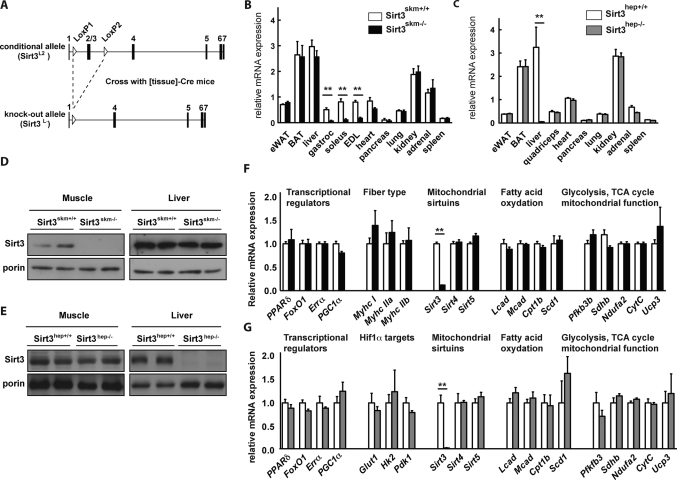
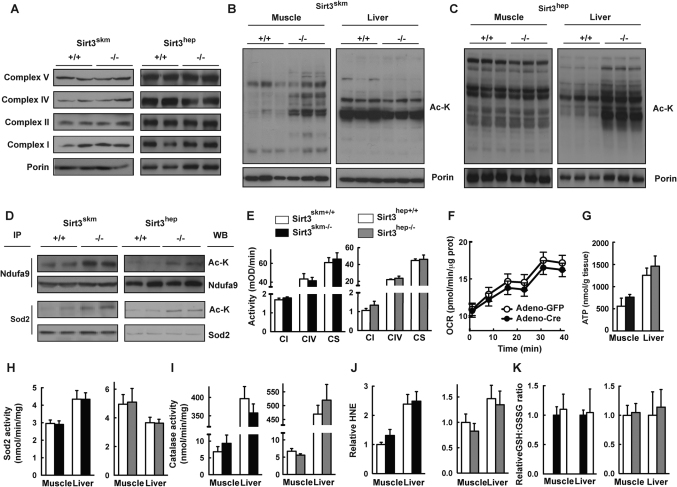
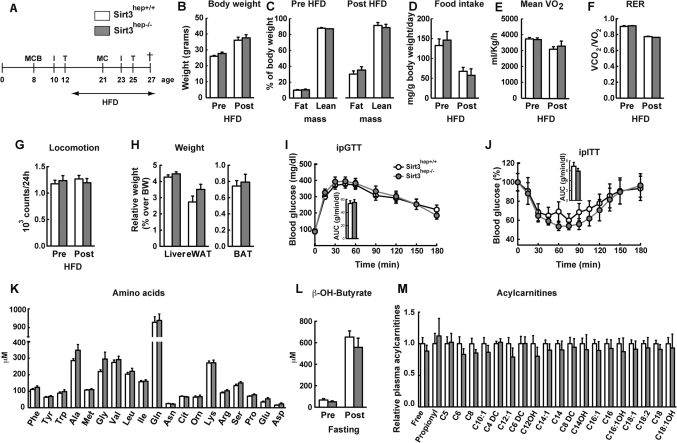
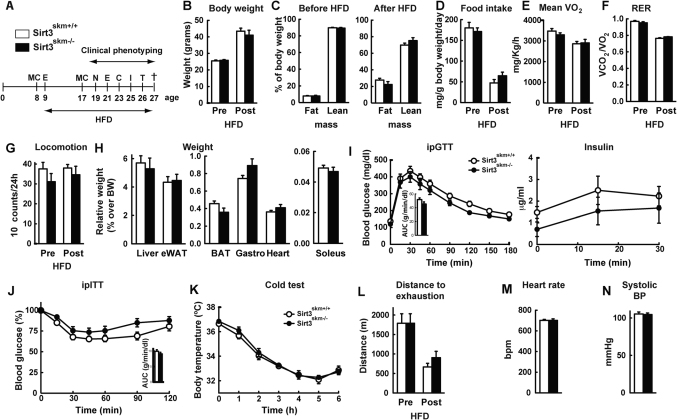
Sirt3 is a mitochondrial sirtuin, predominantly expressed in highly metabolic tissues. Germline ablation of Sirt3 has major metabolic consequences, including increased susceptibility to metabolic damage and oxidative stress after high fat feeding. In order to determine the contribution of liver and skeletal muscle to these phenotypes, we generated muscle-specific Sirt3 (Sirt3(skm-/-)) and liver-specific Sirt3 (Sirt3(hep-/-)) knock-out mice. Despite a marked global hyperacetylation of mitochondrial proteins, Sirt3(skm-/-) and Sirt3(hep-/-) mice did not manifest any overt metabolic phenotype under either chow or high fat diet conditions. Similarly, there was no evidence for increased oxidative stress in muscle or liver when Sirt3 was ablated in a tissue-specific manner. These observations suggest that the mitochondrial hyperacetylation induced by Sirt3-deletion in a tissue specific manner is not necessarily linked to mitochondrial dysfunction and does not recapitulate the metabolic abnormalities observed in the germline Sirt3 knock-out mice.
Sirt3 是一种线粒体中的去乙酰化酶,主要在高代谢组织中表达。Sirt3 基因敲除的种系具有重大的代谢后果,包括在高脂肪喂养后增加对代谢损伤和氧化应激的易感性。为了确定肝脏和骨骼肌对这些表型的贡献,我们生成了肌肉特异性 Sirt3(Sirt3(skm-/-))和肝脏特异性 Sirt3(Sirt3(hep-/-))敲除小鼠。尽管线粒体蛋白的整体乙酰化程度显著增加,但 Sirt3(skm-/-)和 Sirt3(hep-/-)小鼠在正常饮食或高脂肪饮食条件下均未表现出任何明显的代谢表型。同样,当 Sirt3 以组织特异性方式被剔除时,肌肉或肝脏中也没有证据表明氧化应激增加。这些观察结果表明,Sirt3 缺失在组织特异性方式下诱导的线粒体过度乙酰化不一定与线粒体功能障碍有关,也不能重现种系 Sirt3 敲除小鼠中观察到的代谢异常。