CERIM, Research Department, Lille, CEDEX, France.
BMC Nephrol. 2012 May 30;13:31. doi: 10.1186/1471-2369-13-31.
In survival analysis, patients on peritoneal dialysis are confronted with three different outcomes: transfer to hemodialysis, renal transplantation, or death. The Kaplan-Meier method takes into account one event only, so whether it adequately considers these different risks is questionable. The more recent competing risks method has been shown to be more appropriate in analyzing such situations.
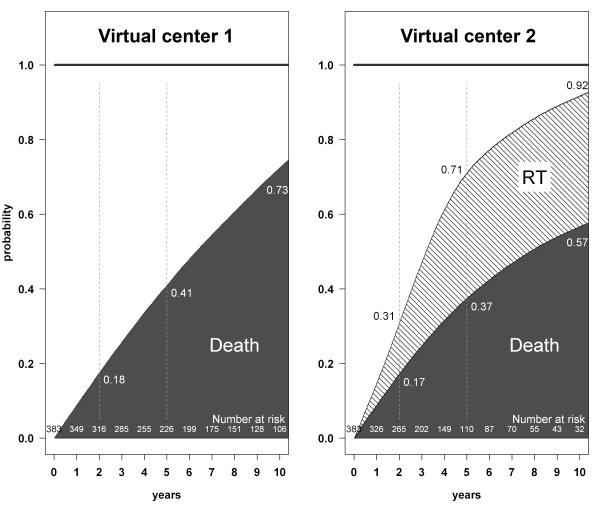
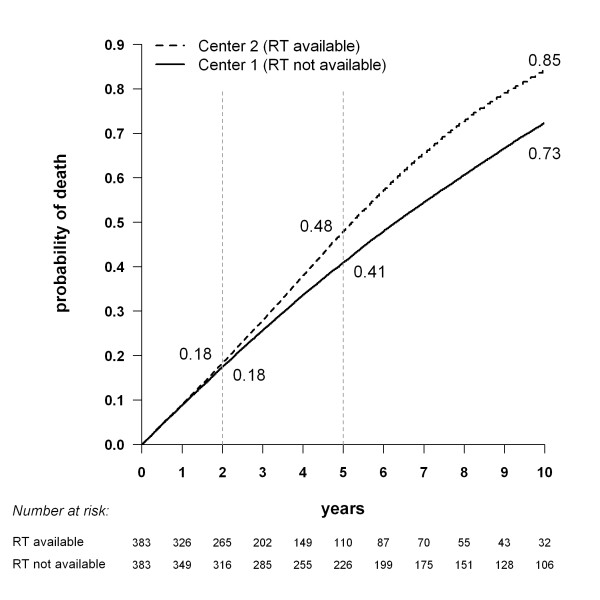
We compared the estimations obtained by the Kaplan-Meier method and the competing risks method (namely the Kalbfleisch and Prentice approach), in 383 consecutive incident peritoneal dialysis patients. By means of simulations, we then compared the Kaplan-Meier estimations obtained in two virtual centers where patients had exactly the same probability of death. The only difference between these two virtual centers was whether renal transplantation was available or not.
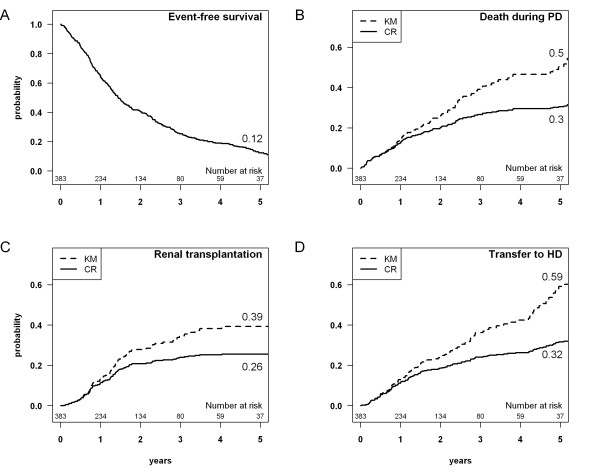
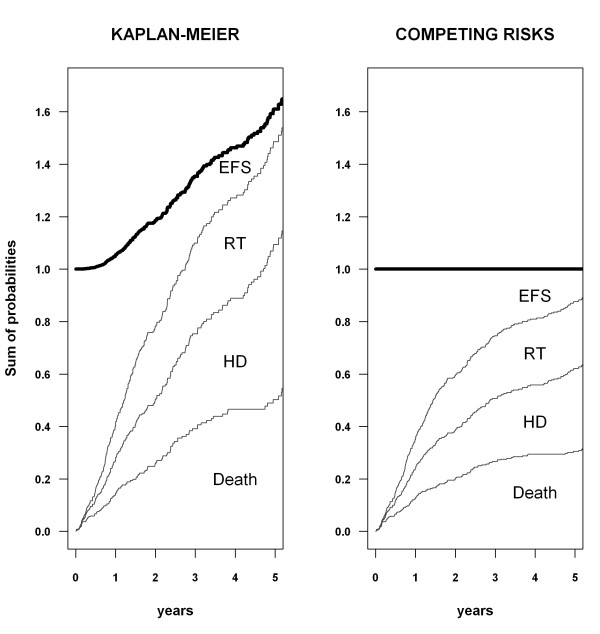
At five years, 107 (27.9%) patients had died, 109 (28.4%) had been transferred to hemodialysis, 91 (23.8%) had been transplanted, and 37 (9.7%) were still alive on peritoneal dialysis; before five years, 39 (10.2%) patients were censored alive on peritoneal dialysis. The five-year probabilities estimated by the Kaplan-Meier and the competing risks methods were respectively: death: 50% versus 30%; transfer to hemodialysis: 59% versus 32%; renal transplantation: 39% versus 26%; event-free survival: 12% versus 12%. The sum of the Kaplan-Meier estimations exceeded 100%, implying that patients could experience more than one event, death and transplantation for example, which is impossible. In the simulations, the probability of death estimated by the Kaplan-Meier method increased as the probability of renal transplantation increased, although the probability of death actually remained constant.
The competing risks method appears more appropriate than the Kaplan-Meier method for estimating the probability of events in peritoneal dialysis in the context of univariable survival analysis.
在生存分析中,腹膜透析患者面临三种不同的结局:转血液透析、肾移植或死亡。Kaplan-Meier 法仅考虑一种事件,因此其是否充分考虑这些不同风险值得怀疑。最近的竞争风险法已被证明在分析这种情况时更为合适。
我们比较了 Kaplan-Meier 法和竞争风险法(即 Kalbfleisch 和 Prentice 方法)在 383 例连续腹膜透析患者中的估计值。然后通过模拟,我们比较了两个虚拟中心的 Kaplan-Meier 估计值,这两个虚拟中心的唯一区别在于肾移植是否可用。
五年时,107 例(27.9%)患者死亡,109 例(28.4%)转血液透析,91 例(23.8%)肾移植,37 例(9.7%)仍在腹膜透析;五年前,39 例(10.2%)患者因腹膜透析存活而被删失。Kaplan-Meier 和竞争风险法估计的五年概率分别为:死亡:50%比 30%;转血液透析:59%比 32%;肾移植:39%比 26%;无事件生存:12%比 12%。Kaplan-Meier 估计值的总和超过 100%,这意味着患者可能经历不止一种事件,例如死亡和移植,这是不可能的。在模拟中,尽管死亡概率实际上保持不变,但 Kaplan-Meier 法估计的死亡概率随着肾移植概率的增加而增加。
在单变量生存分析中,竞争风险法似乎比 Kaplan-Meier 法更适合估计腹膜透析事件的概率。