• 文献检索
  • 文档翻译
  • 深度研究
  • 学术资讯
  • Suppr Zotero 插件Zotero 插件
  • 邀请有礼
  • 套餐&价格
  • 历史记录
应用&插件
Suppr Zotero 插件Zotero 插件浏览器插件Mac 客户端Windows 客户端微信小程序
定价
高级版会员购买积分包购买API积分包
服务
文献检索文档翻译深度研究API 文档MCP 服务
关于我们
关于 Suppr公司介绍联系我们用户协议隐私条款
关注我们

Suppr 超能文献

核心技术专利:CN118964589B侵权必究
粤ICP备2023148730 号-1Suppr @ 2026

文献检索

告别复杂PubMed语法,用中文像聊天一样搜索,搜遍4000万医学文献。AI智能推荐,让科研检索更轻松。

立即免费搜索

文件翻译

保留排版,准确专业,支持PDF/Word/PPT等文件格式,支持 12+语言互译。

免费翻译文档

深度研究

AI帮你快速写综述,25分钟生成高质量综述,智能提取关键信息,辅助科研写作。

立即免费体验

父母养育方式和偏差同伴对青少年早期到中期行为问题的影响。

Effects of parenting and deviant peers on early to mid-adolescent conduct problems.

机构信息

Partnerships in Prevention Science Institute, Iowa State University, 2625 North Loop Drive, Suite 2400, Ames, IA 50010, USA.

出版信息

J Abnorm Child Psychol. 2012 Nov;40(8):1249-64. doi: 10.1007/s10802-012-9648-1.

DOI:10.1007/s10802-012-9648-1
PMID:22648200
原文链接:https://pmc.ncbi.nlm.nih.gov/articles/PMC3740509/
Abstract

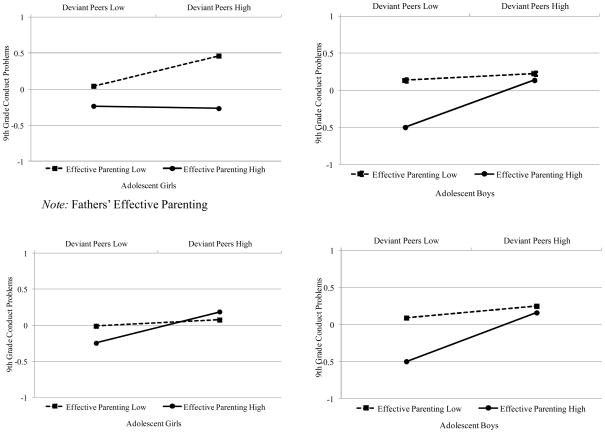
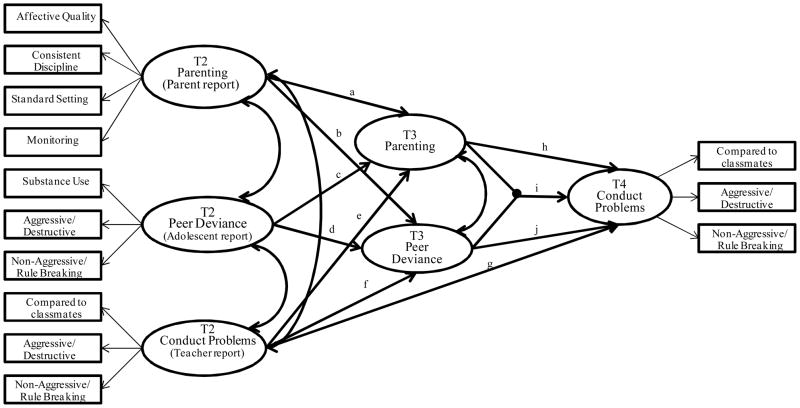
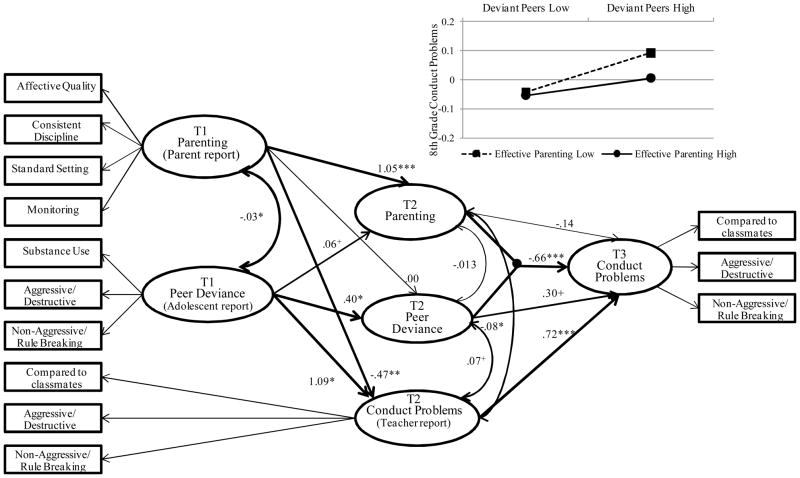
We investigated the influence of effective parenting behaviors (father and mother reports) and deviant peer association (adolescent reports) on subsequent young adolescent conduct problems (teacher reports) during grades 7-9, using structural equation modeling. Data were from a sample of 226 rural adolescents (n = 112 boys; n = 107 girls; n = 7 gender unknown), their parents, and teachers. Both effective parenting and association with deviant peers influenced later conduct problems; however, the pattern of influence varied across time and between fathers and mothers, with complex patterns of interactions between effective parenting and peer deviance. From seventh to eighth grade, effective parenting by both mothers and fathers buffered the effect of higher levels of peer deviance on conduct problems across adolescent gender. From eighth to ninth grade (i.e., transition into high school), fathers' effective parenting buffered the effects of deviant peer association on their daughters' conduct problems, whereas both fathers' and mothers' influence was stronger for sons when deviant peer associations were lower. Analyses also evaluated bi-directional longitudinal effects among adolescents, parents, and peers. Although varying by parent and adolescent gender or adolescent age, results generally supported the protective effects of parenting on their children's conduct problems during early to mid adolescence.

摘要

我们使用结构方程模型研究了有效育儿行为(父母报告)和偏差同伴关系(青少年报告)对 7-9 年级后续青少年行为问题(教师报告)的影响。数据来自 226 名农村青少年(n=112 名男孩;n=107 名女孩;n=7 名性别不详)、他们的父母和老师的样本。有效的育儿和与偏差同伴的关系都影响了后来的行为问题;然而,影响的模式随时间和父母的不同而变化,有效育儿和同伴偏差之间存在复杂的相互作用模式。从七年级到八年级,母亲和父亲的有效育儿都缓冲了较高水平的同伴偏差对青少年性别行为问题的影响。从八年级到九年级(即进入高中),父亲的有效育儿缓冲了偏差同伴关系对其女儿行为问题的影响,而当偏差同伴关系较低时,父亲和母亲的影响对儿子更强。分析还评估了青少年、父母和同伴之间的双向纵向影响。虽然因父母和青少年的性别或青少年的年龄而异,但结果普遍支持父母在青少年早期和中期对孩子行为问题的保护作用。
https://cdn.ncbi.nlm.nih.gov/pmc/blobs/99f5/3740509/4885364a8dfa/nihms503711f3.jpg
https://cdn.ncbi.nlm.nih.gov/pmc/blobs/99f5/3740509/c93ae62c19d3/nihms503711f1.jpg
https://cdn.ncbi.nlm.nih.gov/pmc/blobs/99f5/3740509/4854364403e4/nihms503711f2.jpg
https://cdn.ncbi.nlm.nih.gov/pmc/blobs/99f5/3740509/4885364a8dfa/nihms503711f3.jpg
https://cdn.ncbi.nlm.nih.gov/pmc/blobs/99f5/3740509/c93ae62c19d3/nihms503711f1.jpg
https://cdn.ncbi.nlm.nih.gov/pmc/blobs/99f5/3740509/4854364403e4/nihms503711f2.jpg
https://cdn.ncbi.nlm.nih.gov/pmc/blobs/99f5/3740509/4885364a8dfa/nihms503711f3.jpg

相似文献

1
Effects of parenting and deviant peers on early to mid-adolescent conduct problems.父母养育方式和偏差同伴对青少年早期到中期行为问题的影响。
J Abnorm Child Psychol. 2012 Nov;40(8):1249-64. doi: 10.1007/s10802-012-9648-1.
2
Longitudinal links between fathers' and mothers' harsh verbal discipline and adolescents' conduct problems and depressive symptoms.父亲和母亲的严厉言语管教与青少年行为问题及抑郁症状之间的纵向联系。
Child Dev. 2014 May-Jun;85(3):908-923. doi: 10.1111/cdev.12143. Epub 2013 Sep 3.
3
Influence of Parental Alcohol Dependence Symptoms and Parenting on Adolescent Risky Drinking and Conduct Problems: A Family Systems Perspective.父母酒精依赖症状和教养方式对青少年冒险饮酒和行为问题的影响:家庭系统视角。
Alcohol Clin Exp Res. 2018 Sep;42(9):1783-1794. doi: 10.1111/acer.13827. Epub 2018 Jul 20.
4
Coparenting Conflict Behavior, Parent-Adolescent Attachment, and Social Competence with Peers: An Investigation of Developmental Differences.亲代冲突行为、父母-青少年依恋与同伴社会能力:发展差异的研究
J Youth Adolesc. 2020 Jan;49(1):267-282. doi: 10.1007/s10964-019-01131-x. Epub 2019 Oct 7.
5
Parental academic involvement across adolescence contextualized by gender and parenting practices.青少年时期的父母学业参与情况受性别和教养实践的影响。
Sch Psychol. 2019 Jul;34(4):386-397. doi: 10.1037/spq0000319.
6
Ready to make nice: parental socialization of young sons' and daughters' prosocial behaviors with peers.准备好表现友善:父母对年幼子女与同伴亲社会行为的社会化培养。
J Genet Psychol. 2007 Jun;168(2):177-200. doi: 10.3200/GNTP.168.2.177-200.
7
Contextual risks linking parents' adolescent marijuana use to offspring onset.将父母青少年时期使用大麻与后代发病联系起来的背景风险。
Drug Alcohol Depend. 2015 Sep 1;154:222-8. doi: 10.1016/j.drugalcdep.2015.06.041. Epub 2015 Jul 2.
8
Marital conflict management skills, parenting style, and early-onset conduct problems: processes and pathways.婚姻冲突管理技巧、养育方式与早期出现的行为问题:过程与路径
J Child Psychol Psychiatry. 1999 Sep;40(6):917-27.
9
Family relationships and parental monitoring during middle school as predictors of early adolescent problem behavior.家庭关系和父母监督在中学阶段对青少年早期问题行为的预测作用。
J Clin Child Adolesc Psychol. 2012;41(2):202-13. doi: 10.1080/15374416.2012.651989.
10
Deviant Peers and Adolescent Risky Behaviors: The Protective Effect of Nonverbal Display of Parental Warmth.偏差同伴与青少年风险行为:非言语性父母温暖展示的保护效应。
J Res Adolesc. 2019 Dec;29(4):863-878. doi: 10.1111/jora.12418. Epub 2018 Jun 22.

引用本文的文献

1
Weight status and psychosomatic complaints in Swedish adolescent boys and girls: does family support play a buffering role?瑞典青少年男女生的体重状况和身心失调投诉:家庭支持是否起缓冲作用?
BMC Public Health. 2024 Oct 31;24(1):3024. doi: 10.1186/s12889-024-20517-6.
2
Parental Psychological Aggression and Phubbing in Adolescents: A Moderated Mediation Model.青少年中的父母心理攻击与低头族行为:一个有调节的中介模型。
Psychiatry Investig. 2022 Dec;19(12):1012-1020. doi: 10.30773/pi.2022.0142. Epub 2022 Dec 22.
3
Mapping Pathways by Which Genetic Risk Influences Adolescent Externalizing Behavior: The Interplay Between Externalizing Polygenic Risk Scores, Parental Knowledge, and Peer Substance Use.

本文引用的文献

1
Age-of-onset or behavioral sub-types? A prospective comparison of two approaches to characterizing the heterogeneity within antisocial behavior.发病年龄或行为亚型?两种方法在描述反社会行为异质性方面的前瞻性比较。
J Abnorm Child Psychol. 2011 Jul;39(5):633-44. doi: 10.1007/s10802-011-9491-9.
2
Predicting change in early adolescent problem behavior in the middle school years: a mesosystemic perspective on parenting and peer experiences.预测中学阶段青少年早期问题行为的变化:基于亲代和同伴经验的中系统观点。
J Abnorm Child Psychol. 2010 Nov;38(8):1125-37. doi: 10.1007/s10802-010-9431-0.
3
Friendship Quality, Peer Group Affiliation, and Peer Antisocial Behavior as Moderators of the Link Between Negative Parenting and Adolescent Externalizing Behavior.
遗传风险影响青少年外化行为的途径分析:外化多基因风险评分、父母知识与同伴物质使用的相互作用。
Behav Genet. 2021 Sep;51(5):543-558. doi: 10.1007/s10519-021-10067-7. Epub 2021 Jun 12.
4
Moderators of Friend Selection and Influence in Relation to Adolescent Alcohol Use.青少年饮酒与朋友选择和影响的调节因素。
Prev Sci. 2021 Jul;22(5):567-578. doi: 10.1007/s11121-021-01208-9. Epub 2021 Mar 11.
5
How Should Mothers React When They First Learn About Their Child's Involvement With Deviant Peers? The Adolescents' Perspective.母亲们初次得知孩子与偏差同伴交往时应如何反应?青少年的观点。
J Youth Adolesc. 2021 May;50(5):935-951. doi: 10.1007/s10964-020-01383-y. Epub 2021 Jan 15.
6
Analyzing the Relationship Between Child-to-Parent Violence and Perceived Parental Warmth.分析儿童对父母的暴力行为与感知到的父母温暖之间的关系。
Front Psychol. 2020 Nov 10;11:590097. doi: 10.3389/fpsyg.2020.590097. eCollection 2020.
7
Do peer social relationships mediate the harmful effects of a housing mobility experiment on boys' risky behaviors?同伴社会关系是否在住房流动实验对男孩危险行为的有害影响中起中介作用?
Ann Epidemiol. 2020 Aug;48:36-42.e3. doi: 10.1016/j.annepidem.2020.05.007. Epub 2020 May 27.
8
Developmental Changes in Deviant and Violent Behaviors from Early to Late Adolescence: Associations with Parental Monitoring and Peer Deviance.从青春期早期到晚期异常和暴力行为的发展变化:与父母监督和同伴偏差行为的关联
Psychol Violence. 2018;9(2):196-208. doi: 10.1037/vio0000207. Epub 2018 Sep 27.
9
Parenting, deviant peer affiliation, and externalizing behavior during adolescence: processes conditional on sympathetic nervous system reactivity.养育方式、偏差同伴关系和青少年期的外化行为:交感神经系统反应条件下的过程。
J Child Psychol Psychiatry. 2019 Jul;60(7):793-802. doi: 10.1111/jcpp.13046. Epub 2019 Mar 25.
10
Parental Disengagement in Childhood and Adolescent Male Gun Carrying.父母在儿童期和青少年期对孩子的放任与青少年男性持枪行为。
Pediatrics. 2019 Apr;143(4). doi: 10.1542/peds.2018-1552. Epub 2019 Mar 4.
友谊质量、同伴群体归属以及同伴反社会行为作为消极教养与青少年外化行为之间联系的调节因素
J Res Adolesc. 2003 May 1;13(2):161-184. doi: 10.1111/1532-7795.1302002.
4
Developmental origins of disruptive behaviour problems: the 'original sin' hypothesis, epigenetics and their consequences for prevention.破坏性行为问题的发展起源:“原罪”假说、表观遗传学及其对预防的影响。
J Child Psychol Psychiatry. 2010 Apr;51(4):341-67. doi: 10.1111/j.1469-7610.2010.02211.x. Epub 2010 Feb 8.
5
Developmental trajectories of girls' and boys' delinquency and associated problems.女孩和男孩犯罪及相关问题的发展轨迹。
J Abnorm Child Psychol. 2010 Oct;38(7):1033-44. doi: 10.1007/s10802-010-9389-y.
6
Longitudinal relations among negative affect, substance use, and peer deviance during the transition from middle to late adolescence.从中年到青春期后期的转变过程中,消极情绪、物质使用和同伴偏差之间的纵向关系。
Subst Use Misuse. 2009;44(8):1142-59. doi: 10.1080/10826080802495211.
7
Situational and generalised conduct problems and later life outcomes: evidence from a New Zealand birth cohort.情境性和广泛性行为问题与晚年生活结局:来自新西兰出生队列的证据。
J Child Psychol Psychiatry. 2009 Sep;50(9):1084-92. doi: 10.1111/j.1469-7610.2009.02070.x. Epub 2009 Feb 27.
8
The relationship between parenting and delinquency: a meta-analysis.养育方式与青少年犯罪之间的关系:一项荟萃分析。
J Abnorm Child Psychol. 2009 Aug;37(6):749-75. doi: 10.1007/s10802-009-9310-8.
9
Outcomes of conduct problems in adolescence: 40 year follow-up of national cohort.青少年行为问题的后果:全国队列40年随访
BMJ. 2009 Jan 8;338:a2981. doi: 10.1136/bmj.a2981.
10
A quasi-experimental analysis of the association between family income and offspring conduct problems.家庭收入与子代行为问题之间关联的准实验分析
J Abnorm Child Psychol. 2009 Apr;37(3):415-29. doi: 10.1007/s10802-008-9280-2.