Department of Adult Psychiatry, Tsao-Tun Psychiatric Center and Department of Health, Executive Yuan, Nan-Tou 54249, Taiwan.
Evid Based Complement Alternat Med. 2012;2012:567639. doi: 10.1155/2012/567639. Epub 2012 May 10.
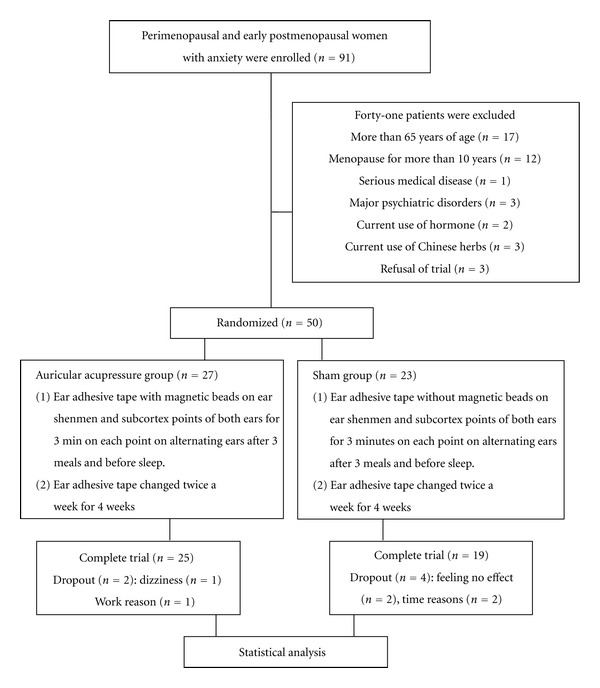
We tested effects of auricular acupressure on peri- and early postmenopausal women with anxiety (PPWA). Fifty PPWA were randomly assigned to the auricular acupressure group (AG) or the sham group (SG). After 3 meals and before sleep every day for 4 weeks, the AG received auricular acupressure on the bilateral ear shenmen and subcortex points for 3 min per point on alternating ears. The SG received sham auricular acupressure. The Alprazolam was reduced from 0.5 mg/day at baseline to 0.3 mg/day 4 weeks after auricular acupressure (4 W) in the AG (P < .05) whereas maintained at 0.5 mg/day in the SG (P > .05). The Zolpidem was reduced from 3.0 mg/day at baseline to 1.5 mg/day at 4 W (P < .05) whereas was reduced from 2.4 mg/day to 1.9 mg/day at 4 W in the SG (P > .05), thus, significant tapering medication, suggesting auricular acupressure is helpful to PPWA.
我们测试了耳压对围绝经期和绝经早期焦虑症(PPWA)女性的影响。50 名 PPWA 被随机分配到耳压组(AG)或假耳压组(SG)。在 4 周内,每天三餐前和睡前,AG 对双侧耳神门和皮质下点进行耳压,每个点按压 3 分钟,交替耳朵。SG 接受假耳压。AG 组在耳压 4 周后(4W)将阿普唑仑从基线时的 0.5mg/天减少到 0.3mg/天(P<.05),而 SG 组仍维持在 0.5mg/天(P>.05)。佐匹克隆从基线时的 3.0mg/天减少到 4W 时的 1.5mg/天(P<.05),而 SG 组从 2.4mg/天减少到 4W 时的 1.9mg/天(P>.05),因此,药物显著减少,表明耳压对 PPWA 有帮助。