Clinical Translational Research Division, The Translational Genomics Research Institute Scottsdale, AZ, USA.
Front Oncol. 2012 Apr 17;2:38. doi: 10.3389/fonc.2012.00038. eCollection 2012.
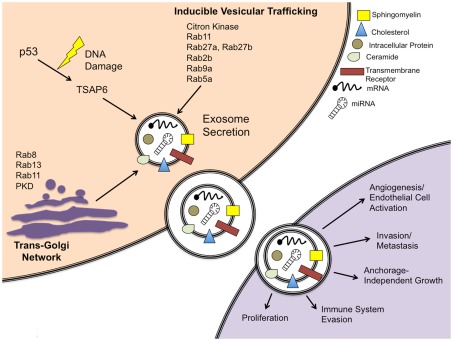
Exosomes are secreted membrane vesicles that have been proposed as an effective means to detect a variety of disease states, including cancer. The properties of exosomes, including stability in biological fluids, allow for their efficient isolation and make them an ideal vehicle for studies on early disease detection and evaluation. Much data has been collected over recent years regarding the messenger RNA, microRNA, and protein contents of exosomes. In addition, many studies have described the functional role that exosomes play in disease initiation and progression. Tumor cells have been shown to secrete exosomes, often in increased amounts compared to normal cells, and these exosomes can carry the genomic and proteomic signatures characteristic of the tumor cells from which they were derived. While these unique signatures make exosomes ideal for cancer detection, exosomes derived from cancer cells have also been shown to play a functional role in cancer progression. Here, we review the unique genomic and proteomic contents of exosomes originating from cancer cells as well as their functional effects to promote tumor progression.
外泌体是一种分泌的膜囊泡,被认为是一种有效的方法来检测各种疾病状态,包括癌症。外泌体的特性,包括在生物流体中的稳定性,允许它们的有效分离,并使它们成为研究早期疾病检测和评估的理想载体。近年来,已经收集了大量关于外泌体信使 RNA、microRNA 和蛋白质含量的数据。此外,许多研究已经描述了外泌体在疾病发生和进展中所起的功能作用。已经表明肿瘤细胞分泌外泌体,通常比正常细胞分泌的量更多,这些外泌体可以携带与其来源的肿瘤细胞特征的基因组和蛋白质组特征。虽然这些独特的特征使外泌体成为癌症检测的理想选择,但已经表明源自癌细胞的外泌体在癌症进展中也发挥了功能作用。在这里,我们回顾了源自癌细胞的外泌体的独特基因组和蛋白质组内容,以及它们促进肿瘤进展的功能效应。