Department of Nuclear Medicine, University Medical Centre Ljubljana, Ljubljana, Slovenia.
Curr Genomics. 2011 Dec;12(8):576-88. doi: 10.2174/138920211798120763.
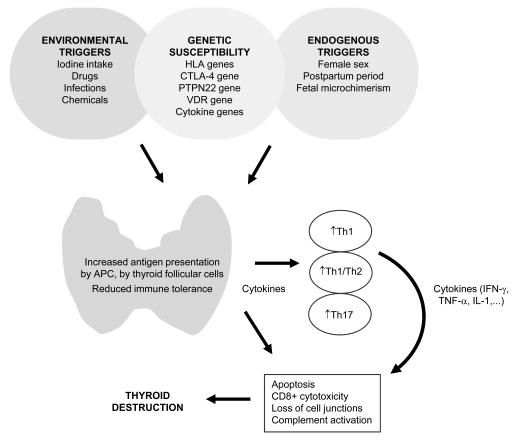
Hashimoto's thyroiditis (HT) is the most prevalent autoimmune thyroid disorder. Intrathyroidal lymphocytic infiltration is followed by a gradual destruction of the thyroid gland which may lead to subclinical or overt hypothyroidism. Biochemical markers of the disease are thyroid peroxidase and/or thyroglobulin autoantibodies in the serum which are present with a higher prevalence in females than in males and increase with age. Although exact mechanisms of aetiology and pathogenesis of the disorder are not completely understood, a strong genetic susceptibility to the disease has been confirmed predominantly by family and twin studies. Several genes were shown to be associated with the disease occurrence, progression, and severity. Genes for human leukocyte antigen, cytotoxic T lymphocyte antigen-4, protein tyrosine phosphatase nonreceptor-type 22, thyroglobulin, vitamin D receptor, and cytokines are considered to be of utmost importance. Amongst endogenous factors for the disease development, the attention is focused predominantly on female sex, pregnancy with postpartum period and fetal microchimerism. Environmental factors influencing HT development are iodine intake, drugs, infections and different chemicals. Disturbed self-tolerance accompanied by the increased antigen presentation is a prerequisite for the HT occurrence, whereas proper interaction of thyroid cells, antigen presenting cells, and T cells are necessary for the initiation of thyroid autoimmunity. Secreted cytokines lead predominantly to T-helper type 1 (Th1) response as well as to Th 17 response which has only recently been implicated. Final outcome of HT is thyroid destruction which is mostly a consequence of the apoptotic processes combined with T-cell mediated cytotoxicity.
桥本甲状腺炎(HT)是最常见的自身免疫性甲状腺疾病。甲状腺内淋巴细胞浸润后,甲状腺逐渐被破坏,导致亚临床或显性甲状腺功能减退。血清中甲状腺过氧化物酶和/或甲状腺球蛋白自身抗体是疾病的生化标志物,其在女性中的患病率高于男性,并随年龄增长而增加。尽管该疾病的病因和发病机制的确切机制尚未完全理解,但主要通过家族和双胞胎研究证实了对该疾病的强烈遗传易感性。已经显示出几种基因与疾病的发生、进展和严重程度有关。人类白细胞抗原、细胞毒性 T 淋巴细胞抗原-4、蛋白酪氨酸磷酸酶非受体型 22、甲状腺球蛋白、维生素 D 受体和细胞因子等基因被认为是最重要的。在疾病发展的内源性因素中,主要关注女性、怀孕和产后以及胎儿微嵌合体。影响 HT 发展的环境因素包括碘摄入、药物、感染和各种化学物质。自身耐受的破坏伴随着抗原呈递的增加是 HT 发生的前提,而甲状腺细胞、抗原呈递细胞和 T 细胞的适当相互作用是甲状腺自身免疫的起始所必需的。分泌的细胞因子主要导致辅助性 T 细胞 1(Th1)反应以及最近才被牵连的 Th17 反应。HT 的最终结果是甲状腺破坏,这主要是细胞凋亡过程与 T 细胞介导的细胞毒性相结合的结果。