Department of Psychology, Neuroscience, and Behaviour, McMaster University, Hamilton ON, Canada.
Front Syst Neurosci. 2012 May 28;6:40. doi: 10.3389/fnsys.2012.00040. eCollection 2012.
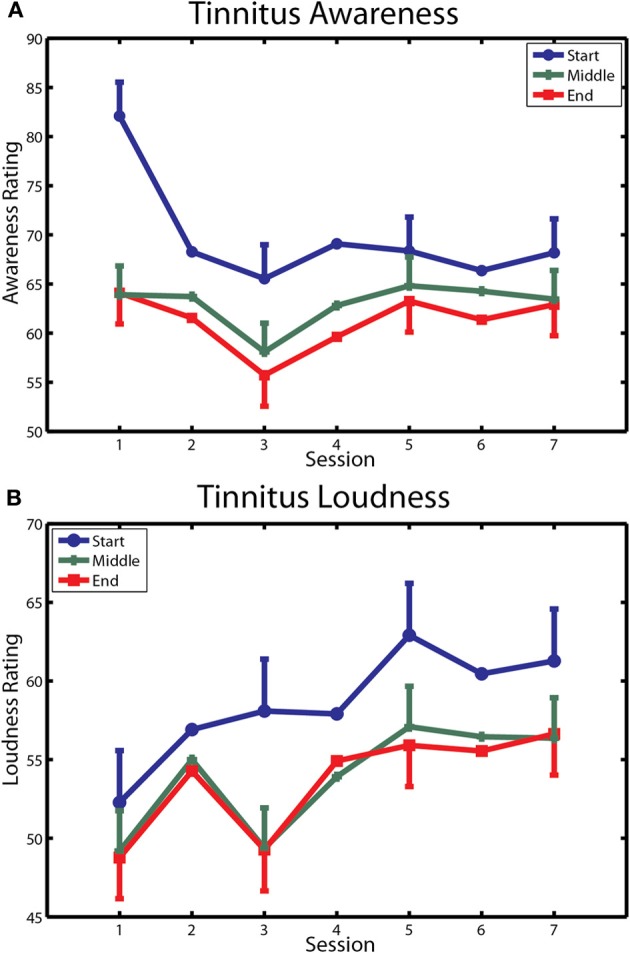
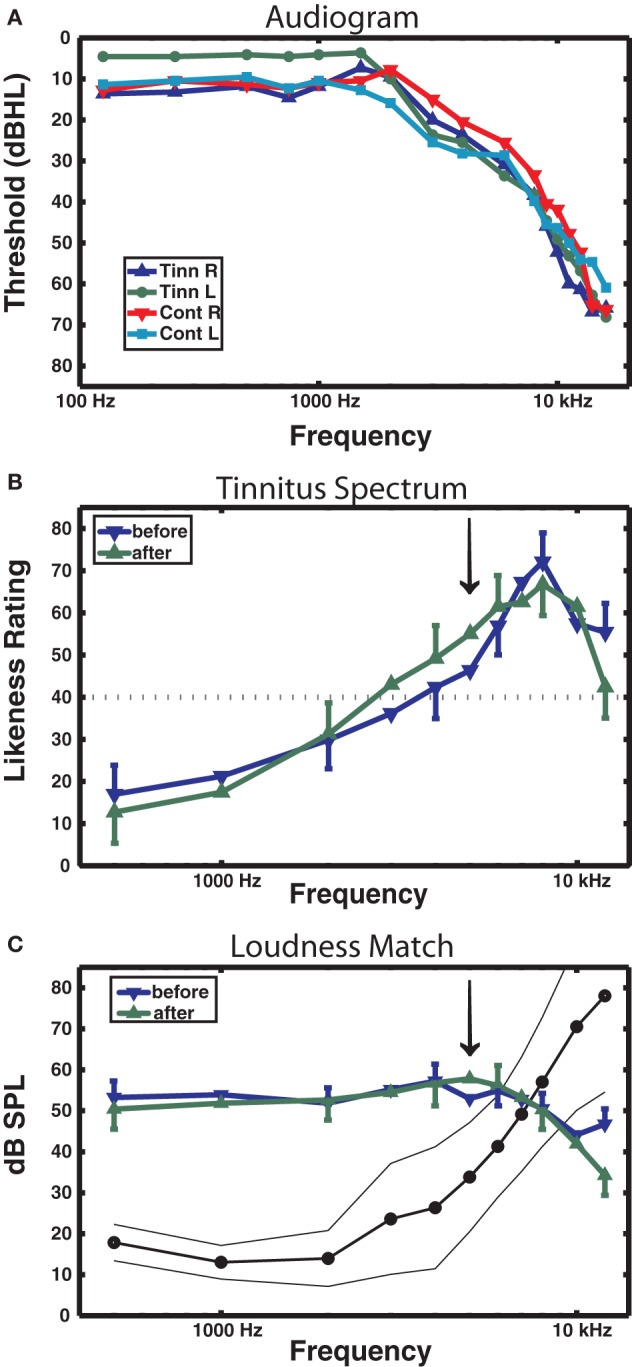
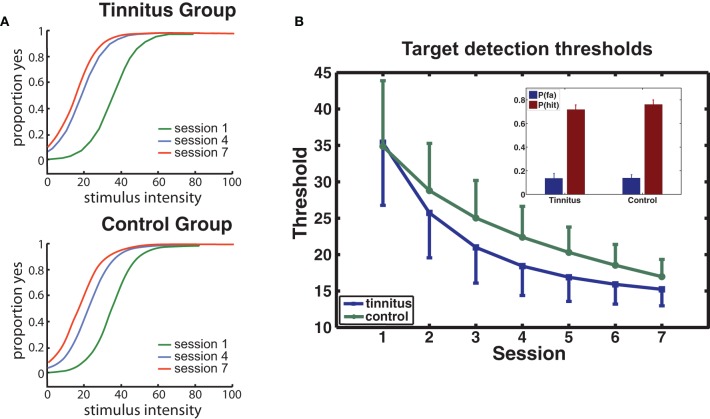
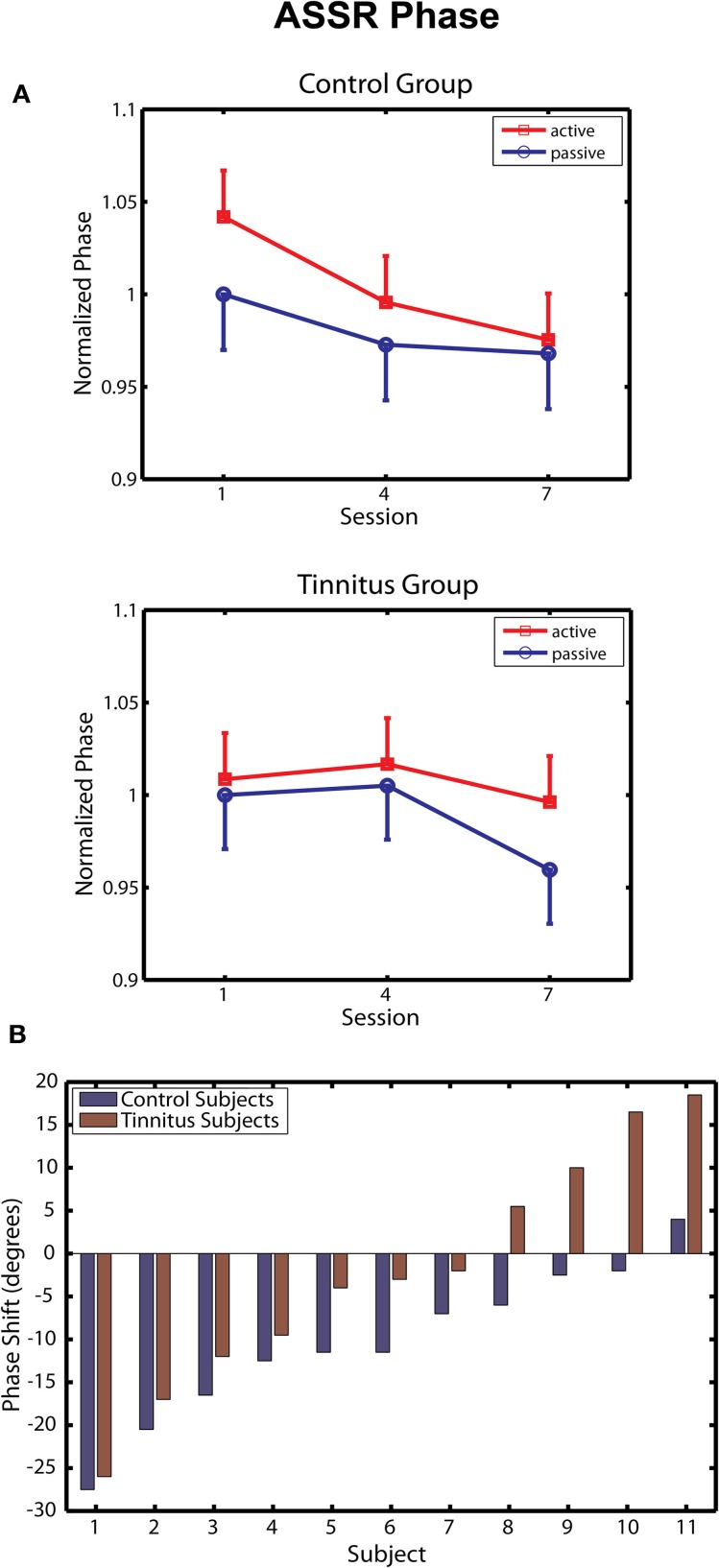
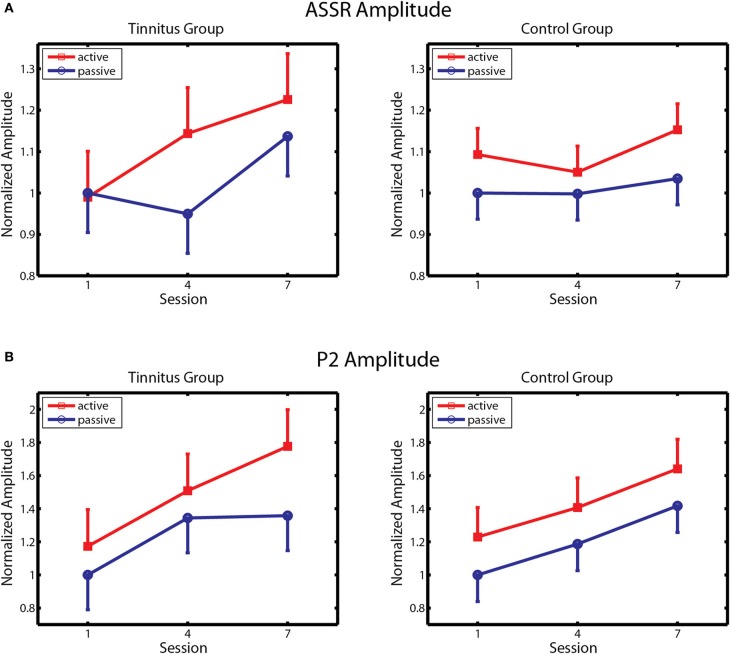
Sensory training therapies for tinnitus are based on the assumption that, notwithstanding neural changes related to tinnitus, auditory training can alter the response properties of neurons in auditory pathways. To assess this assumption, we investigated whether brain changes induced by sensory training in tinnitus sufferers and measured by electroencephalography (EEG) are similar to those induced in age and hearing loss matched individuals without tinnitus trained on the same auditory task. Auditory training was given using a 5 kHz 40-Hz amplitude-modulated (AM) sound that was in the tinnitus frequency region of the tinnitus subjects and enabled extraction of the 40-Hz auditory steady-state response (ASSR) and P2 transient response known to localize to primary and non-primary auditory cortex, respectively. P2 amplitude increased over training sessions equally in participants with tinnitus and in control subjects, suggesting normal remodeling of non-primary auditory regions in tinnitus. However, training-induced changes in the ASSR differed between the tinnitus and control groups. In controls the phase delay between the 40-Hz response and stimulus waveforms reduced by about 10° over training, in agreement with previous results obtained in young normal hearing individuals. However, ASSR phase did not change significantly with training in the tinnitus group, although some participants showed phase shifts resembling controls. On the other hand, ASSR amplitude increased with training in the tinnitus group, whereas in controls this response (which is difficult to remodel in young normal hearing subjects) did not change with training. These results suggest that neural changes related to tinnitus altered how neural plasticity was expressed in the region of primary but not non-primary auditory cortex. Auditory training did not reduce tinnitus loudness although a small effect on the tinnitus spectrum was detected.
耳鸣感觉训练疗法基于这样一种假设,即尽管与耳鸣相关的神经变化存在,但听觉训练可以改变听觉通路中神经元的反应特性。为了评估这一假设,我们研究了通过脑电图(EEG)测量的耳鸣患者的感觉训练引起的大脑变化是否与在没有耳鸣的年龄和听力损失匹配个体中诱导的变化相似,这些个体接受了相同的听觉任务训练。听觉训练使用 5 kHz 40 Hz 幅度调制(AM)声音进行,该声音处于耳鸣受试者的耳鸣频率区域内,能够提取已知分别定位于初级和非初级听觉皮层的 40 Hz 听觉稳态反应(ASSR)和 P2 瞬态反应。P2 振幅在耳鸣和对照组参与者的训练过程中均同等增加,表明耳鸣中非初级听觉区域的正常重塑。然而,ASSR 诱导的变化在耳鸣和对照组之间存在差异。在对照组中,40 Hz 反应与刺激波形之间的相位延迟在训练过程中减少了约 10°,这与在年轻正常听力个体中获得的先前结果一致。然而,在耳鸣组中,ASSR 相位随训练的变化不显著,尽管一些参与者表现出类似于对照组的相位变化。另一方面,ASSR 幅度随耳鸣组的训练而增加,而在对照组中,该反应(在年轻正常听力受试者中难以重塑)随训练而不发生变化。这些结果表明,与耳鸣相关的神经变化改变了初级听觉皮层区域中神经可塑性的表达方式。尽管检测到对耳鸣频谱的微小影响,但听觉训练并未降低耳鸣响度。