Key laboratory of Molecular Epigenetics of MOE, Northeast Normal University, Changchun, Jilin Province, China.
PLoS One. 2012;7(5):e37817. doi: 10.1371/journal.pone.0037817. Epub 2012 May 24.
Alkali stress is an important agricultural contaminant and has complex effects on plant metabolism. The aim of this study was to investigate whether the alkali stress has different effects on the growth, ion balance, and nitrogen metabolism in old and young leaves of rice plants, and to compare functions of both organs in alkali tolerance.
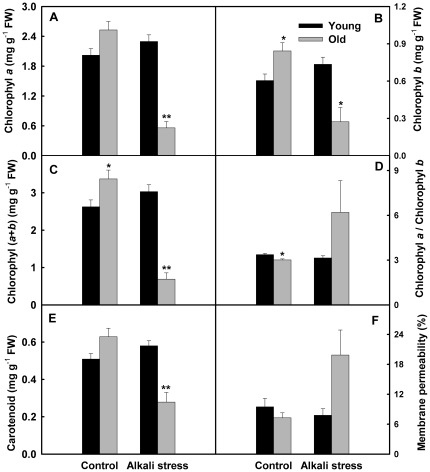
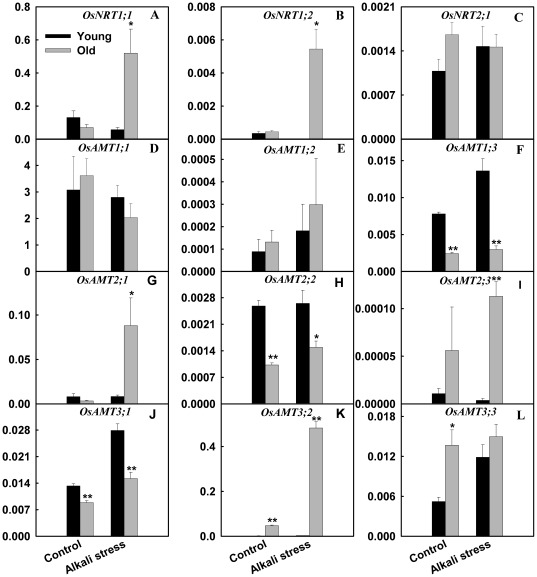
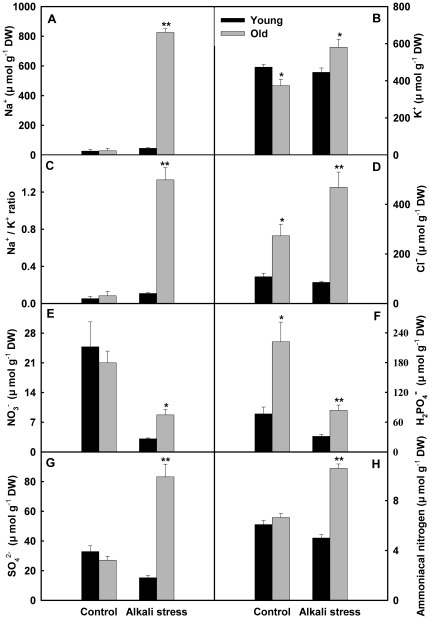
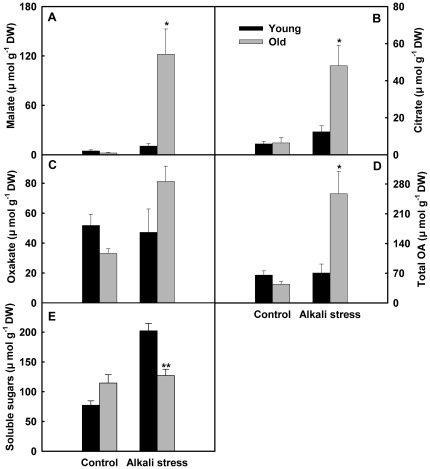
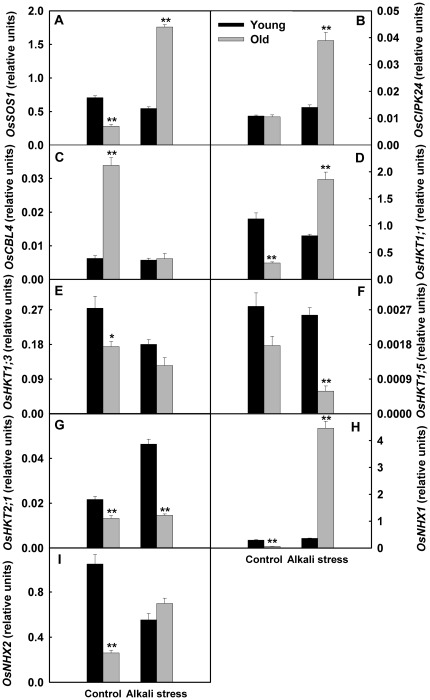
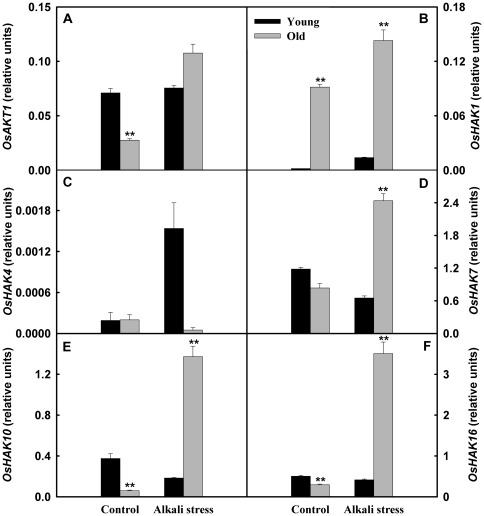
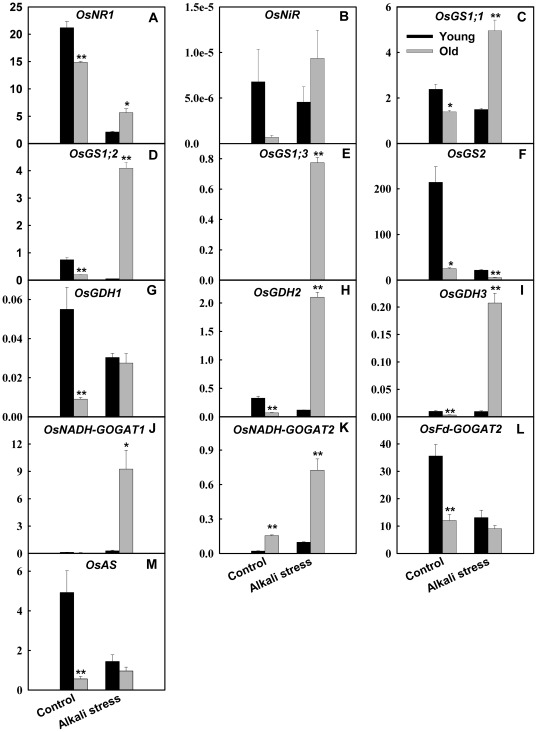
METHODOLOGY/PRINCIPAL FINDINGS: The results showed that alkali stress only produced a small effect on the growth of young leaves, whereas strongly damaged old leaves. Rice protected young leaves from ion harm via the large accumulation of Na(+) and Cl(-) in old leaves. The up-regulation of OsHKT1;1, OsAKT1, OsHAK1, OsHAK7, OsHAK10 and OsHAK16 may contribute to the larger accumulation of Na(+) in old leaves under alkali stress. Alkali stress mightily reduced the NO(3)(-) contents in both organs. As old leaf cells have larger vacuole, under alkali stress these scarce NO(3)(-) was principally stored in old leaves. Accordingly, the expression of OsNRT1;1 and OsNRT1;2 in old leaves was up-regulated by alkali stress, revealing that the two genes might contribute to the accumulation of NO(3)(-) in old leaves. NO(3)(-) deficiency in young leaves under alkali stress might induce the reduction in OsNR1 expression and the subsequent lacking of NH(4)(+), which might be main reason for the larger down-regulation of OsFd-GOGAT and OsGS2 in young leaves.
CONCLUSIONS/SIGNIFICANCE: Our results strongly indicated that, during adaptation of rice to alkali stress, young and old leaves have distinct mechanisms of ion balance and nitrogen metabolism regulation. We propose that the comparative studies of young and old tissues may be important for abiotic stress tolerance research.
碱胁迫是一种重要的农业污染物,对植物代谢有复杂的影响。本研究旨在探讨碱胁迫对水稻植株老叶和嫩叶生长、离子平衡和氮代谢的影响是否不同,并比较两个器官在耐碱方面的功能。
方法/主要发现:结果表明,碱胁迫对嫩叶生长只有很小的影响,而对老叶则有严重的损害。水稻通过在老叶中大量积累 Na(+)和 Cl(-)来保护嫩叶免受离子伤害。OsHKT1;1、OsAKT1、OsHAK1、OsHAK7、OsHAK10 和 OsHAK16 的上调可能有助于在碱胁迫下老叶中 Na(+)的大量积累。碱胁迫强烈降低了两个器官中的 NO(3)(-)含量。由于老叶细胞具有较大的液泡,在碱胁迫下这些稀少的 NO(3)(-)主要储存在老叶中。因此,OsNRT1;1 和 OsNRT1;2 在老叶中的表达受碱胁迫上调,表明这两个基因可能有助于老叶中 NO(3)(-)的积累。碱胁迫下嫩叶中 NO(3)(-)的缺乏可能导致 OsNR1 表达减少,随后 NH(4)(+)缺乏,这可能是 OsFd-GOGAT 和 OsGS2 在嫩叶中更大下调的主要原因。
结论/意义:我们的研究结果强烈表明,在水稻适应碱胁迫的过程中,嫩叶和老叶具有不同的离子平衡和氮代谢调节机制。我们提出,对幼叶和老叶组织的比较研究可能对非生物胁迫耐受研究很重要。