Department of Nutritional Medicine, University of Hohenheim, Stuttgart, Germany.
Nutr J. 2012 Jun 1;11:34. doi: 10.1186/1475-2891-11-34.
The prevalence of micronutrient deficiencies is higher in obese individuals compared to normal-weight people, probably because of inadequate eating habits but also due to increased demands among overweight persons, which are underestimated by dietary reference intakes (DRI) intended for the general population. We therefore evaluated the dietary micronutrient intake in obese individuals compared to a reference population and DRI recommendations. Furthermore, we determined the micronutrient status in obese subjects undergoing a standardized DRI-covering low-calorie formula diet to analyze if the DRI meet the micronutrient requirements of obese individuals.
In 104 subjects baseline micronutrient intake was determined by dietary record collection. A randomly assigned subgroup of subjects (n = 32) underwent a standardized DRI-covering low-calorie formula diet over a period of three months. Pre- and post-interventional intracellular micronutrient status in buccal mucosa cells (BMC) was analyzed, as well as additional micronutrient serum concentrations in 14 of the subjects.
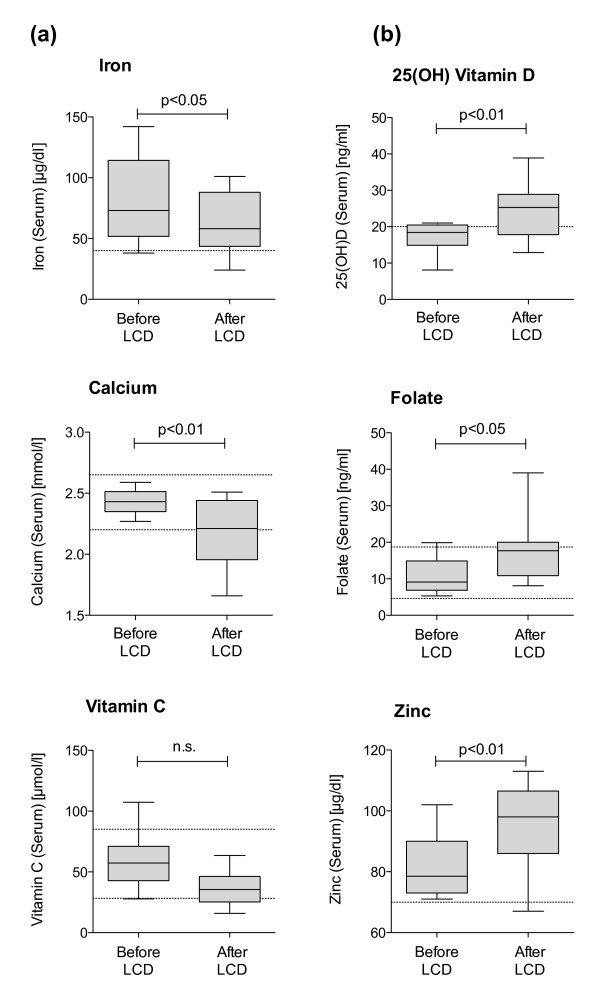
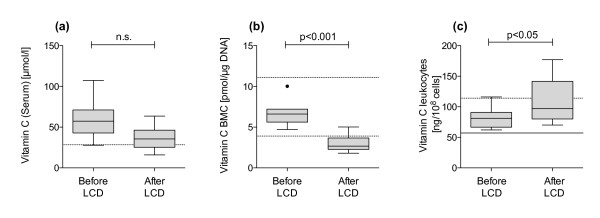
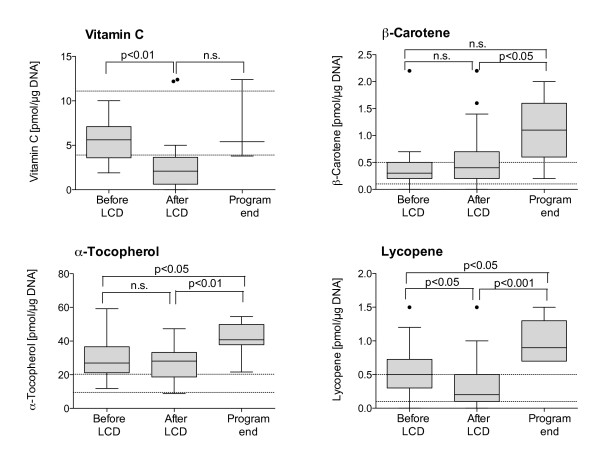
Prior to dietetic intervention, nutrition was calorie-rich and micronutrient-poor. Baseline deficiencies in serum concentrations were observed for 25-hydroxyvitamin-D, vitamin C, selenium, iron, as well as ß-carotene, vitamin C, and lycopene in BMC. After a three-month period of formula diet even more subjects had reduced micronutrient levels of vitamin C (serum, BMC), zinc, and lycopene. There was a significant negative correlation between lipophilic serum vitamin concentrations and body fat, as well as between iron and C-reactive protein.
The present pilot study shows that micronutrient deficiency occurring in obese individuals is not corrected by protein-rich formula diet containing vitamins and minerals according to DRI. In contrast, micronutrient levels remain low or become even lower, which might be explained by insufficient intake, increased demand and unbalanced dispersal of lipophilic compounds in the body.
The study was registered at ClinicalTrials.gov (NCT01344525). The study protocol comprises only a part of the approved trial protocol.
与正常体重人群相比,肥胖人群微量营养素缺乏的发生率更高,这可能是由于饮食习惯不当,但也可能是超重人群的需求增加所致,而这些需求被针对普通人群的膳食参考摄入量(DRI)低估了。因此,我们评估了肥胖人群与参考人群和 DRI 推荐摄入量相比的膳食微量营养素摄入量。此外,我们还测定了接受标准化 DRI 覆盖的低热量配方饮食的肥胖受试者的微量营养素状态,以分析 DRI 是否满足肥胖人群的微量营养素需求。
在 104 名受试者中,通过饮食记录收集基线微量营养素摄入量。随机分配的受试者亚组(n = 32)接受了为期三个月的标准化 DRI 覆盖的低热量配方饮食。在干预前和干预后分析颊黏膜细胞(BMC)中的细胞内微量营养素状态,并在 14 名受试者中分析了额外的微量营养素血清浓度。
在进行饮食干预之前,营养是高热量、低微量营养素的。在基线时,血清 25-羟维生素 D、维生素 C、硒、铁以及 BMC 中的β-胡萝卜素、维生素 C 和番茄红素的浓度均存在不足。在接受三个月的配方饮食后,更多的受试者的维生素 C(血清、BMC)、锌和番茄红素的水平降低。亲脂性血清维生素浓度与体脂呈显著负相关,铁与 C 反应蛋白也呈显著负相关。
本初步研究表明,富含蛋白质的维生素和矿物质的 DRI 配方饮食并不能纠正肥胖人群中存在的微量营养素缺乏。相反,微量营养素水平仍然较低或甚至更低,这可能是由于摄入不足、需求增加以及脂溶性化合物在体内分布不均所致。
该研究在 ClinicalTrials.gov(NCT01344525)注册。研究方案仅包含已批准试验方案的一部分。