School of Natural Sciences, University of Queretaro, Queretaro, Mexico.
Nutr J. 2012 Jun 18;11:44. doi: 10.1186/1475-2891-11-44.
Obesity is a major public health problem in many poor countries where micronutrient deficiencies are prevalent. A partial meal replacement may be an effective strategy to decrease obesity and increase micronutrient intake in such populations. The objective was to evaluate the efficacy of a partial meal replacement with and without inulin on weight reduction, blood lipids and micronutrients intake in obese Mexican women.
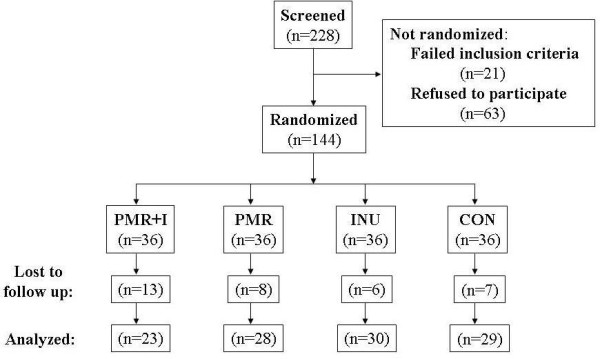
In a randomized controlled clinical trial 144 women (18-50 y) with BMI ≥ 25 kg/m², were allocated into one of the following treatments during 3 months: 1) Two doses/d of a partial meal replacement (PMR), 2) Two doses/d of PMR with inulin (PMR + I) , 3) Two doses/d of 5 g of inulin (INU) and 4) Control group (CON). All groups received a low calorie diet (LCD). Weight, height, hip and waist circumference were measured every 2 weeks and body composition, lipids and glucose concentration and nutrient intake were assessed at baseline and after 3 months.
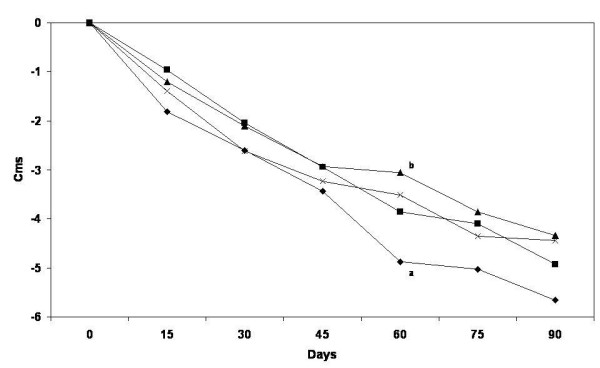
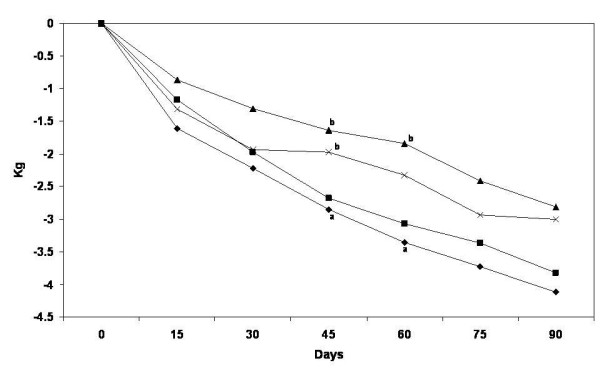
All groups significantly reduced weight, BMI, waist and hip circumference. Differences between groups were only observed in BMI and weight adjusted changes: At 45 days PMR group lost more weight than INU and CON groups by 0.9 and 1.2Kg, respectively. At 60 days, PMR + I and PMR groups lost more weight than in INU by 0.7 and 1Kg, respectively. Subjects in PMR, PMR + I and INU significantly decreased triglycerides. Energy intake was reduced in all groups. Fiber intake increased in PMR + I and INU groups. Some minerals and vitamins intakes were higher in PMR and PMR + I compared with INU and CON groups.
Inclusion of PMR with and without inulin to a LCD had no additional effect on weight reduction than a LCD alone but reduced triglycerides and improved intake of micronutrients during caloric restriction. PMR could be a good alternative for obese populations with micronutrient deficiencies.
肥胖是许多贫穷国家的一个主要公共卫生问题,这些国家普遍存在微量营养素缺乏症。部分代餐可能是减少肥胖和增加此类人群微量营养素摄入的有效策略。本研究旨在评估含有或不含有菊粉的部分代餐对肥胖墨西哥女性体重减轻、血脂和微量营养素摄入的影响。
在一项随机对照临床试验中,将 144 名 BMI≥25kg/m²的肥胖女性(18-50 岁)随机分配到以下治疗组之一,持续 3 个月:1)部分代餐(PMR)每日两次;2)PMR 每日两次+菊粉(PMR+I);3)菊粉每日两次(5g);4)对照组(CON)。所有组均接受低热量饮食(LCD)。每两周测量一次体重、身高、臀围和腰围,在基线和 3 个月后评估身体成分、血脂和血糖浓度以及营养素摄入。
所有组的体重、BMI、腰围和臀围均显著降低。组间差异仅在 BMI 和体重调整变化中观察到:45 天时,PMR 组比 INU 组和 CON 组分别多减重 0.9 和 1.2kg;60 天时,PMR+I 组和 PMR 组比 INU 组分别多减重 0.7 和 1kg。PMR、PMR+I 和 INU 组的甘油三酯显著降低。所有组的能量摄入均减少。PMR+I 和 INU 组的膳食纤维摄入量增加。与 INU 组和 CON 组相比,PMR 和 PMR+I 组的一些矿物质和维生素摄入较高。
与单独的 LCD 相比,在 LCD 中添加 PMR 或 PMR+I 对体重减轻没有额外的影响,但可以减少热量限制期间的甘油三酯并改善微量营养素的摄入。PMR 可能是微量营养素缺乏的肥胖人群的良好选择。