California State University San Marcos, USA.
Addict Behav. 2012 Oct;37(10):1167-70. doi: 10.1016/j.addbeh.2012.05.002. Epub 2012 May 22.
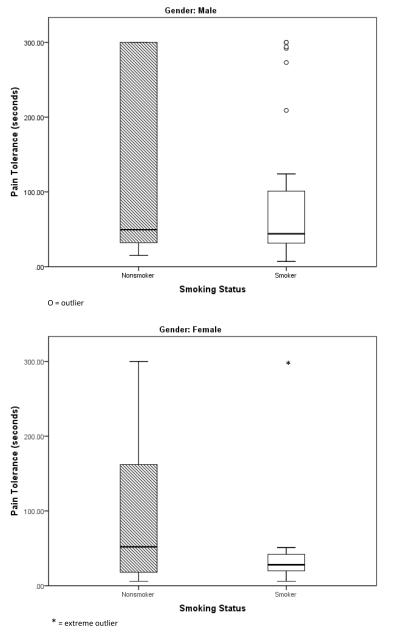
Numerous studies have established a link between distress tolerance and smoking cessation outcomes. The present study examined whether smoking status affected physical distress tolerance, and considered this question separately for men and women. The sample was comprised of healthy adults, 56 smokers (63% male) and 58 nonsmokers (62% female). The pain stimulus was a cold pressor task. Outcome variables were seconds immersed in cold water when pain was first reported (threshold), and total seconds immersed in cold water (tolerance). Participants verbally reported their pain rating on a 0-100 scale after the task, and then completed the McGill Pain Questionnaire-Short Form. Smokers displayed lower pain tolerance than nonsmokers (p=.045), and women displayed lower pain tolerance than men (p=.017). Female smokers had significantly lower pain tolerance than other groups (p=.001). There were no significant differences in pain threshold or pain perception by smoking status or gender (p>.05). Lower physical distress tolerance could place female smokers at risk for difficulty in quitting smoking. This population needs additional research to better understand their unique pain experience and how physical distress tolerance impacts their smoking cessation outcomes.
许多研究已经证实了痛苦耐受力与戒烟效果之间的联系。本研究检验了吸烟状况是否会影响身体痛苦耐受力,并分别考虑了男性和女性的情况。样本由健康成年人组成,包括 56 名吸烟者(63%为男性)和 58 名不吸烟者(62%为女性)。疼痛刺激是冷加压任务。因变量是首次报告疼痛时浸入冷水中的秒数(阈值),以及浸入冷水中的总秒数(耐受)。参与者在任务结束后用 0-100 分制的量表报告他们的疼痛评分,然后完成 McGill 疼痛问卷-短表。吸烟者的疼痛耐受力低于不吸烟者(p=.045),女性的疼痛耐受力低于男性(p=.017)。女性吸烟者的疼痛耐受力明显低于其他组(p=.001)。吸烟状况或性别对疼痛阈值或疼痛感知没有显著差异(p>.05)。较低的身体痛苦耐受力可能使女性吸烟者戒烟困难。这一人群需要进一步的研究,以更好地了解他们独特的疼痛体验以及身体痛苦耐受力如何影响他们的戒烟效果。