Karmiloff-Smith Annette, Broadbent Hannah, Farran Emily K, Longhi Elena, D'Souza Dean, Metcalfe Kay, Tassabehji May, Wu Rachel, Senju Atsushi, Happé Francesca, Turnpenny Peter, Sansbury Francis
Birkbeck Centre for Brain and Cognitive Development, University of London London, UK.
Front Psychol. 2012 May 30;3:168. doi: 10.3389/fpsyg.2012.00168. eCollection 2012.
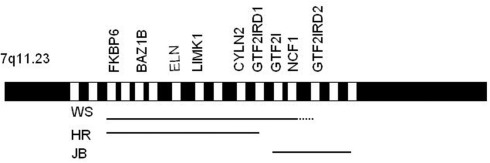
Identifying genotype/phenotype relations in human social cognition has been enhanced by the study of Williams syndrome (WS). Indeed, individuals with WS present with a particularly strong social drive, and researchers have sought to link deleted genes in the WS critical region (WSCR) of chromosome 7q11.23 to this unusual social profile. In this paper, we provide details of two case studies of children with partial genetic deletions in the WSCR: an 11-year-old female with a deletion of 24 of the 28 WS genes, and a 14-year-old male who presents with the opposite profile, i.e., the deletion of only four genes at the telomeric end of the WSCR. We tested these two children on a large battery of standardized and experimental social perception and social cognition tasks - both implicit and explicit - as well as standardized social questionnaires and general psychometric measures. Our findings reveal a partial WS socio-cognitive profile in the female, contrasted with a more autistic-like profile in the male. We discuss the implications of these findings for genotype/phenotype relations, as well as the advantages and limitations of animal models and of case study approaches.
威廉姆斯综合征(WS)的研究增进了我们对人类社会认知中基因型/表型关系的理解。事实上,患有WS的个体表现出特别强烈的社交驱动力,研究人员一直试图将7号染色体q11.23区域的威廉姆斯综合征关键区域(WSCR)中的缺失基因与这种不寻常的社交特征联系起来。在本文中,我们详细介绍了两个在WSCR中存在部分基因缺失的儿童的案例研究:一名11岁女性,其28个WS基因中有24个缺失;一名14岁男性,其表现出相反的特征,即在WSCR的端粒末端仅缺失四个基因。我们用大量标准化和实验性的社会感知与社会认知任务(包括内隐和外显任务)以及标准化社会问卷和一般心理测量方法对这两个孩子进行了测试。我们的研究结果显示,女性呈现出部分WS社会认知特征,而男性则呈现出更类似自闭症的特征。我们讨论了这些发现对基因型/表型关系的影响,以及动物模型和案例研究方法的优缺点。