Department of Ophthalmology, Erasmus Medical Center, 3000 CA Rotterdam, The Netherlands.
Hum Genet. 2012 Sep;131(9):1467-80. doi: 10.1007/s00439-012-1176-0. Epub 2012 Jun 5.
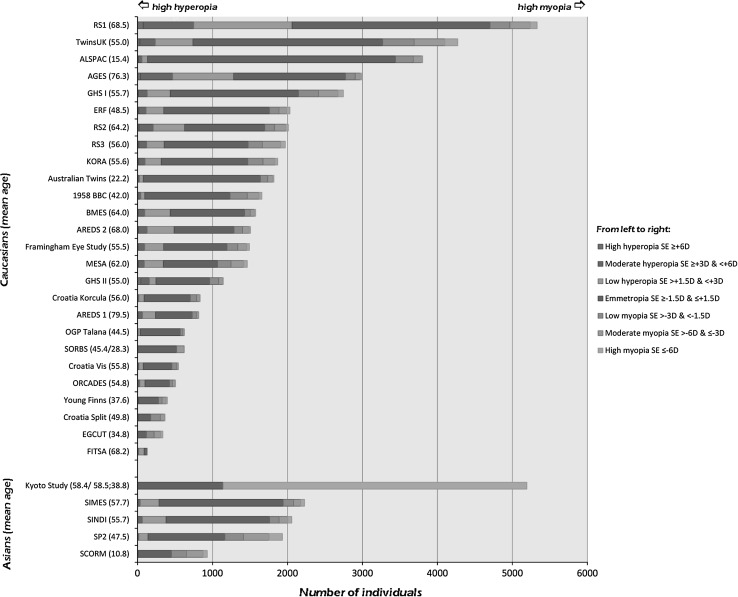
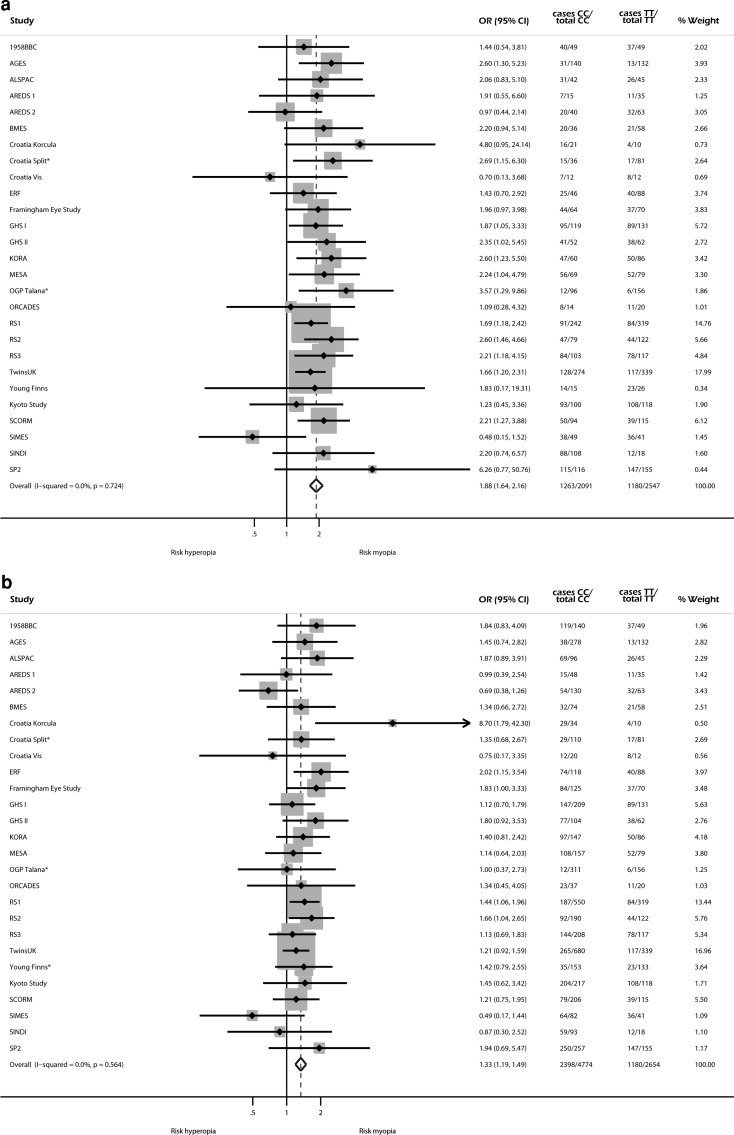
Myopia is a complex genetic disorder and a common cause of visual impairment among working age adults. Genome-wide association studies have identified susceptibility loci on chromosomes 15q14 and 15q25 in Caucasian populations of European ancestry. Here, we present a confirmation and meta-analysis study in which we assessed whether these two loci are also associated with myopia in other populations. The study population comprised 31 cohorts from the Consortium of Refractive Error and Myopia (CREAM) representing 4 different continents with 55,177 individuals; 42,845 Caucasians and 12,332 Asians. We performed a meta-analysis of 14 single nucleotide polymorphisms (SNPs) on 15q14 and 5 SNPs on 15q25 using linear regression analysis with spherical equivalent as a quantitative outcome, adjusted for age and sex. We calculated the odds ratio (OR) of myopia versus hyperopia for carriers of the top-SNP alleles using a fixed effects meta-analysis. At locus 15q14, all SNPs were significantly replicated, with the lowest P value 3.87 × 10(-12) for SNP rs634990 in Caucasians, and 9.65 × 10(-4) for rs8032019 in Asians. The overall meta-analysis provided P value 9.20 × 10(-23) for the top SNP rs634990. The risk of myopia versus hyperopia was OR 1.88 (95 % CI 1.64, 2.16, P < 0.001) for homozygous carriers of the risk allele at the top SNP rs634990, and OR 1.33 (95 % CI 1.19, 1.49, P < 0.001) for heterozygous carriers. SNPs at locus 15q25 did not replicate significantly (P value 5.81 × 10(-2) for top SNP rs939661). We conclude that common variants at chromosome 15q14 influence susceptibility for myopia in Caucasian and Asian populations world-wide.
近视是一种复杂的遗传疾病,也是工作年龄段成年人视力损害的常见原因。全基因组关联研究已经确定了欧洲血统白种人群体中染色体 15q14 和 15q25 上的易感位点。在这里,我们进行了一项确认和荟萃分析研究,评估这两个位点是否也与其他人群的近视有关。研究人群包括来自屈光不正和近视联合会(CREAM)的 31 个队列,代表了 4 个不同的大陆,共有 55177 人;42845 名白种人和 12332 名亚洲人。我们使用线性回归分析对 15q14 上的 14 个单核苷酸多态性(SNP)和 15q25 上的 5 个 SNP 进行荟萃分析,将等效球镜作为定量结果进行调整,同时调整年龄和性别。我们使用固定效应荟萃分析计算了携带最高 SNP 等位基因的近视与远视的比值比(OR)。在 15q14 位点,所有 SNP 均得到显著复制,白种人中最低的 P 值为 rs634990 为 3.87×10(-12),亚洲人中为 rs8032019 的 9.65×10(-4)。总体荟萃分析为最高 SNP rs634990 提供了 9.20×10(-23)的 P 值。与远视相比,携带最高 SNP rs634990 风险等位基因的纯合子携带者的近视风险 OR 为 1.88(95%CI 1.64,2.16,P<0.001),杂合子携带者的 OR 为 1.33(95%CI 1.19,1.49,P<0.001)。15q25 位点的 SNP 未得到显著复制(最高 SNP rs939661 的 P 值为 5.81×10(-2))。我们的结论是,染色体 15q14 上的常见变异影响了全球白种人和亚洲人群的近视易感性。