Department of Ophthalmology, Erasmus Medical Center, Rotterdam, The Netherlands.
Nat Genet. 2010 Oct;42(10):897-901. doi: 10.1038/ng.663. Epub 2010 Sep 12.
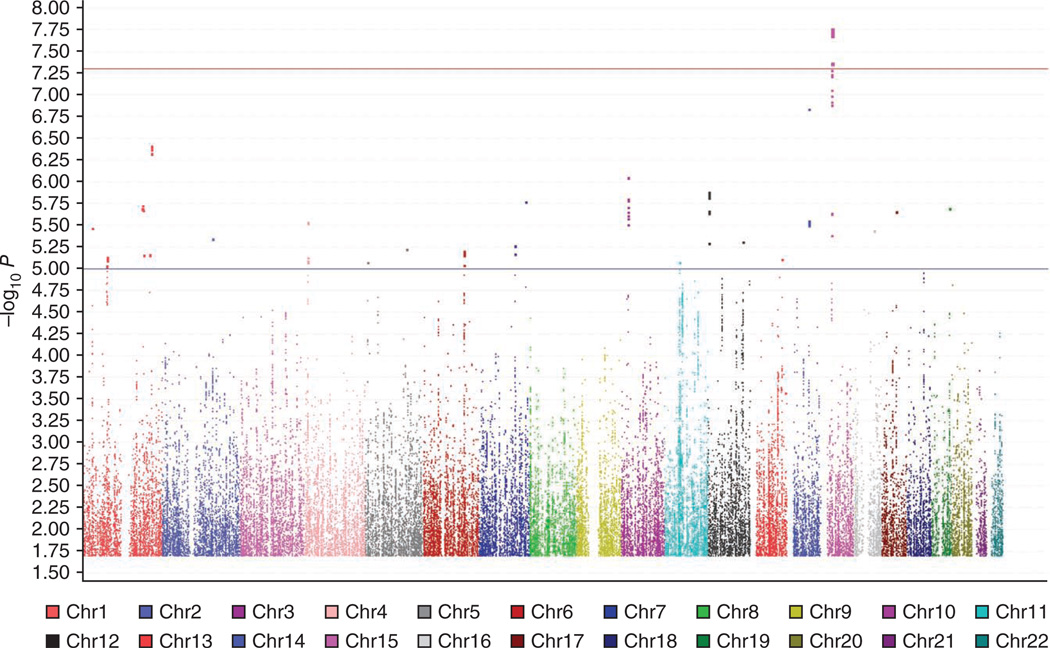
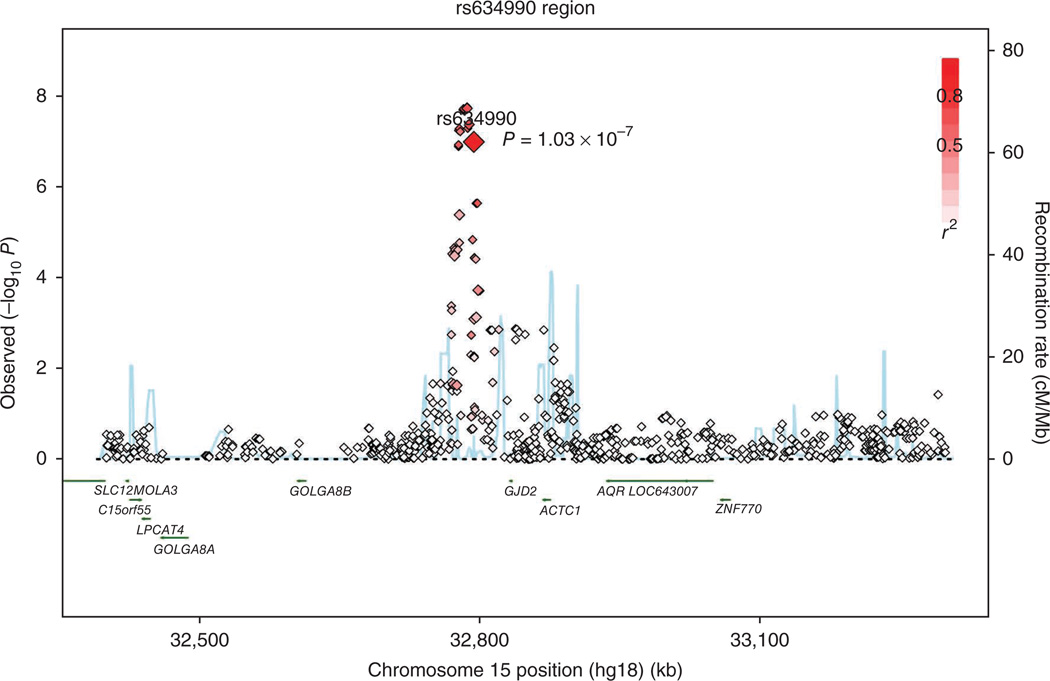
Refractive errors are the most common ocular disorders worldwide and may lead to blindness. Although this trait is highly heritable, identification of susceptibility genes has been challenging. We conducted a genome-wide association study for refractive error in 5,328 individuals from a Dutch population-based study with replication in four independent cohorts (combined 10,280 individuals in the replication stage). We identified a significant association at chromosome 15q14 (rs634990, P = 2.21 × 10⁻¹⁴). The odds ratio of myopia compared to hyperopia for the minor allele (minor allele frequency = 0.47) was 1.41 (95% CI 1.16-1.70) for individuals heterozygous for the allele and 1.83 (95% CI 1.42-2.36) for individuals homozygous for the allele. The associated locus is near two genes that are expressed in the retina, GJD2 and ACTC1, and appears to harbor regulatory elements which may influence transcription of these genes. Our data suggest that common variants at 15q14 influence susceptibility for refractive errors in the general population.
屈光不正(近视、远视、散光等)是全球最常见的眼部疾病,严重时可致盲。尽管该疾病具有高度遗传性,但目前仍难以确定其易感基因。本研究在一个荷兰人群为基础的研究中对 5328 名个体进行了全基因组关联研究,并在四个独立队列中进行了验证(在验证阶段共纳入 10280 名个体)。我们在 15 号染色体 q14 区域(rs634990,P = 2.21×10⁻¹⁴)发现了一个与屈光不正显著相关的位点。与远视相比,携带该位点次要等位基因(次要等位基因频率 = 0.47)的个体发生近视的风险比为 1.41(95%CI 1.16-1.70),杂合子个体为 1.83(95%CI 1.42-2.36),纯合子个体为 1.83(95%CI 1.42-2.36)。该关联位点附近有两个在视网膜中表达的基因,GJD2 和 ACTC1,并且似乎含有调节元件,可能影响这些基因的转录。我们的数据表明,15q14 上的常见变异可能影响一般人群中屈光不正的易感性。