Department of Anesthesiology and Pain Medicine, Dankook University College of Medicine, Cheonan, Korea.
Korean J Anesthesiol. 2012 May;62(5):418-22. doi: 10.4097/kjae.2012.62.5.418. Epub 2012 May 24.
Heat and moisture exchangers (HME) are often used to maintain humidity of breathing circuits during anesthesia. It is also known to increase dead space ventilation in respiratory distress syndromes. However, the effect of a pediatric HME in healthy pediatric patients has not yet been clarified. The purpose of this study was to evaluate the effect of a pediatric HME on dead space in healthy pediatric patients during anesthesia.
20 ASA physical class I pediatric patients, without respiratory impairment, who underwent elective surgery for inguinal hernia or hydrocele with general anesthesia were enrolled. Fifteen minutes after ventilation with and without pediatric HME (internal volume of 22 ml), hemodynamic variables, end tidal CO(2), minute volume and airway pressure were measured, and arterial blood sampling was conducted simultaneously.
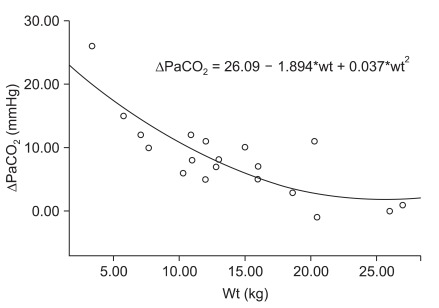
The removal of pediatric HME decreased PaCO(2) significantly from 46.1 ± 6.9 mmHg to 37.9 ± 4.3 mmHg (P < 0.001) and increased the pH from 7.32 to 7.37 (P < 0.001). The differences between PaCO(2) with and without HME (Δ PaCO(2)) were significantly correlated with weight (P < 0.001, β1 = -0.749) and age (P = 0.002, β1 = -0.623).
The use of a pediatric HME significantly increased PaCO(2) in healthy pediatric patients that was inversely proportional to weight and age. The use of pediatric HME should be carefully considered in small pediatric patients.
热湿交换器(HME)常用于麻醉期间维持呼吸回路的湿度。在呼吸窘迫综合征中,它也增加死腔通气。然而,在健康的儿科患者中,小儿 HME 的效果尚未阐明。本研究旨在评估在麻醉期间小儿 HME 对健康儿科患者死腔的影响。
20 例 ASA 身体状况 I 级、无呼吸障碍的择期行腹股沟疝或鞘膜积液手术的小儿患者,接受全身麻醉。在使用和不使用小儿 HME(内部体积 22ml)通气 15 分钟后,测量血流动力学变量、呼气末 CO₂、分钟通气量和气道压力,并同时进行动脉采血。
小儿 HME 的去除使 PaCO₂从 46.1±6.9mmHg 显著降低至 37.9±4.3mmHg(P<0.001),pH 值从 7.32 增加至 7.37(P<0.001)。有和没有 HME 时的 PaCO₂差异(Δ PaCO₂)与体重显著相关(P<0.001,β1=-0.749),与年龄相关(P=0.002,β1=-0.623)。
在健康的儿科患者中使用小儿 HME 会显著增加 PaCO₂,其与体重和年龄成反比。在小儿科患者中使用小儿 HME 应谨慎考虑。