Department of Chemistry, University of Missouri, Columbia, Missouri, United States of America.
PLoS One. 2012;7(6):e38114. doi: 10.1371/journal.pone.0038114. Epub 2012 Jun 7.
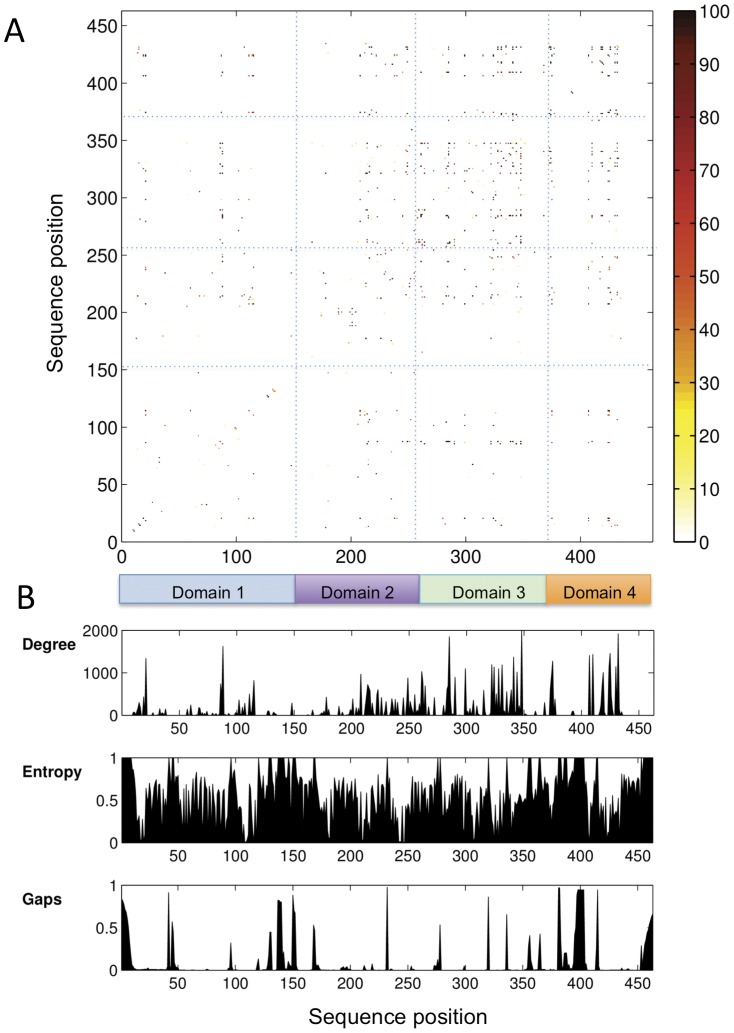
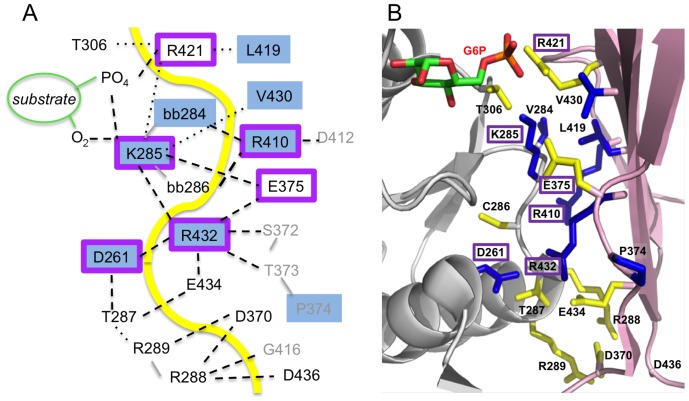
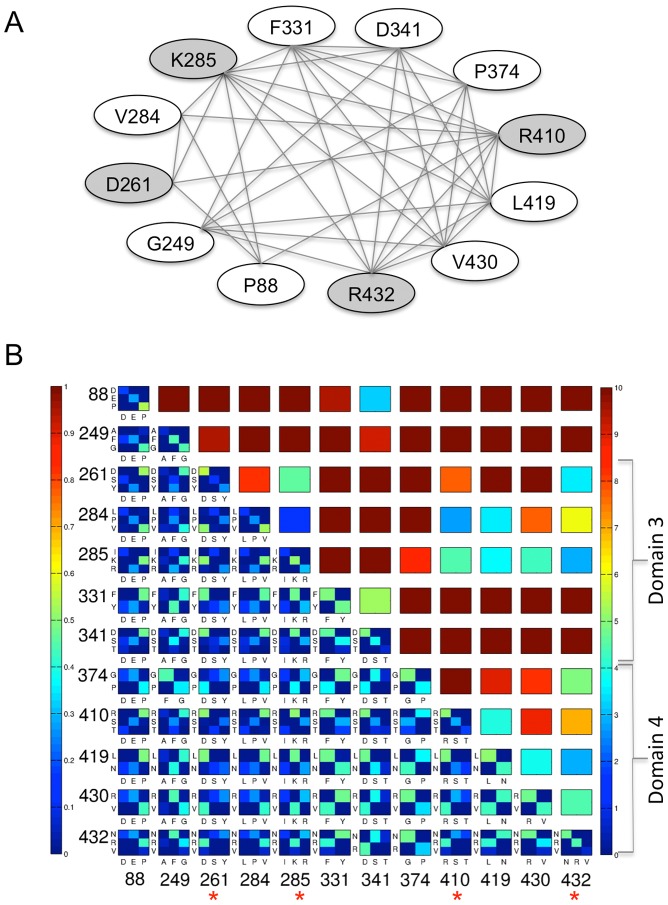
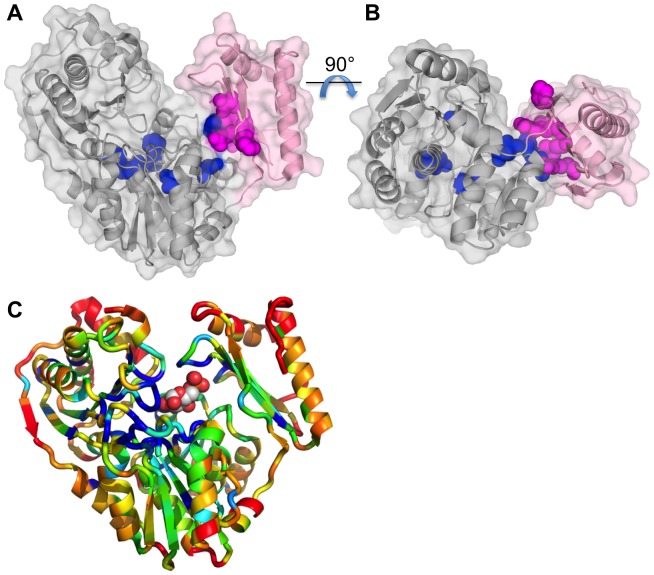
Coevolution analyses identify residues that co-vary with each other during evolution, revealing sequence relationships unobservable from traditional multiple sequence alignments. Here we describe a coevolutionary analysis of phosphomannomutase/phosphoglucomutase (PMM/PGM), a widespread and diverse enzyme family involved in carbohydrate biosynthesis. Mutual information and graph theory were utilized to identify a network of highly connected residues with high significance. An examination of the most tightly connected regions of the coevolutionary network reveals that most of the involved residues are localized near an interdomain interface of this enzyme, known to be the site of a functionally important conformational change. The roles of four interface residues found in this network were examined via site-directed mutagenesis and kinetic characterization. For three of these residues, mutation to alanine reduces enzyme specificity to ~10% or less of wild-type, while the other has ~45% activity of wild-type enzyme. An additional mutant of an interface residue that is not densely connected in the coevolutionary network was also characterized, and shows no change in activity relative to wild-type enzyme. The results of these studies are interpreted in the context of structural and functional data on PMM/PGM. Together, they demonstrate that a network of coevolving residues links the highly conserved active site with the interdomain conformational change necessary for the multi-step catalytic reaction. This work adds to our understanding of the functional roles of coevolving residue networks, and has implications for the definition of catalytically important residues.
共进化分析鉴定了在进化过程中相互协同变化的残基,揭示了传统的多序列比对无法观察到的序列关系。在这里,我们描述了磷酸甘露糖异构酶/磷酸葡萄糖变位酶(PMM/PGM)的共进化分析,这是一种广泛存在且多样化的酶家族,参与碳水化合物的生物合成。互信息和图论被用来识别具有高意义的高度连接残基网络。对共进化网络中最紧密连接区域的检查表明,大多数涉及的残基位于该酶的结构域间界面附近,该界面是功能上重要的构象变化的位点。通过定点突变和动力学特征分析,研究了网络中四个界面残基的作用。在这四个网络中发现的界面残基中,有三个残基突变为丙氨酸后,酶的特异性降低到野生型的 10%或更低,而另一个残基的活性为野生型酶的 45%左右。还对共进化网络中连接不紧密的界面残基的另一个突变体进行了特征分析,与野生型酶相比,其活性没有变化。这些研究结果在 PMM/PGM 的结构和功能数据的背景下进行了解释。总的来说,它们表明一个共进化残基网络将高度保守的活性位点与多步催化反应所需的结构域间构象变化联系起来。这项工作增加了我们对共进化残基网络的功能作用的理解,并对催化重要残基的定义具有启示意义。