School of Public Health, Epidemiology and Biostatistics, University of Birmingham, Birmingham, United Kingdom.
PLoS One. 2012;7(6):e38306. doi: 10.1371/journal.pone.0038306. Epub 2012 Jun 7.
Medication errors are an important source of potentially preventable morbidity and mortality. The PINCER study, a cluster randomised controlled trial, is one of the world's first experimental studies aiming to reduce the risk of such medication related potential for harm in general practice. Bayesian analyses can improve the clinical interpretability of trial findings.
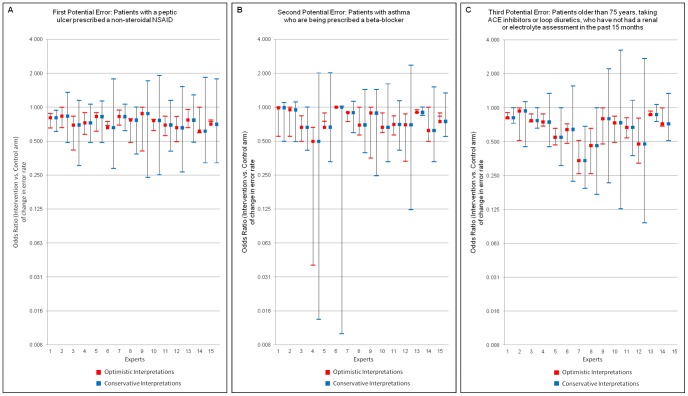
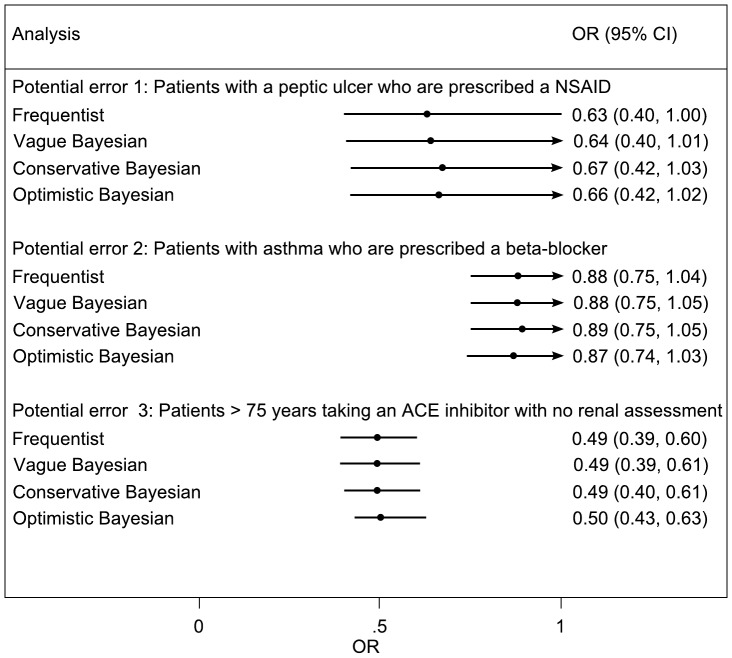
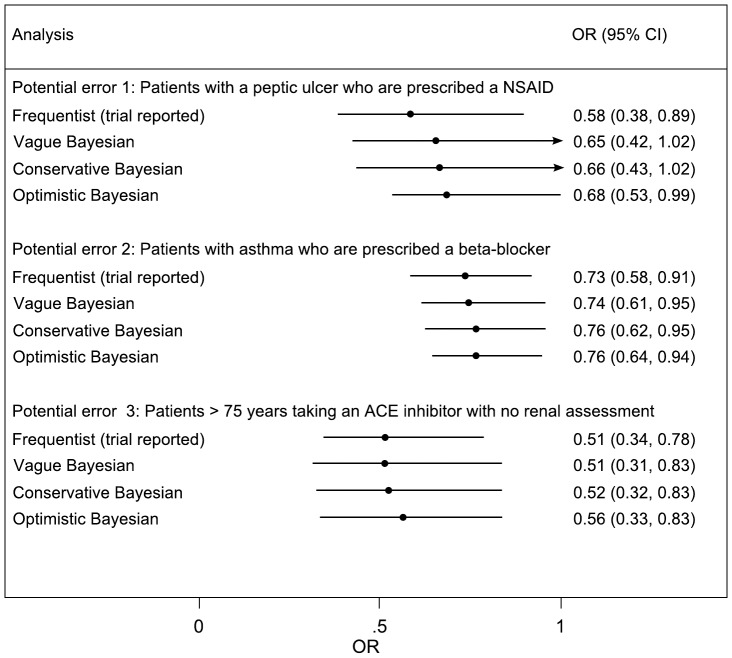
Experts were asked to complete a questionnaire to elicit opinions of the likely effectiveness of the intervention for the key outcomes of interest--three important primary care medication errors. These were averaged to generate collective prior distributions, which were then combined with trial data to generate bayesian posterior distributions. The trial data were analysed in two ways: firstly replicating the trial reported cohort analysis acknowledging pairing of observations, but excluding non-paired observations; and secondly as cross-sectional data, with no exclusions, but without acknowledgement of the pairing. Frequentist and bayesian analyses were compared.
Bayesian evaluations suggest that the intervention is able to reduce the likelihood of one of the medication errors by about 50 (estimated to be between 20% and 70%). However, for the other two main outcomes considered, the evidence that the intervention is able to reduce the likelihood of prescription errors is less conclusive.
Clinicians are interested in what trial results mean to them, as opposed to what trial results suggest for future experiments. This analysis suggests that the PINCER intervention is strongly effective in reducing the likelihood of one of the important errors; not necessarily effective in reducing the other errors. Depending on the clinical importance of the respective errors, careful consideration should be given before implementation, and refinement targeted at the other errors may be something to consider.
用药错误是潜在可预防的发病率和死亡率的一个重要来源。PINCER 研究是一项集群随机对照试验,是世界上首批旨在降低一般实践中此类与药物相关潜在危害风险的实验研究之一。贝叶斯分析可以提高试验结果的临床可解释性。
专家被要求完成一份问卷,以了解干预措施对三个重要初级保健药物错误这一主要结局的有效性的看法。这些意见进行平均处理,生成了集体先验分布,然后将其与试验数据结合起来,生成贝叶斯后验分布。试验数据以两种方式进行分析:首先是复制试验报告的队列分析,承认观察的配对,但排除非配对观察;其次是作为横截面数据,没有排除,但不承认配对。对频率论和贝叶斯分析进行了比较。
贝叶斯评估表明,该干预措施可降低一种药物错误的发生概率约 50%(估计在 20%至 70%之间)。然而,对于另外两个主要结局,干预措施能够降低处方错误的可能性的证据则不太确定。
临床医生关心的是试验结果对他们的意义,而不是试验结果对未来实验的建议。这项分析表明,PINCER 干预措施在降低一种重要错误的发生概率方面非常有效;在降低其他错误的发生概率方面不一定有效。根据各自错误的临床重要性,在实施前应慎重考虑,并考虑针对其他错误进行改进。