Melton Terry, Dimick Gloria, Higgins Bonnie, Yon Michele, Holland Charity
Mitotyping Technologies, 2565 Park Center Boulevard, Suite 200, State College, PA, USA.
Investig Genet. 2012 Jul 13;3(1):12. doi: 10.1186/2041-2223-3-12.
Mitochondrial DNA analysis is typically applied to degraded skeletal remains and telogen or rootless hairs. Data on the application of the method to very small hairs less than 0.5 cm from an age-matched and -challenged sample set are lacking.
One hundred fourteen hairs sized less than 1 cm from a 1993 case were analyzed for mitochondrial DNA according to laboratory standard operating procedures. For some hairs, a screening approach was applied, which permitted some samples, such as victim hairs on victim clothing, to be eliminated from the process quickly. Degraded samples were amplified with "mini-primers," and 12S species testing was applied when non-human hairs were encountered.
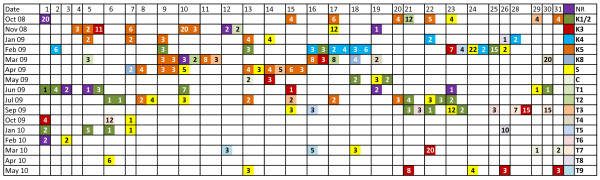
Partial to full control region human mitochondrial DNA profiles or species identifications (non-human species) were obtained from 93% of hairs under 1 cm, 92% of hairs under 5 mm, and 90% of hairs under 3.5 mm. Nineteen of 21 hairs 2 mm or less gave full or partial profiles. Among 128 hairs of all sizes tested in the case, 9 gave no results, 3 were canine in origin, and 73 did not exclude six known individuals tested in the case. Twenty-two hairs had nine additional profiles that were observed two or more times each. Twenty-one hairs showed singleton types not matching each other or any individual.
Crime scene hairs that are both aged and small are often judged to be unsuitable for either hair microscopy or DNA analysis. This study of age-matched challenged small hairs indicates that even the smallest probative crime scene hairs are suitable for mitochondrial DNA analysis and can provide useful data.
线粒体DNA分析通常应用于降解的骨骼遗骸以及休止期或无根毛发。目前缺乏将该方法应用于来自年龄匹配且具有挑战性的样本集中小于0.5厘米的极细毛发的相关数据。
根据实验室标准操作程序,对1993年一起案件中114根长度小于1厘米的毛发进行线粒体DNA分析。对于一些毛发,采用了一种筛选方法,该方法允许快速排除一些样本,如受害者衣物上的受害者毛发。对降解样本使用“微型引物”进行扩增,遇到非人类毛发时进行12S物种检测。
在长度小于1厘米的毛发中,93%获得了部分至完整的控制区人类线粒体DNA图谱或物种鉴定(非人类物种);在长度小于5毫米的毛发中,92%获得了相关结果;在长度小于3.5毫米的毛发中,90%获得了相关结果。21根长度为2毫米或更短的毛发中有19根获得了完整或部分图谱。在该案件中测试的所有尺寸的128根毛发中,9根没有得到结果,3根起源于犬类,73根没有排除该案件中测试的6个已知个体。22根毛发有9个额外的图谱,每个图谱被观察到两次或更多次。21根毛发显示出彼此不匹配或与任何个体都不匹配的单倍型。
既陈旧又细小的犯罪现场毛发通常被判定不适用于毛发显微镜检查或DNA分析。这项对年龄匹配的具有挑战性的细小毛发的研究表明,即使是最小的具有证据价值的犯罪现场毛发也适用于线粒体DNA分析,并能提供有用的数据。