Department of Epidemiology and Biostatistics, Mel and Enid Zuckerman College of Public Health, The University of Arizona, 1515 N. Campbell Ave, Tucson, AZ 85724, USA.
Int J Environ Res Public Health. 2012 Apr;9(4):1051-67. doi: 10.3390/ijerph9041051. Epub 2012 Mar 26.
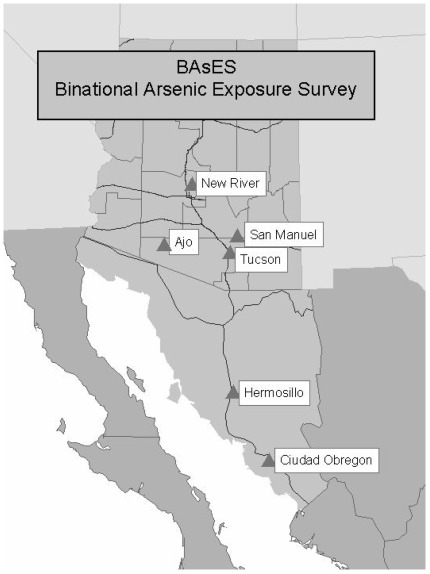
The Binational Arsenic Exposure Survey (BAsES) was designed to evaluate probable arsenic exposures in selected areas of southern Arizona and northern Mexico, two regions with known elevated levels of arsenic in groundwater reserves. This paper describes the methodology of BAsES and the relationship between estimated arsenic intake from beverages and arsenic output in urine. Households from eight communities were selected for their varying groundwater arsenic concentrations in Arizona, USA and Sonora, Mexico. Adults responded to questionnaires and provided dietary information. A first morning urine void and water from all household drinking sources were collected. Associations between urinary arsenic concentration (total, organic, inorganic) and estimated level of arsenic consumed from water and other beverages were evaluated through crude associations and by random effects models. Median estimated total arsenic intake from beverages among participants from Arizona communities ranged from 1.7 to 14.1 µg/day compared to 0.6 to 3.4 µg/day among those from Mexico communities. In contrast, median urinary inorganic arsenic concentrations were greatest among participants from Hermosillo, Mexico (6.2 µg/L) whereas a high of 2.0 µg/L was found among participants from Ajo, Arizona. Estimated arsenic intake from drinking water was associated with urinary total arsenic concentration (p < 0.001), urinary inorganic arsenic concentration (p < 0.001), and urinary sum of species (p < 0.001). Urinary arsenic concentrations increased between 7% and 12% for each one percent increase in arsenic consumed from drinking water. Variability in arsenic intake from beverages and urinary arsenic output yielded counter intuitive results. Estimated intake of arsenic from all beverages was greatest among Arizonans yet participants in Mexico had higher urinary total and inorganic arsenic concentrations. Other contributors to urinary arsenic concentrations should be evaluated.
双国籍砷暴露调查(BAsES)旨在评估美国亚利桑那州南部和墨西哥北部选定地区的可能砷暴露情况,这两个地区的地下水储量中砷含量已知较高。本文介绍了 BAsES 的方法学以及从饮料中估计的砷摄入量与尿液中砷排泄量之间的关系。亚利桑那州和墨西哥索诺拉州的八个社区的家庭根据其地下水砷浓度的不同而被选中。成年人回答了问卷并提供了饮食信息。收集了第一个早晨的尿液和所有家庭饮用水源的水。通过简单关联和随机效应模型评估了尿液中砷浓度(总砷、有机砷、无机砷)与从水中和其他饮料中估计的砷摄入量之间的关系。与来自墨西哥社区的参与者相比,来自亚利桑那州社区的参与者从饮料中估计的总砷摄入量中位数范围为 1.7 至 14.1 µg/天,而来自墨西哥社区的参与者为 0.6 至 3.4 µg/天。相比之下,来自墨西哥埃莫西约的参与者的尿液无机砷浓度中位数最高(6.2 µg/L),而来自亚利桑那州阿霍的参与者的尿液无机砷浓度最高(2.0 µg/L)。从饮用水中摄入的砷与尿总砷浓度(p<0.001)、尿无机砷浓度(p<0.001)和尿物种总和(p<0.001)相关。从饮用水中摄入的砷每增加 1%,尿液中总砷浓度就会增加 7%至 12%。从饮料中摄入的砷和尿液中排出的砷的变异性产生了相反的结果。从所有饮料中摄入的砷估计量在亚利桑那州人中最高,但墨西哥参与者的尿总砷和无机砷浓度更高。应评估尿液中砷浓度的其他因素。