Sautto Giuseppe, Mancini Nicasio, Solforosi Laura, Diotti Roberta A, Clementi Massimo, Burioni Roberto
Laboratorio di Microbiologia e Virologia, Università Vita-Salute San Raffaele, Via Olgettina, 58, 20132 Milano, Italy.
Clin Dev Immunol. 2012;2012:705013. doi: 10.1155/2012/705013. Epub 2012 May 29.
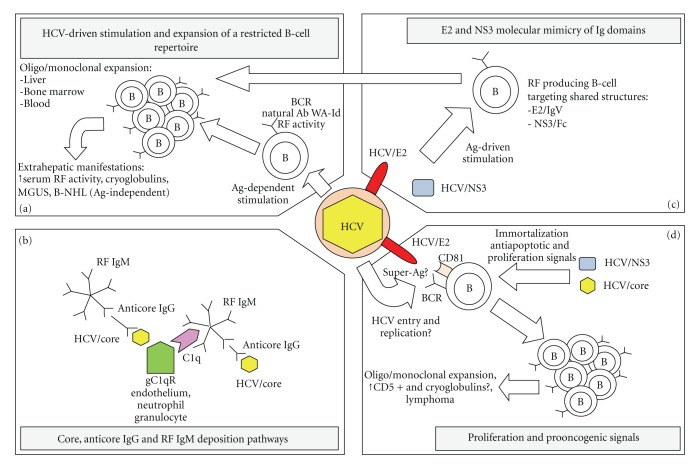
The association between hepatitis C virus (HCV) infection and type II mixed cryoglobulinemia (MCII) is well established, but the role played by distinct HCV proteins and by specific components of the anti-HCV humoral immune response remains to be clearly defined. It is widely accepted that HCV drives the expansion of few B-cell clones expressing a restricted pool of selected immunoglobulin variable (IgV) gene subfamilies frequently endowed with rheumatoid factor (RF) activity. Moreover, the same IgV subfamilies are frequently observed in HCV-transformed malignant B-cell clones occasionally complicating MCII. In this paper, we analyze both the humoral and viral counterparts at the basis of cryoglobulins production in HCV-induced MCII, with particular attention reserved to the single IgV subfamilies most frequently involved.
丙型肝炎病毒(HCV)感染与II型混合性冷球蛋白血症(MCII)之间的关联已得到充分证实,但不同的HCV蛋白以及抗HCV体液免疫反应的特定成分所起的作用仍有待明确界定。人们普遍认为,HCV促使少数表达有限的选定免疫球蛋白可变(IgV)基因亚家族库的B细胞克隆扩增,这些亚家族通常具有类风湿因子(RF)活性。此外,在偶尔使MCII复杂化的HCV转化的恶性B细胞克隆中也经常观察到相同的IgV亚家族。在本文中,我们分析了HCV诱导的MCII中冷球蛋白产生基础上的体液和病毒对应物,特别关注最常涉及的单个IgV亚家族。