Department of Biology, Stanford University, Stanford, CA, 94305-5020, USA.
Evodevo. 2012 Jul 6;3(1):11. doi: 10.1186/2041-9139-3-11.
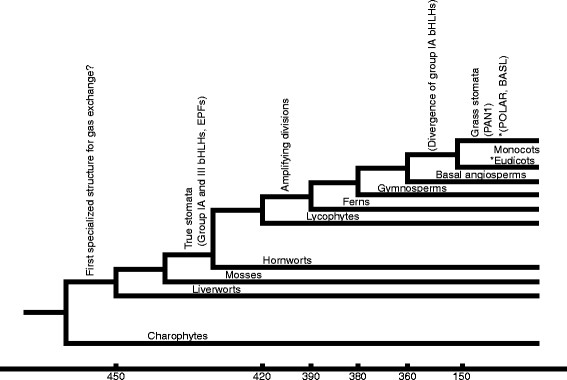
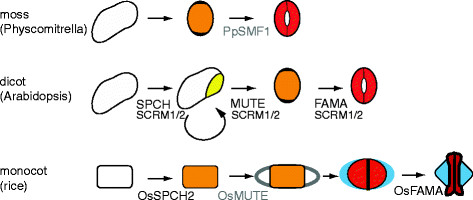
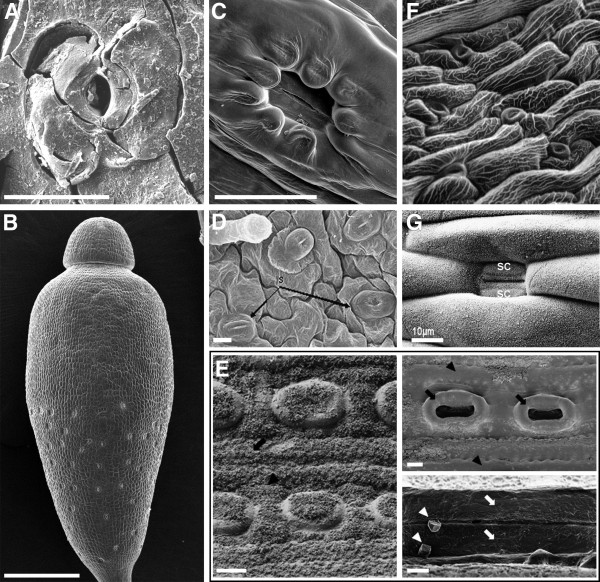
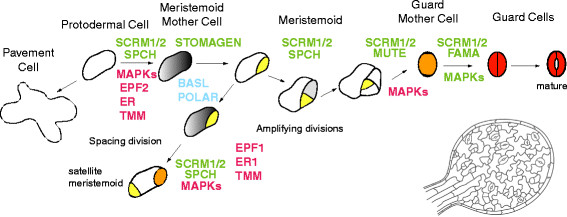
Plant development has a significant postembryonic phase that is guided heavily by interactions between the plant and the outside environment. This interplay is particularly evident in the development, pattern and function of stomata, epidermal pores on the aerial surfaces of land plants. Stomata have been found in fossils dating from more than 400 million years ago. Strikingly, the morphology of the individual stomatal complex is largely unchanged, but the sizes, numbers and arrangements of stomata and their surrounding cells have diversified tremendously. In many plants, stomata arise from specialized and transient stem-cell like compartments on the leaf. Studies in the flowering plant Arabidopsis thaliana have established a basic molecular framework for the acquisition of cell fate and generation of cell polarity in these compartments, as well as describing some of the key signals and receptors required to produce stomata in organized patterns and in environmentally optimized numbers. Here we present parallel analyses of stomatal developmental pathways at morphological and molecular levels and describe the innovations made by particular clades of plants.
植物发育有一个重要的胚胎后阶段,这个阶段受到植物与外部环境之间相互作用的强烈影响。这种相互作用在气孔的发育、模式和功能上表现得尤为明显,气孔是陆地植物气生表面的表皮孔。可以在追溯到 4 亿多年前的化石中发现气孔。引人注目的是,单个气孔复合体的形态在很大程度上保持不变,但气孔及其周围细胞的大小、数量和排列已经发生了巨大的多样化。在许多植物中,气孔是从叶片上专门的、短暂的干细胞样隔室中产生的。在拟南芥等有花植物中的研究已经建立了一个基本的分子框架,用于这些隔室中细胞命运的获得和细胞极性的产生,并描述了产生有组织模式和环境优化数量的气孔所需的一些关键信号和受体。在这里,我们在形态和分子水平上对气孔发育途径进行了平行分析,并描述了特定植物类群的创新。