Institute for Marine and Antarctic Studies, University of Tasmania, Sandy Bay, Tasmania, Australia.
PLoS One. 2012;7(5):e38307. doi: 10.1371/journal.pone.0038307. Epub 2012 May 31.
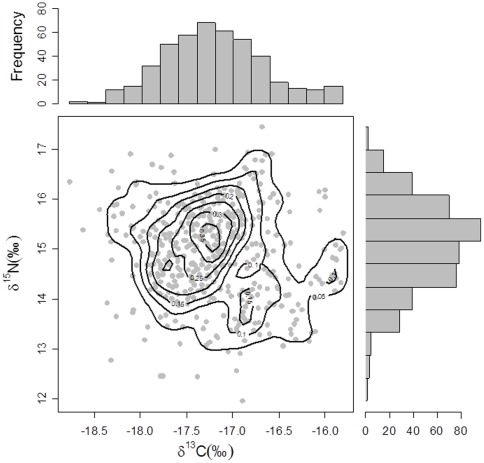
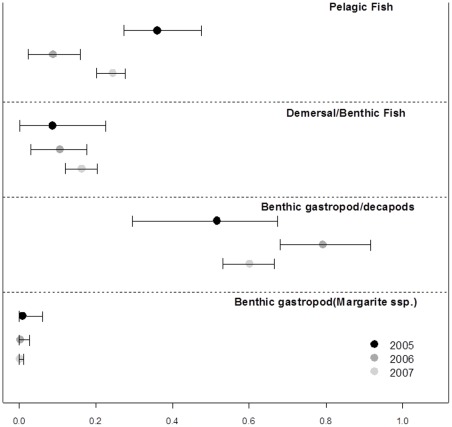
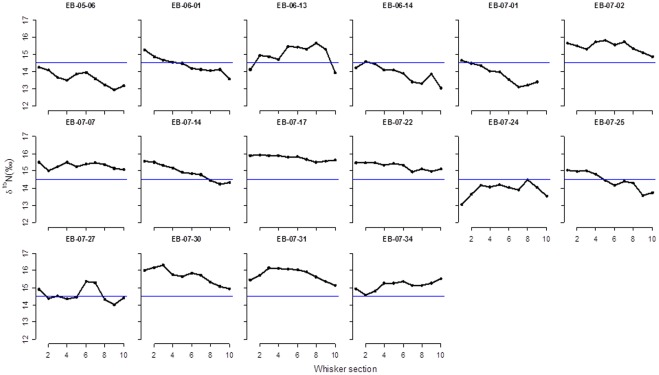
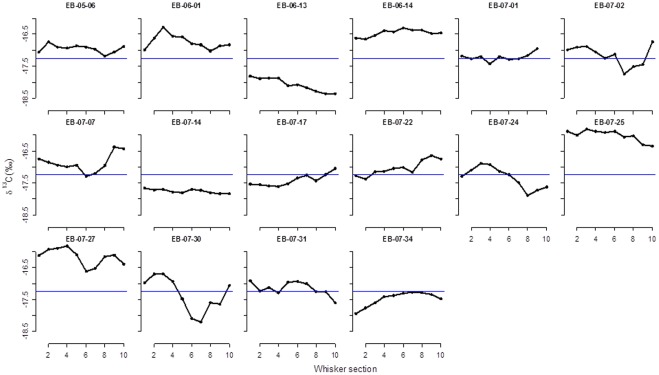
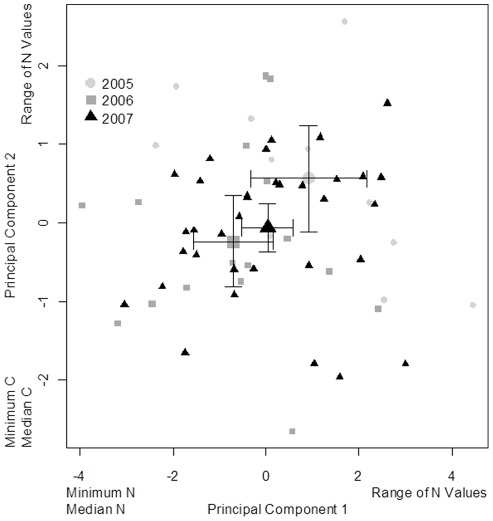
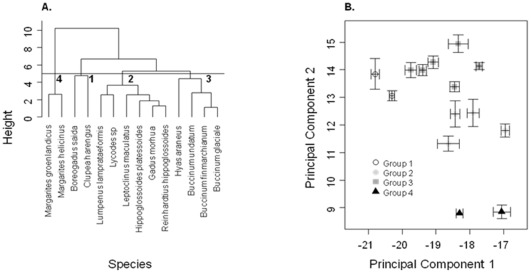
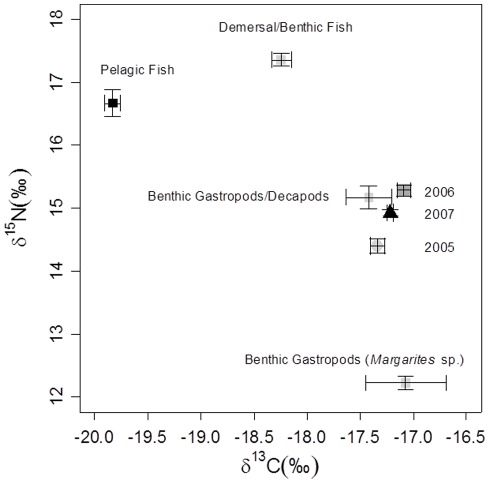
Changing patterns of sea-ice distribution and extent have measurable effects on polar marine systems. Beyond the obvious impacts of key-habitat loss, it is unclear how such changes will influence ice-associated marine mammals in part because of the logistical difficulties of studying foraging behaviour or other aspects of the ecology of large, mobile animals at sea during the polar winter. This study investigated the diet of pregnant bearded seals (Erignathus barbatus) during three spring breeding periods (2005, 2006 and 2007) with markedly contrasting ice conditions in Svalbard using stable isotopes (δ(13)C and δ(15)N) measured in whiskers collected from their newborn pups. The δ(15)N values in the whiskers of individual seals ranged from 11.95 to 17.45 ‰, spanning almost 2 full trophic levels. Some seals were clearly dietary specialists, despite the species being characterised overall as a generalist predator. This may buffer bearded seal populations from the changes in prey distributions lower in the marine food web which seems to accompany continued changes in temperature and ice cover. Comparisons with isotopic signatures of known prey, suggested that benthic gastropods and decapods were the most common prey. Bayesian isotopic mixing models indicated that diet varied considerably among years. In the year with most fast-ice (2005), the seals had the greatest proportion of pelagic fish and lowest benthic invertebrate content, and during the year with the least ice (2006), the seals ate more benthic invertebrates and less pelagic fish. This suggests that the seals fed further offshore in years with greater ice cover, but moved in to the fjords when ice-cover was minimal, giving them access to different types of prey. Long-term trends of sea ice decline, earlier ice melt, and increased water temperatures in the Arctic are likely to have ecosystem-wide effects, including impacts on the forage bases of pagophilic seals.
海冰分布和范围的变化模式对极地海洋系统有着可衡量的影响。除了关键栖息地丧失的明显影响外,人们还不清楚这些变化将如何影响与冰相关的海洋哺乳动物,部分原因是在极地冬季,研究大型、移动性动物的觅食行为或其他生态方面存在后勤困难。本研究使用稳定同位素(δ(13)C 和 δ(15)N),调查了 2005 年、2006 年和 2007 年三个春季繁殖期内怀孕的髯海豹(Erignathus barbatus)的饮食,这三个繁殖期斯瓦尔巴群岛的海冰条件有着明显的差异。从它们新生幼崽的胡须中收集的稳定同位素(δ(13)C 和 δ(15)N)进行测量。个体海豹的胡须中δ(15)N 值的范围为 11.95 至 17.45‰,跨越了近 2 个完整的营养级。尽管该物种总体上被描述为杂食性捕食者,但一些海豹显然是食性专家。这可能使髯海豹种群免受海洋食物网中较低层次的猎物分布变化的影响,这种变化似乎伴随着温度和冰盖的持续变化而发生。与已知猎物的同位素特征进行比较,表明底栖腹足类和十足目甲壳类动物是最常见的猎物。贝叶斯同位素混合模型表明,不同年份的饮食差异很大。在快速冰(2005 年)最多的那一年,海豹的远洋鱼类比例最大,底栖无脊椎动物含量最低,而在冰最少的那一年(2006 年),海豹吃的底栖无脊椎动物更多,远洋鱼类更少。这表明,在冰盖更大的年份,海豹在更远的海域觅食,但当冰盖最小时,它们会进入峡湾,从而获得不同类型的猎物。北极地区海冰减少、冰融化提前和水温升高的长期趋势可能会对整个生态系统产生影响,包括对 pagophilic 海豹的饲料基础产生影响。