Nature Research Center, North Carolina Museum of Natural Sciences, Raleigh, NC 27603, USA.
BMC Evol Biol. 2012 Jun 14;12:87. doi: 10.1186/1471-2148-12-87.
Members of the hemipteran suborder Auchenorrhyncha (commonly known as planthoppers, tree- and leafhoppers, spittlebugs, and cicadas) are unusual among insects known to harbor endosymbiotic bacteria in that they are associated with diverse assemblages of bacterial endosymbionts. Early light microscopic surveys of species representing the two major lineages of Auchenorrhyncha (the planthopper superfamily Fulgoroidea; and Cicadomorpha, comprising Membracoidea [tree- and leafhoppers], Cercopoidea [spittlebugs], and Cicadoidea [cicadas]), found that most examined species harbored at least two morphologically distinct bacterial endosymbionts, and some harbored as many as six. Recent investigations using molecular techniques have identified multiple obligate bacterial endosymbionts in Cicadomorpha; however, much less is known about endosymbionts of Fulgoroidea. In this study, we present the initial findings of an ongoing PCR-based survey (sequencing 16S rDNA) of planthopper-associated bacteria to document endosymbionts with a long-term history of codiversification with their fulgoroid hosts.
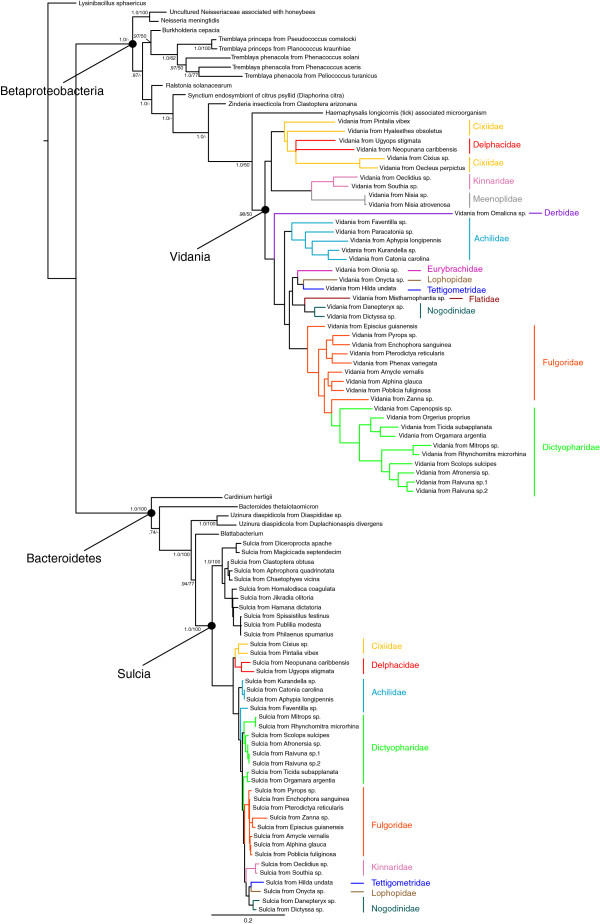
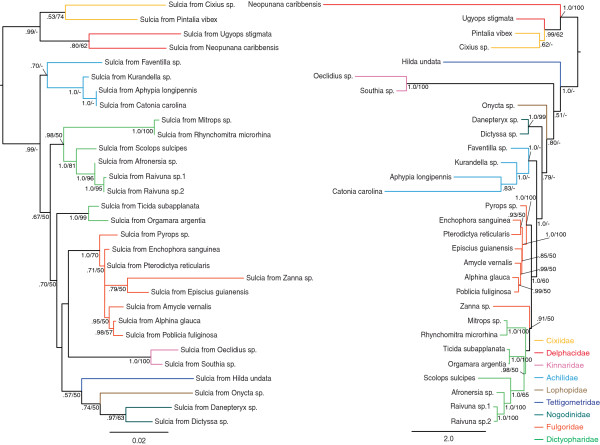
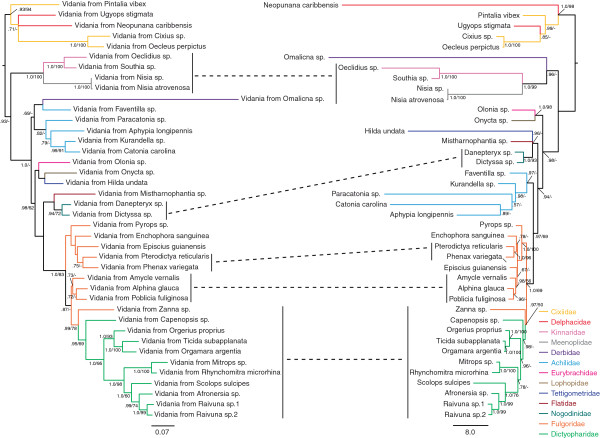
Results of PCR surveys and phylogenetic analyses of 16S rDNA recovered a monophyletic clade of Betaproteobacteria associated with planthoppers; this clade included Vidania fulgoroideae, a recently described bacterium identified in exemplars of the planthopper family Cixiidae. We surveyed 77 planthopper species representing 18 fulgoroid families, and detected Vidania in 40 species (representing 13 families). Further, we detected the Sulcia endosymbiont (identified as an obligate endosymbiont of Auchenorrhyncha in previous studies) in 30 of the 40 species harboring Vidania. Concordance of the Vidania phylogeny with the phylogeny of the planthopper hosts (reconstructed based on sequence data from five genes generated from the same insect specimens from which the bacterial sequences were obtained) was supported by statistical tests of codiversification. Codiversification tests also supported concordance of the Sulcia phylogeny with the phylogeny of the planthopper hosts, as well as concordance of planthopper-associated Vidania and Sulcia phylogenies.
Our results indicate that the Betaproteobacterium Vidania is an ancient endosymbiont that infected the common ancestor of Fulgoroidea at least 130 million years ago. Comparison of our findings with the early light-microscopic surveys conducted by Müller suggests that Vidania is Müller's x-symbiont, which he hypothesized to have codiversified with most lineages of planthoppers and with the Sulcia endosymbiont.
半翅目昆虫亚目(通常称为叶蝉、树蝉、沫蝉和蝉)的成员在已知携带内共生细菌的昆虫中是不寻常的,因为它们与多种细菌内共生体有关。对代表半翅目两个主要谱系(叶蝉总科 Fulgoridea;和 Cicadomorpha,包括 Membracoidea [树蝉和叶蝉]、Cercopoidea [沫蝉]和 Cicadoidea [蝉])的物种进行的早期光学显微镜调查发现,大多数检查的物种都至少携带两种形态不同的细菌内共生体,有些则携带多达六种。使用分子技术的最近调查已经在 Cicadomorpha 中鉴定出多种必需的细菌内共生体;然而,关于 Fulgoridea 的内共生体知之甚少。在这项研究中,我们介绍了正在进行的基于 PCR 的叶蝉相关细菌调查(16S rDNA 测序)的初步结果,以记录与它们的飞蝗宿主长期共同进化的内共生体。
PCR 调查结果和 16S rDNA 的系统发育分析结果表明,与叶蝉相关的 Betaproteobacteria 形成一个单系分支;这个分支包括 Vidania fulgoroideae,这是一种最近在蝉科蝉属的标本中发现的细菌。我们调查了 77 种代表 18 种飞蝗科的叶蝉物种,并在 40 种物种(代表 13 个科)中检测到了 Vidania。此外,我们在携带 Vidania 的 30 种 40 种物种中检测到了 Sulcia 共生体(在之前的研究中被鉴定为半翅目昆虫的必需共生体)。基于从获得细菌序列的相同昆虫标本中生成的五个基因的序列数据重建的叶蝉宿主的系统发育,Vidania 的系统发育与叶蝉宿主的系统发育的一致性得到了统计检验的支持。Codiversification 测试还支持 Sulcia 系统发育与叶蝉宿主系统发育的一致性,以及叶蝉相关的 Vidania 和 Sulcia 系统发育的一致性。
我们的结果表明,β变形菌 Vidania 是一种古老的内共生体,它在 1.3 亿年前感染了飞蝗的共同祖先。将我们的发现与 Müller 进行的早期光学显微镜调查进行比较表明,Vidania 是 Müller 的 x-共生体,他假设它与叶蝉的大多数谱系以及 Sulcia 共生体共同进化。