Institute of Food, Nutrition and Health, ETH Zurich, Zurich, Switzerland.
PLoS One. 2012;7(6):e38514. doi: 10.1371/journal.pone.0038514. Epub 2012 Jun 6.
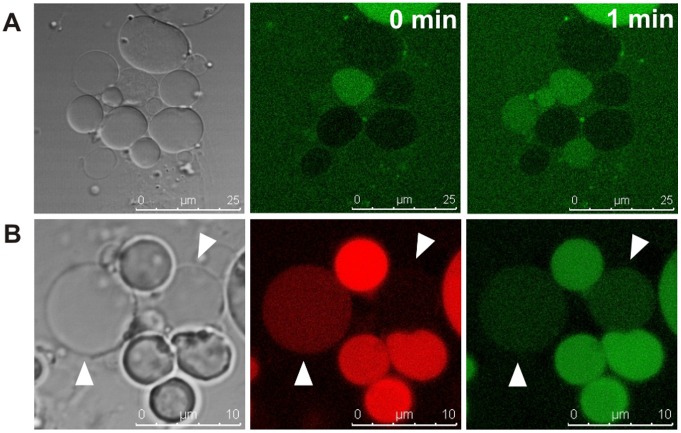
Cell wall-deficient bacteria, or L-forms, represent an extreme example of bacterial plasticity. Stable L-forms can multiply and propagate indefinitely in the absence of a cell wall. Data presented here are consistent with the model that intracellular vesicles in Listeria monocytogenes L-form cells represent the actual viable reproductive elements. First, small intracellular vesicles are formed along the mother cell cytoplasmic membrane, originating from local phospholipid accumulation. During growth, daughter vesicles incorporate a small volume of the cellular cytoplasm, and accumulate within volume-expanding mother cells. Confocal Raman microspectroscopy demonstrated the presence of nucleic acids and proteins in all intracellular vesicles, but only a fraction of which reveals metabolic activity. Following collapse of the mother cell and release of the daughter vesicles, they can establish their own membrane potential required for respiratory and metabolic processes. Premature depolarization of the surrounding membrane promotes activation of daughter cell metabolism prior to release. Based on genome resequencing of L-forms and comparison to the parental strain, we found no evidence for predisposing mutations that might be required for L-form transition. Further investigations revealed that propagation by intracellular budding not only occurs in Listeria species, but also in L-form cells generated from different Enterococcus species. From a more general viewpoint, this type of multiplication mechanism seems reminiscent of the physicochemical self-reproducing properties of abiotic lipid vesicles used to study the primordial reproduction pathways of putative prokaryotic precursor cells.
细胞壁缺陷细菌,或 L 型细菌,代表了细菌可塑性的一个极端例子。稳定的 L 型细菌在没有细胞壁的情况下可以无限繁殖和增殖。这里呈现的数据与以下模型一致:李斯特菌 L 型细胞的细胞内小泡代表实际的有活力的生殖元素。首先,沿着母细胞细胞质膜形成小的细胞内小泡,起源于局部磷脂积累。在生长过程中,子小泡会吸收少量的细胞质,并在体积不断扩大的母细胞内积累。共焦拉曼微光谱分析表明,所有细胞内小泡中都存在核酸和蛋白质,但只有一部分显示出代谢活性。在母细胞崩溃并释放子小泡后,它们可以建立自己的膜电位,这是呼吸和代谢过程所必需的。周围膜的过早去极化促进了子细胞代谢在释放之前的激活。基于 L 型的基因组重测序和与亲本菌株的比较,我们没有发现可能需要 L 型转变的倾向突变的证据。进一步的研究表明,细胞内出芽的繁殖不仅发生在李斯特菌属中,也发生在不同肠球菌属生成的 L 型细胞中。从更普遍的观点来看,这种类型的繁殖机制似乎让人联想到用于研究假定原核前体细胞原始繁殖途径的无生命脂质小泡的物理化学自我复制特性。