Division of Hematology/Oncology, Children's Hospital Los Angeles, 4650 Sunset Boulevard, Los Angeles, CA 90027, USA.
BMC Immunol. 2012 Jun 15;13:31. doi: 10.1186/1471-2172-13-31.
Upon stimulation with different cytokines, macrophages can undergo classical or alternative activation to become M1 or M2 macrophages. Alternatively activated (or M2) macrophages are defined by their expression of specific gene products and play an important role in containing inflammation, removing apoptotic cells and repairing tissue damage. Whereas it is well-established that IL-4 can drive alternative activation, if lack of TGFβ signaling at physiological levels affects M2 polarization has not been addressed.
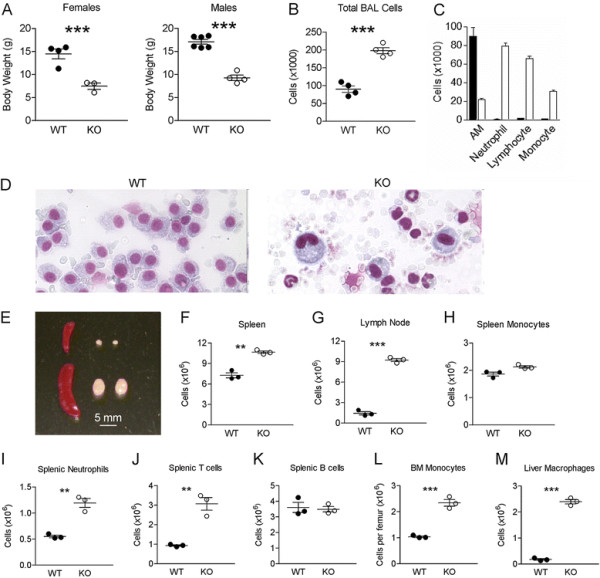
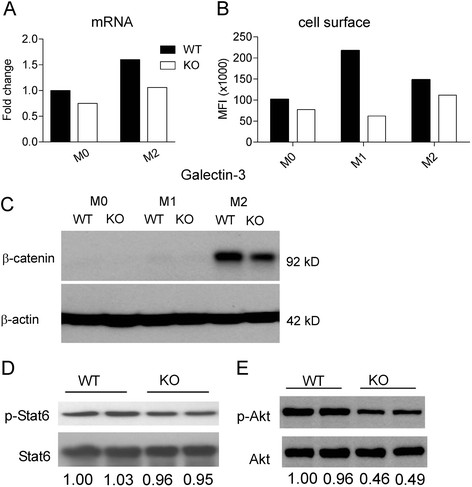
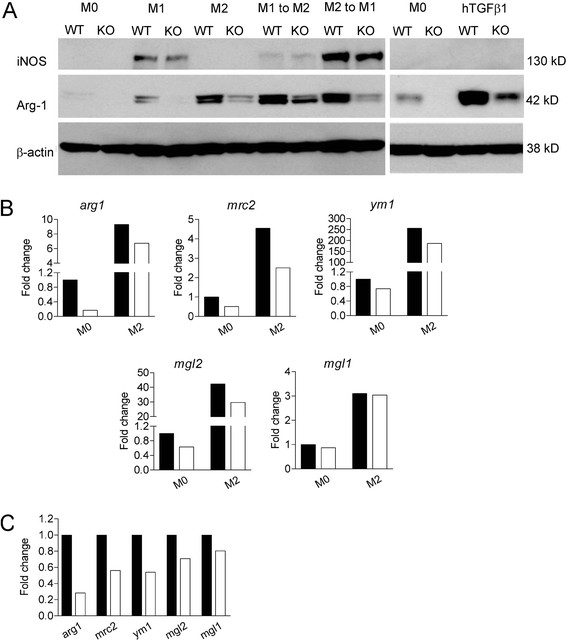
Vav1-Cre x TβRIIfx/fx mice, lacking TβRII function in hematopoietic cells, exhibited uncontrolled pulmonary inflammation and developed a lethal autoimmune syndrome at young age. This was accompanied by significantly increased numbers of splenic neutrophils and T cells as well as elevated hepatic macrophage infiltration and bone marrow monocyte counts. TβRII-/- CD4+ and CD8+ T-cells in the lymph nodes and spleen expressed increased cell surface CD44, and CD69 was also higher on CD4+ lymph node T-cells. Loss of TβRII in bone marrow-derived macrophages (BMDMs) did not affect the ability of these cells to perform efferocytosis. However, these cells were defective in basal and IL-4-induced arg1 mRNA and Arginase-1 protein production. Moreover, the transcription of genes that are typically upregulated in M2-polarized macrophages, such as ym1, mcr2 and mgl2, was also decreased in peritoneal macrophages and IL-4-stimulated TβRII-/- BMDMs. We found that cell surface and mRNA expression of Galectin-3, which also regulates M2 macrophage polarization, was lower in TβRII-/- BMDMs. Very interestingly, the impaired ability of these null mutant BMDMs to differentiate into IL-4 polarized macrophages was Stat6- and Smad3-independent, but correlated with reduced levels of phospho-Akt and β-catenin.
Our results establish a novel biological role for TGFβ signaling in controlling expression of genes characteristic for alternatively activated macrophages. We speculate that lack of TβRII signaling reduces the anti-inflammatory M2 phenotype of macrophages because of reduced expression of these products. This would cause defects in the ability of the M2 macrophages to negatively regulate other immune cells such as T-cells in the lung, possibly explaining the systemic inflammation observed in Vav1-Cre x TβRIIfx/fx mice.
巨噬细胞在受到不同细胞因子刺激后,可以发生经典或替代激活,成为 M1 或 M2 巨噬细胞。替代激活(或 M2)巨噬细胞的特征是其特异性基因产物的表达,并在控制炎症、清除凋亡细胞和修复组织损伤方面发挥重要作用。虽然 IL-4 可以驱动替代激活已得到充分证实,但生理水平缺乏 TGFβ 信号是否会影响 M2 极化尚未得到解决。
Vav1-Cre x TβRIIfx/fx 小鼠,造血细胞中缺乏 TβRII 功能,表现出不受控制的肺部炎症,并在年轻时发展出致命的自身免疫综合征。这伴随着脾中性粒细胞和 T 细胞数量显著增加,以及肝巨噬细胞浸润和骨髓单核细胞计数升高。淋巴结和脾脏中的 TβRII-/- CD4+和 CD8+T 细胞表达增加的细胞表面 CD44,CD69 也在 CD4+淋巴结 T 细胞上更高。骨髓来源的巨噬细胞(BMDMs)中 TβRII 的缺失并不影响这些细胞吞噬作用的能力。然而,这些细胞在基础状态和 IL-4 诱导的 arg1 mRNA 和精氨酸酶-1 蛋白产生方面存在缺陷。此外,通常在 M2 极化巨噬细胞中上调的基因的转录,如 ym1、mcr2 和 mgl2,在腹膜巨噬细胞和 IL-4 刺激的 TβRII-/- BMDMs 中也减少。我们发现,Galectin-3 的细胞表面和 mRNA 表达,它也调节 M2 巨噬细胞极化,在 TβRII-/- BMDMs 中较低。非常有趣的是,这些缺失突变 BMDMs 分化为 IL-4 极化巨噬细胞的能力与 Stat6 和 Smad3 无关,但与磷酸化 Akt 和 β-连环蛋白水平降低相关。
我们的结果确立了 TGFβ 信号在控制替代激活巨噬细胞特征基因表达中的新的生物学作用。我们推测,TβRII 信号的缺失降低了这些产物的表达,从而降低了巨噬细胞的抗炎 M2 表型。这将导致 M2 巨噬细胞负调控肺部等其他免疫细胞的能力缺陷,可能解释了 Vav1-Cre x TβRIIfx/fx 小鼠中观察到的全身炎症。