Department of Psychology, Boston College, Chestnut Hill MA, USA.
Front Integr Neurosci. 2012 Jun 15;6:34. doi: 10.3389/fnint.2012.00034. eCollection 2012.
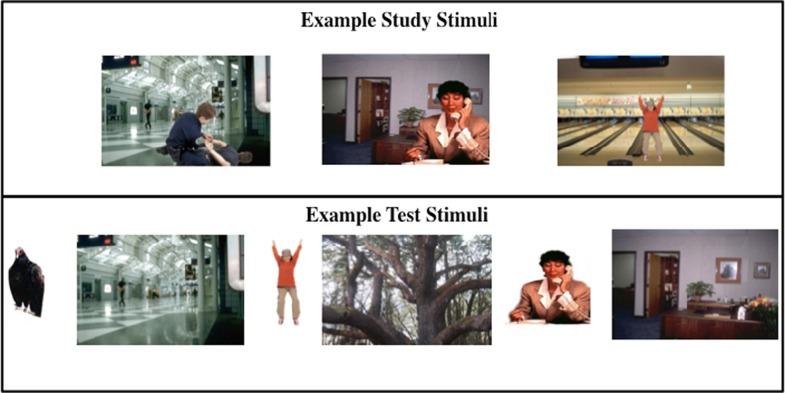
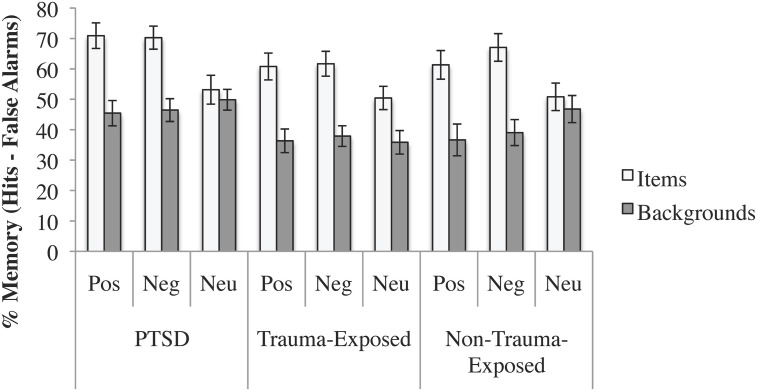
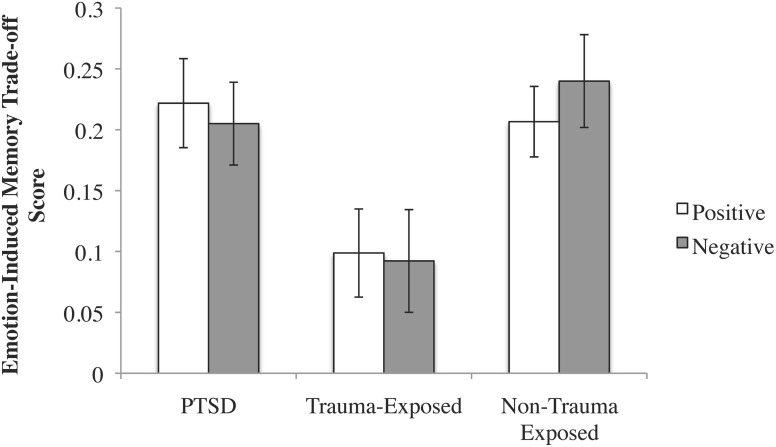
Many past examinations of memory changes in individuals with posttraumatic stress disorder (PTSD) have focused on changes in memory for trauma. However, it is unclear if these mnemonic differences extend beyond the memory of the trauma to memory for other positive and negative information and if they are specific to individuals with PTSD or extend to other individuals who have experienced trauma. The present study examined the influences of trauma exposure and PTSD on an effect that may parallel tunnel memory in PTSD: the emotion-induced memory trade-off, whereby emotional aspects of an experience are remembered at the expense of the nonemotional context. Three groups of participants (25 with current PTSD, 27 who had experienced trauma but did not have current PTSD, and 25 controls who had neither experienced significant trauma nor met criteria for current PTSD) were shown complex visual scenes that included an item (positive, negative, or neutral) placed on a neutral background. Forty-five minutes later, participants underwent a recognition memory test for the items and backgrounds separately. An emotion-induced memory trade-off was said to occur when there was a significant difference in item and background memory for emotional scenes, but not for neutral scenes. Results indicated that people with PTSD, like the other groups, were more likely to remember positive and negative items than neutral items. Moreover, people with PTSD exhibited a memory trade-off comparable in magnitude to that exhibited by the non-trauma control group. In contrast, trauma-exposed people without a current diagnosis of PTSD did not show a trade-off, because they remembered items within scenes better than their accompanying contexts not only for emotional but also for neutral scenes. These results suggest that (1) the effect of emotion on memory for visual scenes is similar in people with PTSD and control participants, and (2) people who have experienced trauma, but do not have PTSD, may have a different way of attending to and remembering visual scenes, exhibiting less of a memory trade-off than either control participants or people with PTSD.
许多过去关于创伤后应激障碍(PTSD)个体记忆变化的研究都集中在创伤记忆的变化上。然而,目前尚不清楚这些记忆差异是否不仅局限于创伤记忆,还扩展到对其他正性和负性信息的记忆,以及它们是否仅存在于 PTSD 个体中,还是扩展到其他经历过创伤的个体中。本研究考察了创伤暴露和 PTSD 对一种可能与 PTSD 中的隧道记忆类似的效应的影响:情绪诱发的记忆权衡,即体验的情绪方面被记住,而牺牲非情绪背景。三组参与者(25 名当前 PTSD 患者、27 名经历过创伤但当前没有 PTSD 的患者和 25 名既没有经历过重大创伤也没有达到当前 PTSD 标准的对照组)观看了包含放置在中性背景上的一个项目(积极、消极或中性)的复杂视觉场景。45 分钟后,参与者分别对项目和背景进行了识别记忆测试。当情绪场景的项目和背景记忆存在显著差异,而中性场景没有差异时,就会出现情绪诱发的记忆权衡。结果表明,PTSD 患者与其他组一样,更有可能记住积极和消极的项目,而不是中性的项目。此外,PTSD 患者表现出的记忆权衡与非创伤对照组相当。相比之下,经历过创伤但目前没有 PTSD 诊断的人没有表现出权衡,因为他们不仅在情绪场景中,而且在中性场景中,对场景中的项目的记忆要好于它们的伴随背景。这些结果表明:(1)情绪对视觉场景记忆的影响在 PTSD 患者和对照组参与者中是相似的;(2)经历过创伤但没有 PTSD 的人可能以不同的方式关注和记忆视觉场景,与对照组参与者或 PTSD 患者相比,他们的记忆权衡较少。