Department of Medical Biology, University of Tromsø, NO-9037 Tromsø, Norway.
Virology. 2012 Oct 25;432(2):316-26. doi: 10.1016/j.virol.2012.05.024. Epub 2012 Jun 21.
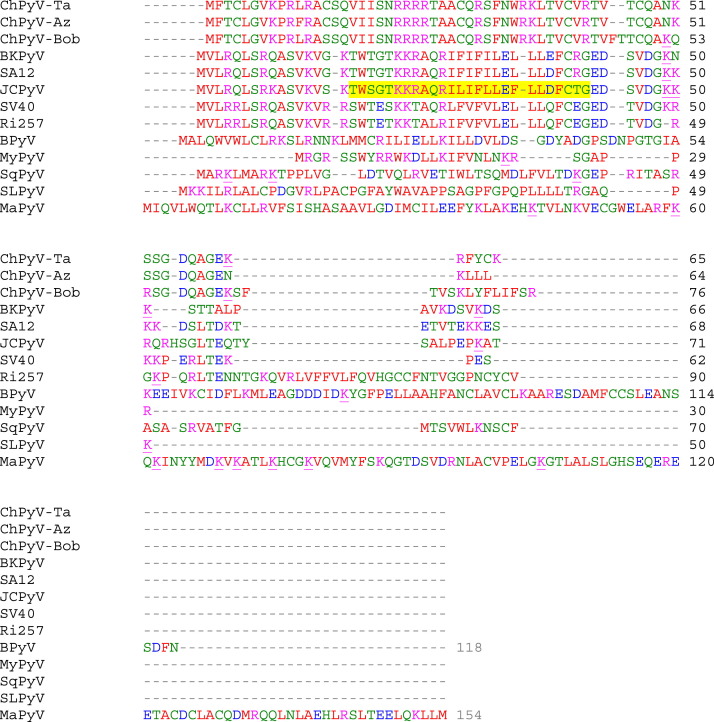
Polyomaviruses are naked viruses with an icosahedral capsid that surrounds a circular double-stranded DNA molecule of about 5000 base-pairs. Their genome encodes at least five proteins: large and small tumor antigens and the capsid proteins VP1, VP2 and VP3. The tumor antigens are expressed during early stages of the viral life cycle and are implicated in the regulation of viral transcription and DNA replication, while the capsid proteins are produced later during infection. Members of the Polyomaviridae family have been isolated in birds (Avipolyomavirus) and mammals (Orthopolyomavirus and Wukipolyomavirus). Some mammalian polyomaviruses encode an additional protein, referred to as agnoprotein, which is a relatively small polypeptide that exerts multiple functions. This review discusses the structure, post-translational modifications, and functions of agnoprotein, and speculates why not all polyomaviruses express this protein.
多瘤病毒是一种无包膜的病毒,具有二十面体衣壳,衣壳围绕着约 5000 个碱基对的环状双链 DNA 分子。它们的基因组编码至少五种蛋白质:大、小肿瘤抗原和衣壳蛋白 VP1、VP2 和 VP3。肿瘤抗原在病毒生命周期的早期表达,与病毒转录和 DNA 复制的调节有关,而衣壳蛋白在感染后期产生。多瘤病毒科的成员已在鸟类(禽多瘤病毒)和哺乳动物(正多瘤病毒和 Wukipolyomavirus)中分离出来。一些哺乳动物多瘤病毒编码一种额外的蛋白质,称为 agnoprotein,这是一种相对较小的多肽,具有多种功能。这篇综述讨论了 agnoprotein 的结构、翻译后修饰和功能,并推测为什么不是所有的多瘤病毒都表达这种蛋白质。