Department of Allergy, Complejo Hospitalario de Navarra, Fundación Miguel Servet, Pamplona, Spain.
Respir Res. 2012 Jun 22;13(1):50. doi: 10.1186/1465-9921-13-50.
Asthma Control Questionnaire (ACQ) is a validated tool to measure asthma control. Cut-off points that best discriminate "well-controlled" or "not well-controlled" asthma have been suggested from the analysis of a large randomized clinical trial but they may not be adequate for daily clinical practice.
To establish cut-off points of the ACQ that best discriminate the level of control according to Global Initiative for Asthma (GINA) 2006 guidelines in patients with asthma managed at Allergology and Pulmonology Departments as well as Primary Care Centers in Spain.
An epidemiological descriptive study, with prospective data collection. Asthma control following GINA-2006 classification and 7-item ACQ was assessed. The study population was split in two parts: 2/3 for finding the cut-off points (development population) and 1/3 for validating the results (validation population).
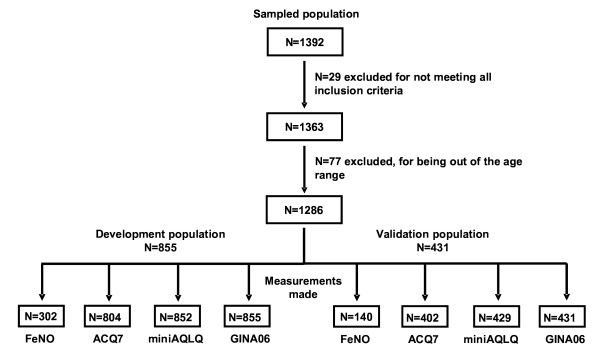
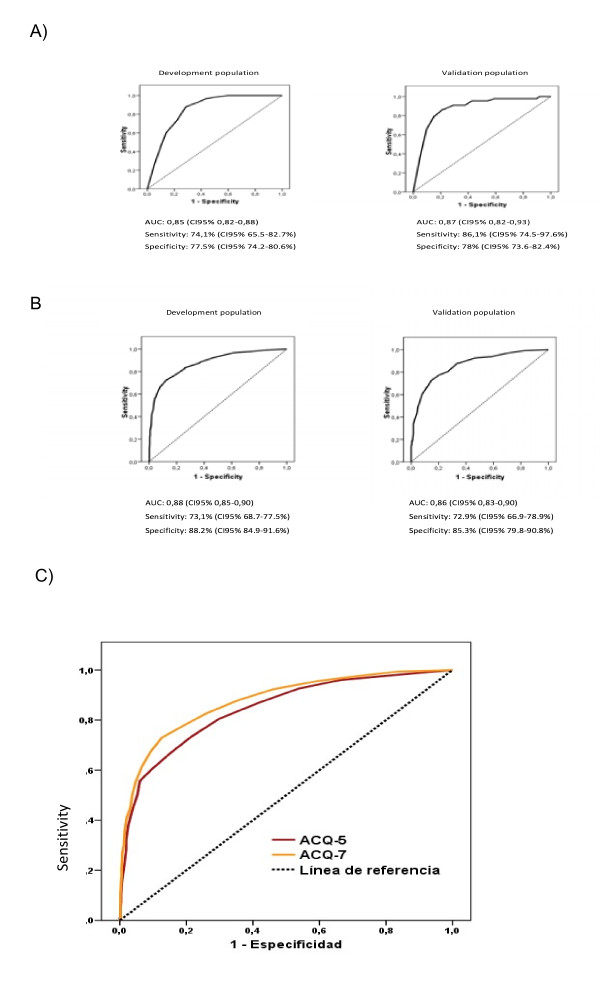
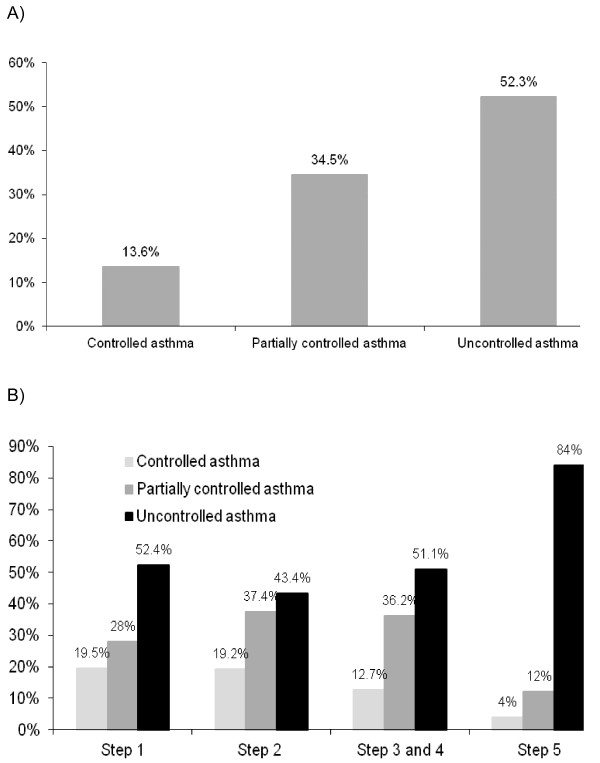
A total of 1,363 stable asthmatic patients were included (mean age 38 ± 14 years, 60.3% women; 69.1% non-smokers). Patient classification according to GINA-defined asthma control was: controlled 13.6%, partially controlled 34.2%, and uncontrolled 52.3%. The ACQ cut-off points that better agreed with GINA-defined asthma control categories were calculated using receiver operating curves (ROC). The analysis showed that ACQ < 0.5 was the optimal cut-off point for "controlled asthma" (sensitivity 74.1%, specificity 77.5%) and 1.00 for "uncontrolled asthma" (sensitivity 73%, specificity 88.2%). Kappa index between GINA categories and ACQ was 0.62 (p < 0.001).
The ACQ cut-off points associated with GINA-defined asthma control in a real-life setting were <0.5 for controlled asthma and ≥1 for uncontrolled asthma.
哮喘控制问卷(ACQ)是一种经过验证的工具,可用于衡量哮喘控制水平。从一项大型随机临床试验的分析中提出了最佳区分“控制良好”或“控制不佳”哮喘的截断点,但它们可能不适用于日常临床实践。
根据全球哮喘倡议(GINA)2006 年指南,在西班牙过敏和肺病科以及初级保健中心管理的哮喘患者中,确定最佳区分控制水平的 ACQ 截断点。
这是一项具有前瞻性数据收集的流行病学描述性研究。根据 GINA-2006 分类和 7 项 ACQ 评估哮喘控制情况。研究人群分为两部分:2/3 用于寻找截断点(开发人群),1/3 用于验证结果(验证人群)。
共纳入 1363 例稳定期哮喘患者(平均年龄 38±14 岁,60.3%为女性;69.1%为非吸烟者)。根据 GINA 定义的哮喘控制患者分类为:控制 13.6%,部分控制 34.2%,未控制 52.3%。使用受试者工作特征曲线(ROC)计算出与 GINA 定义的哮喘控制类别更好一致的 ACQ 截断点。分析表明,ACQ<0.5 是“控制良好的哮喘”的最佳截断点(敏感性 74.1%,特异性 77.5%),1.00 是“未控制的哮喘”的最佳截断点(敏感性 73%,特异性 88.2%)。GINA 类别与 ACQ 之间的 Kappa 指数为 0.62(p<0.001)。
在现实环境中,与 GINA 定义的哮喘控制相关的 ACQ 截断点为控制良好的哮喘<0.5,未控制的哮喘≥1.0。