Department of Bioengineering, University of Pittsburgh, Pittsburgh, Pennsylvania, USA.
Nat Med. 2012 Jul;18(7):1148-53. doi: 10.1038/nm.2821.
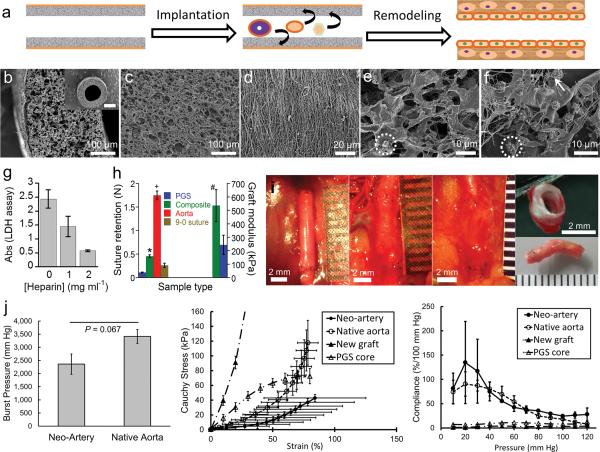
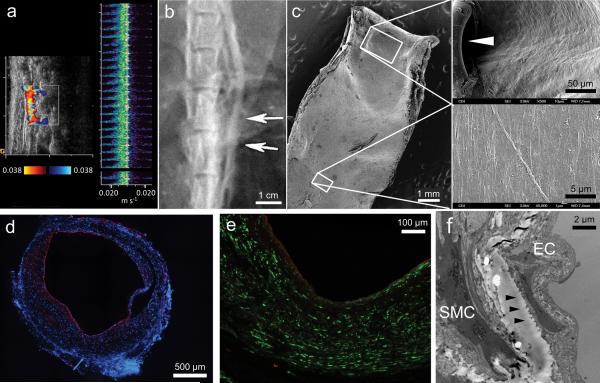
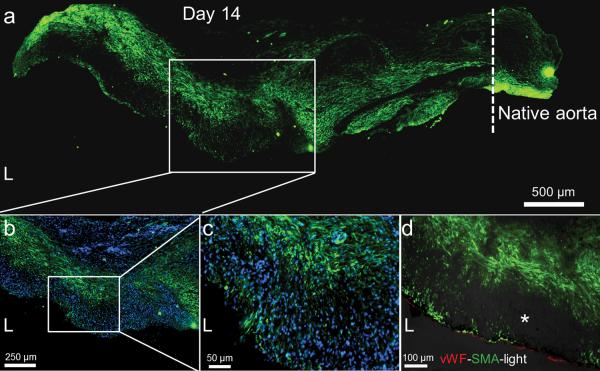
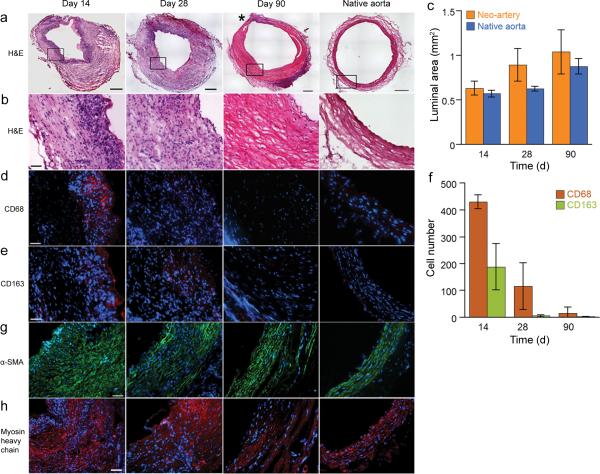
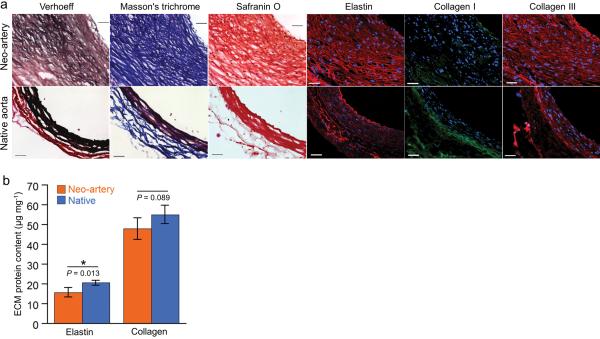
Host remodeling is important for the success of medical implants, including vascular substitutes. Synthetic and tissue-engineered grafts have yet to show clinical effectiveness in arteries smaller than 5 mm in diameter. We designed cell-free biodegradable elastomeric grafts that degrade rapidly to yield neoarteries nearly free of foreign materials 3 months after interposition grafting in rat abdominal aorta. This design focuses on enabling rapid host remodeling. Three months after implantation, the neoarteries resembled native arteries in the following aspects: regular, strong and synchronous pulsation; a confluent endothelium and contractile smooth muscle layers; expression of elastin, collagen and glycosaminoglycan; and tough and compliant mechanical properties. Therefore, future studies employing large animal models more representative of human vascular regeneration are warranted before clinical translation. This cell-free approach represents a philosophical shift from the prevailing focus on cells in vascular tissue engineering and may have an impact on regenerative medicine in general.
宿主重塑对于医学植入物的成功至关重要,包括血管替代品。合成和组织工程化移植物在直径小于 5 毫米的动脉中尚未显示出临床效果。我们设计了无细胞可生物降解的弹性移植物,这些移植物在大鼠腹主动脉内位移植 3 个月后迅速降解,产生几乎不含异物的新动脉。这种设计侧重于实现快速宿主重塑。植入 3 个月后,新生成的动脉在以下方面类似于天然动脉:规则、有力且同步的搏动;连续的内皮细胞和平滑肌层;弹性蛋白、胶原蛋白和糖胺聚糖的表达;以及坚韧和顺应性的机械性能。因此,在临床转化之前,有必要进行更能代表人类血管再生的大型动物模型的未来研究。这种无细胞方法代表了从血管组织工程中普遍关注细胞的理念转变,可能对再生医学产生广泛影响。