Columbia Center for Children's Environmental Health, Department of Environmental Health Sciences, Mailman School of Public Health, Columbia University, New York, New York 10032, USA.
Environ Health Perspect. 2012 Oct;120(10):1475-80. doi: 10.1289/ehp.1104544. Epub 2012 Jun 26.
Recent cross-sectional studies suggest a link between butylbenzyl phthalate (BBzP) in house dust and childhood eczema.
We aimed to evaluate whether concentrations of monobenzyl phthalate (MBzP), the main BBzP metabolite in urine, during pregnancy are associated prospectively with eczema in young children, and whether this association varies by the child's sensitization to indoor allergens or serological evidence of any allergies.
MBzP was measured in spot urine samples during the third trimester of pregnancy from 407 African-American and Dominican women residing in New York City in 1999-2006. Repeated questionnaires asked mothers whether their doctor ever said their child had eczema. Child blood samples at 24, 36, and 60 months of age were analyzed for total, anti-cockroach, dust mite, and mouse IgE. Relative risks (RR) were estimated with multivariable modified Poisson regression. Analyses included a multinomial logistic regression model for early- and late-onset eczema versus no eczema through 60 months of age.
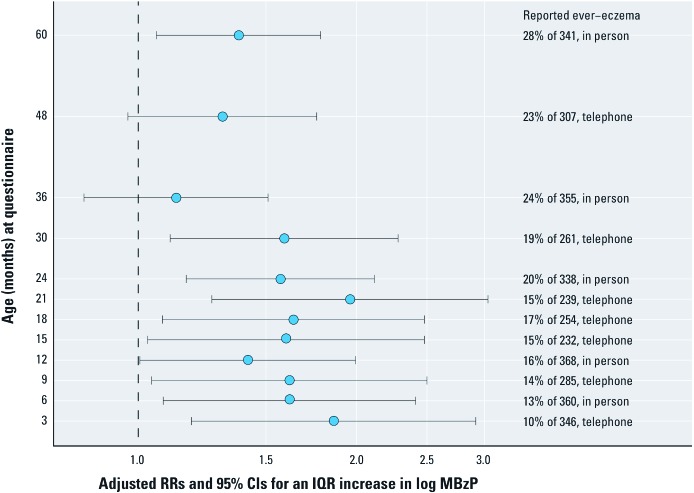
MBzP was detected in > 99% of samples (geometric mean = 13.6; interquartile range: 5.7-31.1 ng/mL). By 24 months, 30% of children developed eczema, with the proportion higher among African Americans (48%) than among Dominicans (21%) (p < 0.001). An interquartile range increase in log MBzP concentration was associated positively with early-onset eczema (RR = 1.52 for eczema by 24 months; 95% confidence interval: 1.21, 1.91, p = 0.0003, n = 113 reporting eczema/376 total sample), adjusting for urine specific gravity, sex, and race/ethnicity. MBzP was not associated with allergic sensitization, nor did seroatopy modify consistently the MBzP and eczema association.
Prenatal exposure to BBzP may influence the risk of developing eczema in early childhood.
最近的横断面研究表明,房屋灰尘中的丁基苄基邻苯二甲酸酯(BBzP)与儿童湿疹之间存在关联。
我们旨在评估孕妇尿液中主要代谢产物单苄基邻苯二甲酸酯(MBzP)浓度是否与幼儿湿疹有前瞻性关联,以及这种关联是否因儿童对室内过敏原的致敏或任何过敏的血清学证据而有所不同。
1999-2006 年间,407 名居住在纽约市的非裔美国人和多米尼加裔美国妇女在妊娠第三个三个月期间采集了尿液样本,测量了 MBzP 的浓度。反复的问卷调查询问母亲医生是否曾说过孩子患有湿疹。在 24、36 和 60 个月时采集儿童血液样本,检测总 IgE、抗蟑螂 IgE、尘螨 IgE 和鼠 IgE。采用多变量修正泊松回归估计相对风险(RR)。分析包括用于早发性和迟发性湿疹与 60 个月内无湿疹的多项逻辑回归模型。
99%的样本中检测到 MBzP(几何均数=13.6;四分位距:5.7-31.1ng/ml)。到 24 个月时,30%的儿童出现湿疹,非裔美国人(48%)比多米尼加裔美国人(21%)的比例更高(p<0.001)。MBzP 浓度的四分位距增加与早发性湿疹呈正相关(24 个月时发生湿疹的 RR=1.52;95%置信区间:1.21,1.91,p=0.0003,113 名报告湿疹/376 名总样本),调整了尿液比重、性别和种族/民族。MBzP 与过敏致敏无关,也没有血清学特应性一致改变 MBzP 和湿疹之间的关联。
产前暴露于 BBzP 可能会影响幼儿湿疹的发病风险。