McKusick-Nathans Institute of Genetic Medicine, Johns Hopkins University, Baltimore, MD 21205, United States.
Semin Cell Dev Biol. 2012 Aug;23(6):711-9. doi: 10.1016/j.semcdb.2012.06.008. Epub 2012 Jun 26.
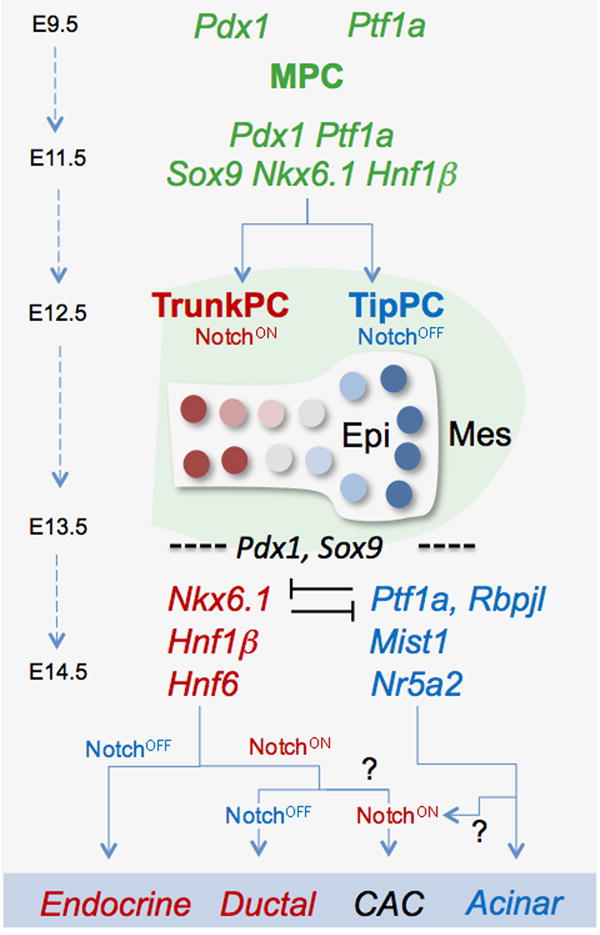
This review summarizes our current understanding of exocrine pancreas development, including the formation of acinar, ductal and centroacinar cells. We discuss the transcription factors associated with various stages of exocrine differentiation, from multipotent progenitor cells to fully differentiated acinar and ductal cells. Within the branching epithelial tree of the embryonic pancreas, this involves the progressive restriction of multipotent pancreatic progenitor cells to either a central "trunk" domain giving rise to the islet and ductal lineages, or a peripheral "tip" domain giving rise to acinar cells. This review also discusses the soluble morphogens and other signaling pathways that influence these events. Finally, we examine centroacinar cells as an enigmatic pancreatic cell type whose lineage remains uncertain, and whose possible progenitor capacities continue to be explored.
这篇综述总结了我们目前对外分泌胰腺发育的理解,包括腺泡、导管和中央腺泡细胞的形成。我们讨论了与外分泌分化各个阶段相关的转录因子,从多能祖细胞到完全分化的腺泡和导管细胞。在胚胎胰腺的分支上皮树中,这涉及多能胰腺祖细胞逐渐局限于中央“干”域,产生胰岛和导管谱系,或外周“尖端”域,产生腺泡细胞。这篇综述还讨论了影响这些事件的可溶性形态发生素和其他信号通路。最后,我们检查了中央腺泡细胞作为一种神秘的胰腺细胞类型,其谱系仍不确定,其可能的祖细胞能力仍在探索中。