School of Public Health, The University of Hong Kong, Hong Kong Special Administrative Region, China.
PLoS One. 2012;7(6):e39423. doi: 10.1371/journal.pone.0039423. Epub 2012 Jun 20.
Poisson regression modeling has been widely used to estimate influenza-associated disease burden, as it has the advantage of adjusting for multiple seasonal confounders. However, few studies have discussed how to judge the adequacy of confounding adjustment. This study aims to compare the performance of commonly adopted model selection criteria in terms of providing a reliable and valid estimate for the health impact of influenza.
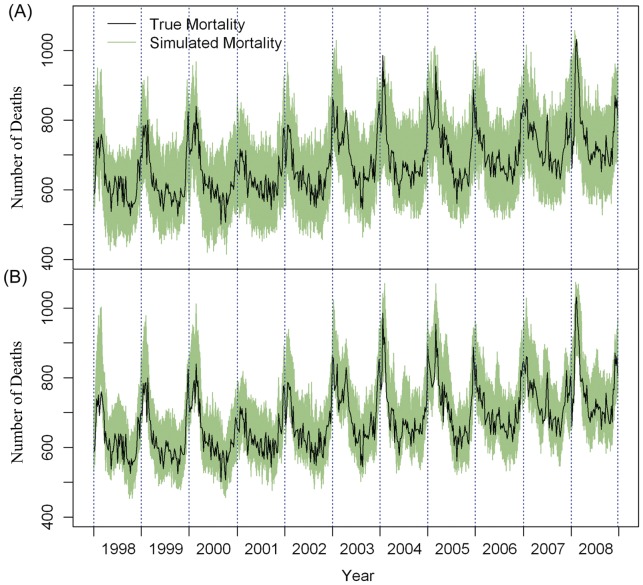
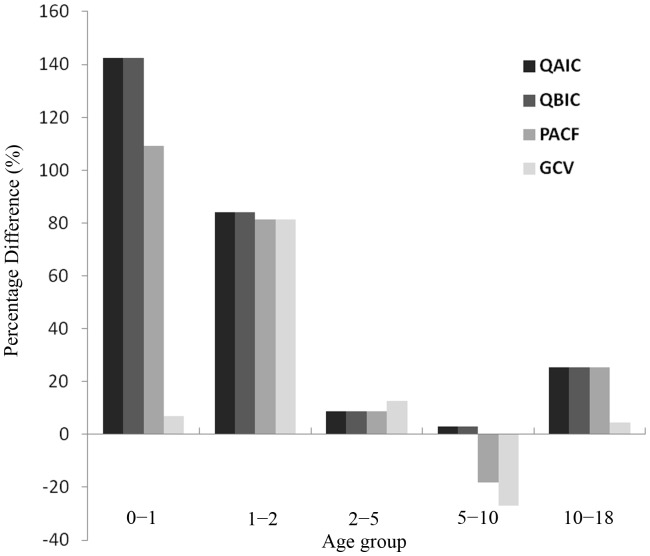
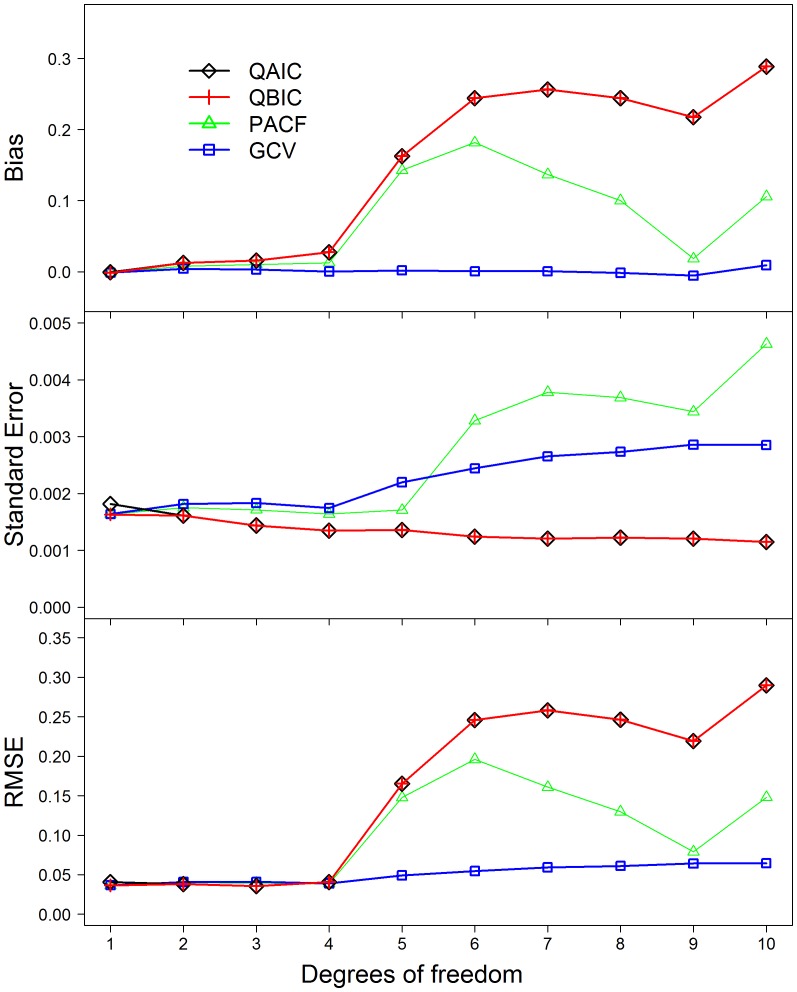
We assessed four model selection criteria: quasi Akaike information criterion (QAIC), quasi bayesian information criterion (QBIC), partial autocorrelation functions of residuals (PACF), and generalized cross-validation (GCV), by separately applying them to select the Poisson model best fitted to the mortality datasets that were simulated under the different assumptions of seasonal confounding. The performance of these criteria was evaluated by the bias and root-mean-square error (RMSE) of estimates from the pre-determined coefficients of influenza proxy variable. These four criteria were subsequently applied to an empirical hospitalization dataset to confirm the findings of simulation study.
GCV consistently provided smaller biases and RMSEs for the influenza coefficient estimates than QAIC, QBIC and PACF, under the different simulation scenarios. Sensitivity analysis of different pre-determined influenza coefficients, study periods and lag weeks showed that GCV consistently outperformed the other criteria. Similar results were found in applying these selection criteria to estimate influenza-associated hospitalization.
GCV criterion is recommended for selection of Poisson models to estimate influenza-associated mortality and morbidity burden with proper adjustment for confounding. These findings shall help standardize the Poisson modeling approach for influenza disease burden studies.
泊松回归模型已广泛用于估计流感相关疾病负担,因为它具有调整多个季节性混杂因素的优势。然而,很少有研究讨论如何判断混杂调整的充分性。本研究旨在比较常用的模型选择标准在提供流感对健康影响的可靠和有效估计方面的表现。
我们评估了四种模型选择标准:拟似然信息准则(QAIC)、拟贝叶斯信息准则(QBIC)、残差偏自相关函数(PACF)和广义交叉验证(GCV),分别将它们应用于选择最适合模拟季节性混杂不同假设下死亡率数据集的泊松模型。通过从预定的流感代理变量系数中评估估计值的偏差和均方根误差(RMSE)来评估这些标准的性能。这四个标准随后被应用于一个实证住院数据集,以确认模拟研究的结果。
在不同的模拟场景下,GCV 始终为流感系数估计值提供较小的偏差和 RMSE,优于 QAIC、QBIC 和 PACF。对不同预定流感系数、研究期间和滞后周的敏感性分析表明,GCV 始终优于其他标准。在应用这些选择标准来估计流感相关住院率时,也得到了类似的结果。
建议使用 GCV 准则选择泊松模型,以适当调整混杂因素来估计流感相关的死亡率和发病率负担。这些发现将有助于规范流感疾病负担研究中的泊松建模方法。