Song Xin, Xiao Jun, Deng Jiang, Kang Qiong, Zhang Yanyu, Xu Jinbo
Beijing Key Laboratory of Blood Safety and Supply Technologies, Beijing Institute of Transfusion Medicine, Haidian District, Beijing.
Medicine (Baltimore). 2016 Jun;95(26):e3929. doi: 10.1097/MD.0000000000003929.
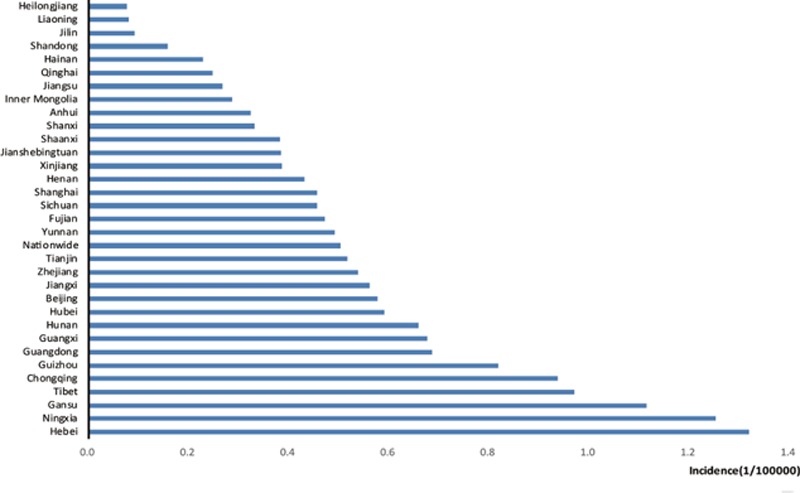
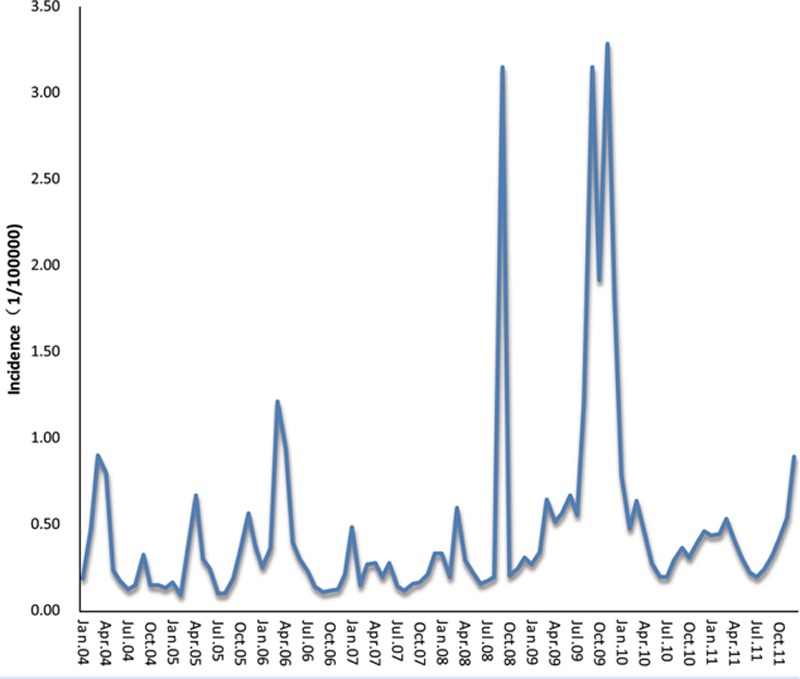
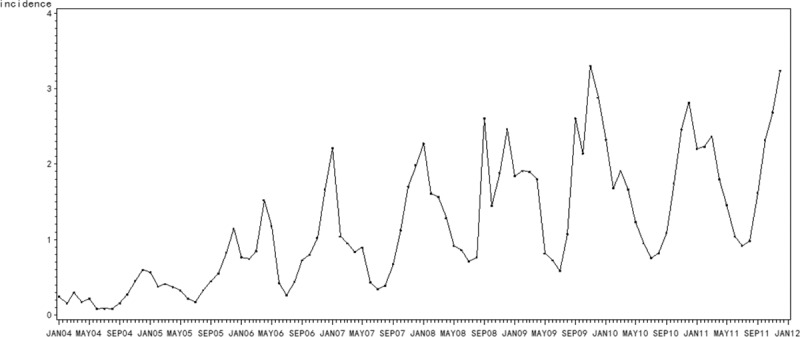
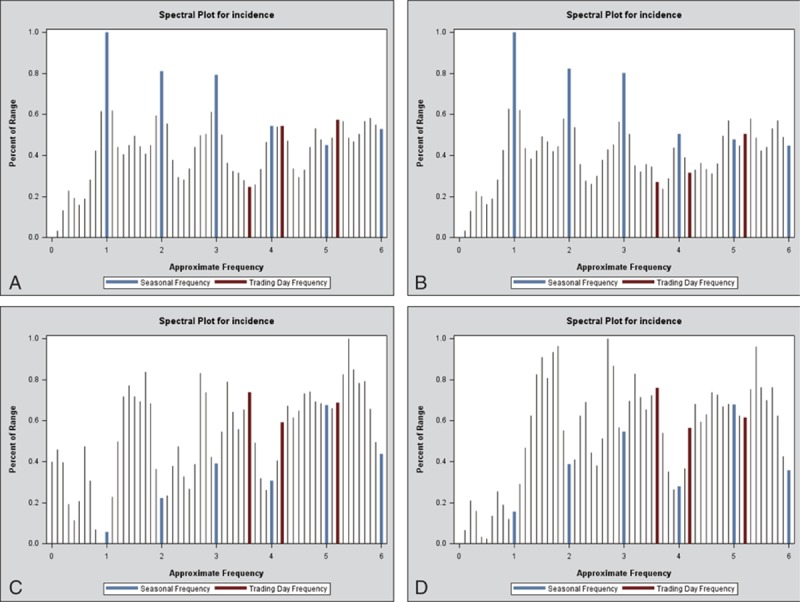
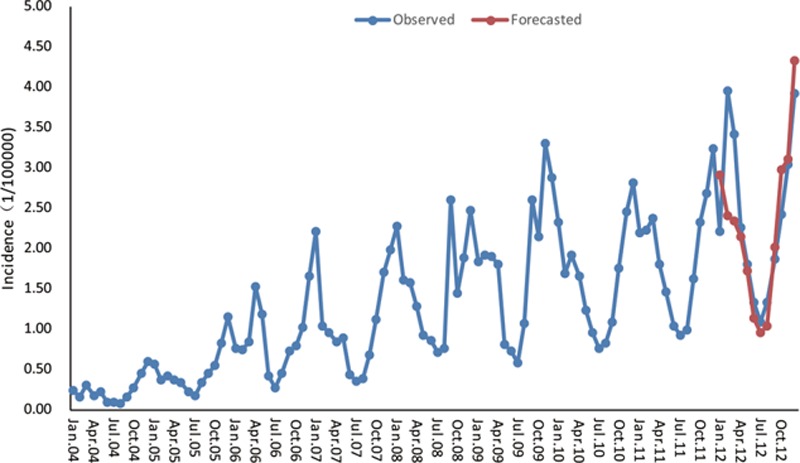
Influenza as a severe infectious disease has caused catastrophes throughout human history, and every pandemic of influenza has produced a great social burden. We compiled monthly data of influenza incidence from all provinces and autonomous regions in mainland China from January 2004 to December 2011, comprehensively evaluated and classified these data, and then randomly selected 4 provinces with higher incidence (Hebei, Gansu, Guizhou, and Hunan), 2 provinces with median incidence (Tianjin and Henan), 1 province with lower incidence (Shandong), using time series analysis to construct an ARIMA model, which is based on the monthly incidence from 2004 to 2011 as the training set. We exerted the X-12-ARIMA procedure for modeling due to the seasonality these data implied. Autocorrelation function (ACF), partial autocorrelation function (PACF), and automatic model selection were to determine the order of the model parameters. The optimal model was decided by a nonseasonal and seasonal moving average test. Finally, we applied this model to predict the monthly incidence of influenza in 2012 as the test set, and the simulated incidence was compared with the observed incidence to evaluate the model's validity by the criterion of both percentage variability in regression analyses (R) and root mean square error (RMSE). It is conceivable that SARIMA (0,1,1)(0,1,1)12 could simultaneously forecast the influenza incidence of the Hebei Province, Guizhou Province, Henan Province, and Shandong Province; SARIMA (1,0,0)(0,1,1)12 could forecast the influenza incidence in Gansu Province; SARIMA (3,1,1)(0,1,1)12 could forecast the influenza incidence in Tianjin City; and SARIMA (0,1,1)(0,0,1)12 could forecast the influenza incidence in Hunan Province. Time series analysis is a good tool for prediction of disease incidence.
流感作为一种严重的传染病,在人类历史上曾引发诸多灾难,每一次流感大流行都带来了巨大的社会负担。我们收集了2004年1月至2011年12月中国大陆所有省份和自治区的流感发病率月度数据,对这些数据进行了全面评估和分类,然后随机选取发病率较高的4个省份(河北、甘肃、贵州和湖南)、发病率处于中位数的2个省份(天津和河南)、发病率较低的1个省份(山东),以2004年至2011年的月度发病率作为训练集,采用时间序列分析构建ARIMA模型。由于这些数据存在季节性,我们运用X - 12 - ARIMA程序进行建模。通过自相关函数(ACF)、偏自相关函数(PACF)以及自动模型选择来确定模型参数的阶数。通过非季节性和季节性移动平均检验来确定最优模型。最后,我们将该模型应用于预测2012年的流感月度发病率作为测试集,并将模拟发病率与观察到的发病率进行比较,依据回归分析中的百分比变异(R)和均方根误差(RMSE)标准来评估模型的有效性。可以想象,SARIMA(0,1,1)(0,1,1)12能够同时预测河北省、贵州省、河南省和山东省的流感发病率;SARIMA(1,0,0)(0,1,1)12能够预测甘肃省的流感发病率;SARIMA(3,1,1)(0,1,1)12能够预测天津市的流感发病率;SARIMA(0,1,1)(0,0,1)12能够预测湖南省的流感发病率。时间序列分析是预测疾病发病率的一个良好工具。