UMR MIVEGEC (UM1, UM2, CNRS 5290, IRD 224), Institut de Recherche pour le Développement (IRD), Montpellier, France.
PLoS One. 2012;7(6):e39453. doi: 10.1371/journal.pone.0039453. Epub 2012 Jun 22.
Anthropogenic habitat disturbance is a prime cause in the current trend of the Earth's reduction in biodiversity. Here we show that the human footprint on the Central African rainforest, which is resulting in deforestation and growth of densely populated urban agglomerates, is associated to ecological divergence and cryptic speciation leading to adaptive radiation within the major malaria mosquito Anopheles gambiae.
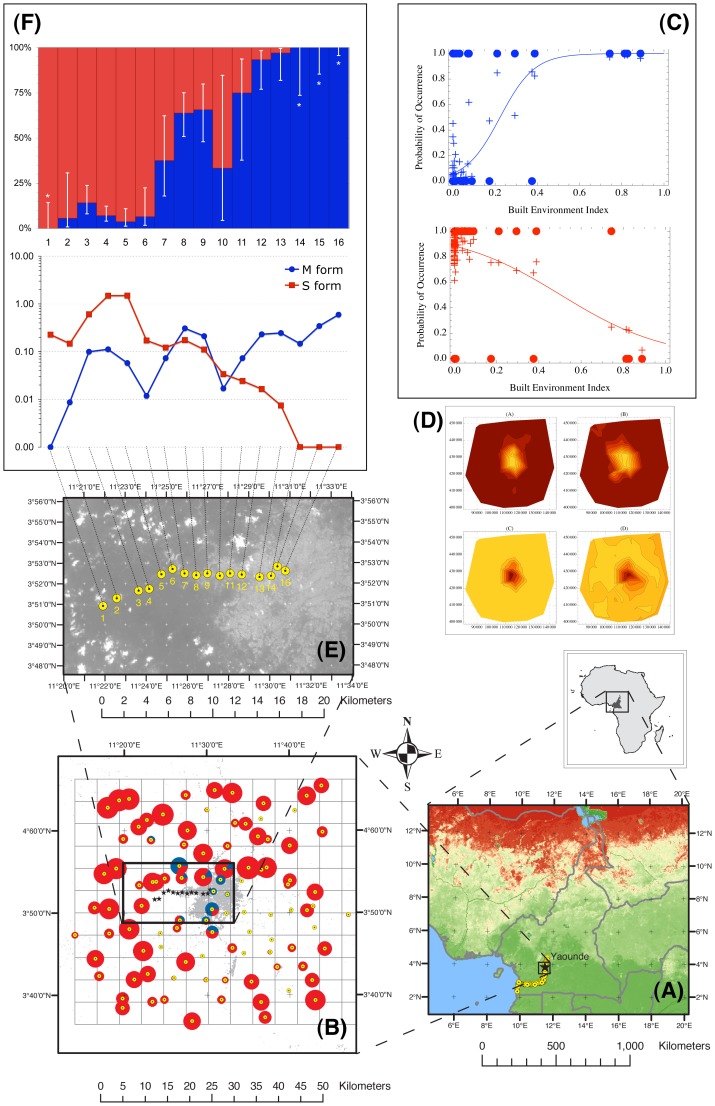
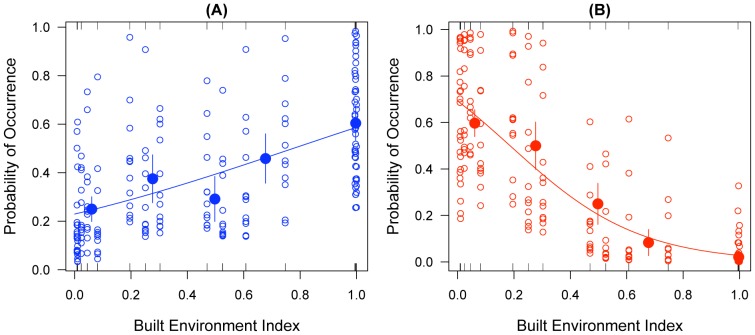
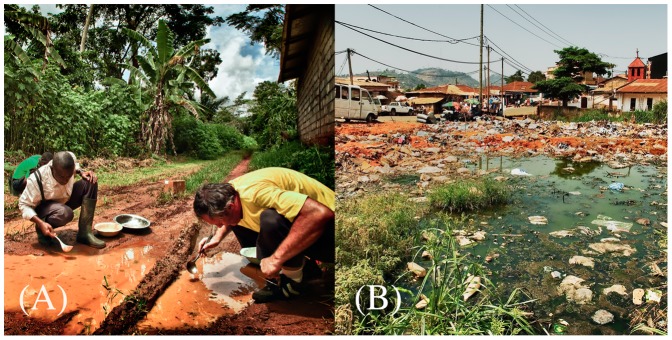
METHODOLOGY/PRINCIPAL FINDINGS: In southern Cameroon, the frequency of two molecular forms--M and S--among which reproductive isolation is strong but still incomplete, was correlated to an index of urbanisation extracted from remotely sensed data, expressed as the proportion of built-up surface in each sampling unit. The two forms markedly segregated along an urbanisation gradient forming a bimodal cline of ∼6-km width: the S form was exclusive to the rural habitat, whereas only the M form was present in the core of densely urbanised settings, co-occurring at times in the same polluted larval habitats of the southern house mosquito Culex quinquefasciatus--a species association that was not historically recorded before.
CONCLUSIONS/SIGNIFICANCE: Our results indicate that when humans create novel habitats and ecological heterogeneities, they can provide evolutionary opportunities for rapid adaptive niche shifts associated with lineage divergence, whose consequences upon malaria transmission might be significant.
人为的栖息地干扰是当前地球生物多样性减少的主要原因。在这里,我们表明,中非热带雨林的人类足迹正在导致森林砍伐和人口密集的城市聚集区的增长,这与生态分歧和隐秘物种形成有关,导致主要疟疾蚊子冈比亚按蚊的适应性辐射。
方法/主要发现:在喀麦隆南部,两种分子形式——M 和 S——之间的频率,其中生殖隔离很强但仍不完全,与从遥感数据中提取的城市化指数相关,用每个采样单元中建成表面的比例表示。这两种形式沿着城市化梯度明显分离,形成一个约 6 公里宽的双峰渐变:S 形式仅存在于农村生境中,而只有 M 形式存在于高度城市化地区的核心,有时在同一受污染的南方家蚊库蚊幼虫栖息地共同存在,这种物种组合以前没有历史记录。
结论/意义:我们的结果表明,当人类创造新的栖息地和生态异质性时,他们可以为与谱系分歧相关的快速适应性生态位转移提供进化机会,这可能对疟疾传播产生重大影响。