Hospital for Tropical Diseases, University College London Hospitals NHS Trust, London, United Kingdom.
PLoS Negl Trop Dis. 2012;6(6):e1688. doi: 10.1371/journal.pntd.0001688. Epub 2012 Jun 26.
Patients with New World cutaneous leishmaniasis (NWCL) caused by Leishmania Viannia are treated with parenteral sodium stibogluconate (SbV) to reduce the risk of development of mucocutanous leishmaniasis. Our centre manages patients with NWCL on an outpatient-basis. This study was conducted to assess the safety and efficacy of this approach.
We reviewed records of 67 consecutive NWCL patients, aged 17-61 years, treated as day-cases with 20 mg/kg/day SbV for up to 28 days at our UK centre. Data had been collected in a standardised format at the time of treatment using a care-record tool. Patients reported adverse-effects daily using a structured questionnaire. Blood tests and electrocardiograms were performed twice weekly to monitor for toxicity.
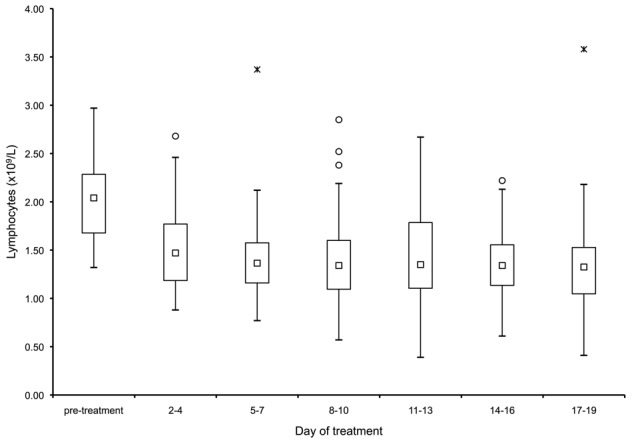
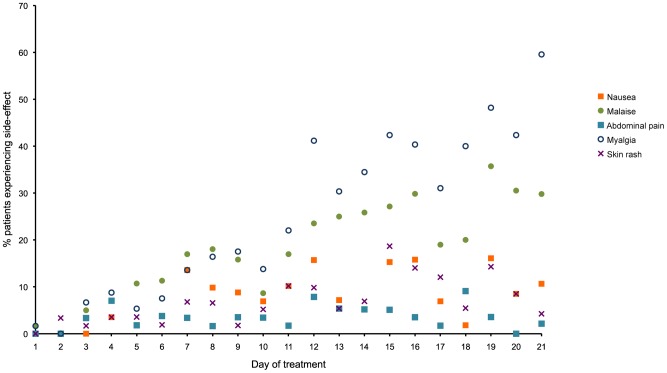
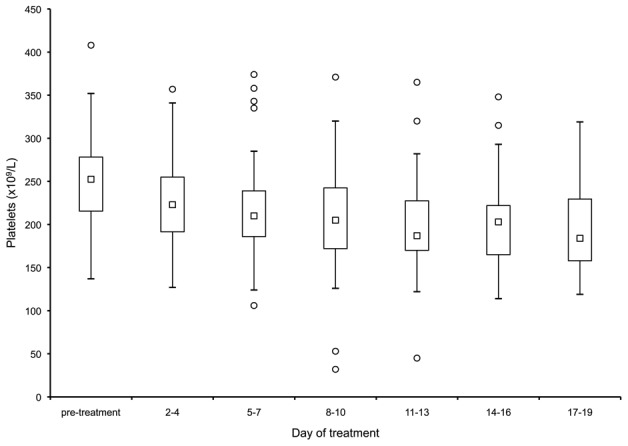
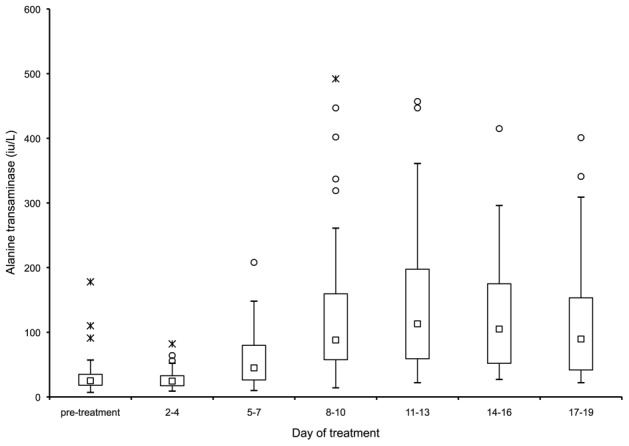
Parenteral SbV treatment was associated with an early, significant suppression of mean lymphocyte and platelet counts. By day four of treatment, lymphocytes reduced by 0.53×10(9)/L (CI 0.29×10(9)/L to 0.76×10(9)/L, p<0.001), and platelets by 31,000/µL (CI 16,000/µL to 46,000/µL, p<0.001). SbV was further associated with significant elevation of serum alanine transaminase concentrations, with a mean peak rise of 107 iu/L by day 13 (CI 52 iu/L to 161 iu/L, p<0.001). These disturbances were temporary and did not result in adverse clinical events. Patient-described symptoms were cumulative and at three weeks of treatment, 59.6% of patients experienced myalgia and 29.8% malaise. Treatment adherence and clinical outcomes were comparable to inpatient treatment studies. A total of 1407 individual doses of SbV resulted in only 26 nights' hospital admission, a saving of 1381 bed-days compared to inpatient treatment.
CONCLUSIONS/SIGNIFICANCE: In specialist centres, NWCL patients aged below 65 years and without co-morbidities can be safely and effectively treated without hospital admission. This reduces the cost of treatment, and is much preferred by patients. Twice weekly blood and electrocardiographic monitoring may be surplus to requirement in clinically well, low-risk patients.
由 Leishmania Viannia 引起的新世界皮肤利什曼病(NWCL)患者接受注射用葡甲胺锑酸钠(SbV)治疗,以降低发生黏膜皮肤利什曼病的风险。我们中心以门诊的方式为 NWCL 患者提供治疗。本研究旨在评估这种方法的安全性和有效性。
我们回顾了在英国中心接受治疗的 67 例连续 NWCL 患者(年龄 17-61 岁)的记录,这些患者采用 20mg/kg/天的 SbV 治疗,疗程为 28 天。在治疗时,使用护理记录工具以标准化格式收集数据。患者每天使用结构化问卷报告不良反应。每周两次进行血液检查和心电图监测以监测毒性。
注射用 SbV 治疗与淋巴细胞和血小板计数的早期显著抑制有关。治疗第四天,淋巴细胞减少 0.53×10(9)/L(CI 0.29×10(9)/L 至 0.76×10(9)/L,p<0.001),血小板减少 31,000/µL(CI 16,000/µL 至 46,000/µL,p<0.001)。SbV 还与血清丙氨酸氨基转移酶浓度的显著升高有关,第 13 天的平均峰值升高 107iu/L(CI 52iu/L 至 161iu/L,p<0.001)。这些紊乱是暂时的,不会导致不良临床事件。患者描述的症状是累积的,在治疗三周时,59.6%的患者出现肌痛,29.8%的患者出现不适。治疗依从性和临床结果与住院治疗研究相当。共给予 1407 个剂量的 SbV,仅住院 26 晚,与住院治疗相比节省了 1381 个床位日。
结论/意义:在专科中心,年龄在 65 岁以下且无合并症的 NWCL 患者可以安全有效地进行治疗,而无需住院。这降低了治疗成本,且更受患者的欢迎。对于临床状况良好、低风险的患者,每周两次的血液和心电图监测可能是多余的。